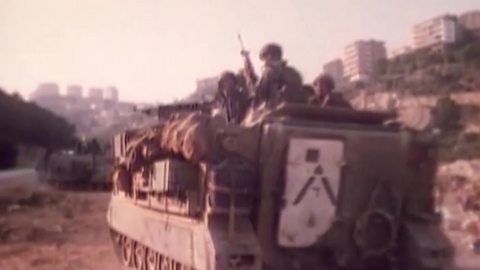
By 1987, tension in the territories was building to boiling point. Palestinians lived with the fear of losing their land and of being forced to move to other countries and with the daily miseries of occupation. These pressures led to the first intifada, or mass uprising. It was a turning point because at that point Israel met its first real challenge in terms of the human spirit and the human will to endure and to defy oppression.
The goal of the Intifada was to end that occupation and achieve independence from Israel. It gave the Palestinians a feeling that they are able to do it and they have the power and their weakness is their strength. And of course it gave the Israelis a view that it will be impossible to continue to occupy the territory without any permanent solution.
[SHOUTING] The Palestinians refused to pay taxes and staged strikes and massive street demonstrations. But there were acts of violence as well and allegations that the Israelis had instructions to use brutal punishments. The PLO leadership in exile watched the Intifada with alarm. They were in danger of losing their position as a leading player in Palestinian resistance.
Arafat rose to the challenge. He moved the PLO to support a two-state solution: a state for Israel and a state for Palestine. "While the Intifada escalates, I declare: we are ready. We are willing to negotiate peace." APPLAUSE He went on to tell the world at the United Nations that the PLO renounced the use of violence. "We totally and absolutely renounce all forms of terrorism."
For the US this was a turning point and it began dialogue with the PLO. But as far as Israel was concerned the PLO were still terrorists and there'd be no negotiation.
Video summary
Using guest speakers, this video clip discusses the first Palestinian mass uprising in 1987, and how it became a turning point in the conflict.
This clip is part of a series which can be treated as historical sources, looking at different viewpoints of the Arab-Israeli conflict. It is one of a series of clips taken from a longer documentary about the Israel/Palestine conflict, from 2004.
The series follows the history of the conflict through the mid-late 20th century, focussing on major incidents, pressure points and conflicts.
Please note, these clips have been edited from the original 2004 broadcast version to remove some scenes young audiences might find disturbing. However, teacher review is advised.
Teacher Notes
After watching the clip, split the class into groups and have them talk about what they saw.
Do you think the speakers give a balanced interpretation of events?
Summarise each speakers' perspective. Can you think of anything that might influence them?
Why do you think some of the speakers hold opposing views? Is there anything they agree on?
Is there anything you would like to ask any of the speakers after seeing the video? Does it leave you with any questions?
This video clip will be relevant for teaching history at KS3, KS4/GCSE, in England and Wales and Northern Ireland. Also at Third Level, Fourth Level, National 4 and National 5 in Scotland.
This topic appears in AQA and Edexcel.
Origins of the Arab-Israel two-state solution. video
Using guest speakers, this video clip discusses the origins of the two-state solution in the Arab-Israeli conflict, through the British Peel Commission of 1937 and the White Paper of 1939.
UN partition plan for Palestine and establishing the State of Israel. video
Using guest speakers, this video clip discusses the background and impact of the UN Partition Plan for Palestine in 1947.
Suez and the arrival of the Cold War in the Middle East. video
Using guest speakers, this video clip examines how the Suez Crisis of 1956 changed international relationships and the landscape of power in the Middle East.
The Six-Day War and the Palestinian Liberation Organisation (PLO) video
Using guest speakers, this video clip discusses how Israel defeated Jordan, Syria and Egypt in only six days in 1967. It also discusses how the war inspired Palestinian resistance movements, such as the PLO under Yasser Arafat.

The Yom Kippur War. video
Using guest speakers, this video clip examines the events surrounding the Yom Kippur War in 1973.

Sabra and Shatila massacres in 1982. video
Using guest speakers, this video clip examines the events surrounding the Israeli invasion of Lebanon in 1982.