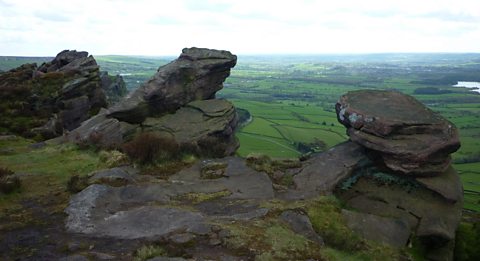
Geologist and keen climber, Dr Tom Challands, challenges a pair of young people to climb Castle Inn Quarry in North Wales and investigate how it was formed using evidence from the rocks.
The video
Dr Tom Challands: Castle Inn is a redundant limestone quarry in Conwy North Wales. Although no longer providing limestone to the building industry, the past quarrying and the way the rock weathers means it's still used by us today. Castle Inn forms part of the local leisure industry as a climbing wall and nature reserve.
I'm Dr Tom Challands, and I'm here today to challenge two keen young climbers and geologists to answer a couple of questions about the rock face we have behind us. The rock face we're going to climb today is made of limestone, which is particularly interesting as it's got several different types of structures on it. This quarry is now a nature reserve.
I hope the young climbers we have with us are going to spot some things about the way this rock was formed, but also about the geography and the way this old limestone quarry has been affected by human use, but also by nature.
Tom: I'm Tom and I'm 14 from Stockport. My hobby is rock climbing. I'm here because I want to learn a lot about the rocks.
Laurie: My name's Laurie. I'm 14 years old and I live in Derbyshire. I love being outdoors on field trips yeah. Outdoors all the time. You're not stuck in the classroom looking at the computer.
Dr Tom Challands: Well, I know that Tom and Laurie are both really good climbers, and they seem very keen to get on with the job. I'm interested to see what they make of the challenges because we've got two things to ask them. We've got to ask them a lot about geography, and also we are going to ask a little bit about the geology, because the two things really are mixed together. So, here we are in the quarry and I'm going to set you the challenge. Are you ready for it?
Tom & Laurie: Yep.
Dr Tom Challands: So, we want you to describe the climate and conditions under which the rock we are about to climb has been formed and what natural and human processes have affected it?
So here it is, written down for you to look over and think about, and what we have in this suitcase here is some equipment that will help you make observations, take measurements, and collect the type of data that you need. So, you've now got 20 minutes to go away choose four pieces of equipment from here, put your heads together make a plan and then we'll get on with climbing the route going and collecting your data.
They can choose four from a range of items in this case. Some will be useful for this climb, others will be no use at all. They don't know this area, or the route they're going to climb. They'll have to find as many clues as possible, to unlock this rock's history. So, part of the question we've asked Tom and Laurie today centres around the principal of uniformitarianism. Using the present as the key to the past.
It's hard to believe looking at today's weather, but this rock was created in a climate we'd now expect to find in the Bahamas.
Tom: Is that hydrochloric acid?
Laurie: Oh yeah, we used it in science. We were dripping it onto the limestone.
Tom: So, we can test if the rocks are actually limestone. Definitely hydrochloric. We've got the geological timescale which lets us know in the rocks there's many fossils and we get to know how old the rock is and my prediction is the higher up it'll get the newer the fossils will be. Also, I've got a magnifying glass, to work out the fossils in the rock and we'll be able to work them out and compare them to this sheet. As well as that, our final item is the micro fossils sheet. We'll be able to find out what the fossils are called. I'm quite confident, because I think we've chosen the right things but we'll see.
Dr Tom Challands: They might not be able to learn much about how this rock was formed, just using a geological time scale and with the microfossil card, well, they're microfossils. They'd really need a microscope to see them. However, the hand lens will be very useful for looking at some larger fossils they might see, and finally the hydrochloric acid will be really useful to find out whether or not this is limestone. Laurie, Tom, one of the things you wanted to do before you went climbing was test whether or not this rock is limestone. So to do that, we have some hydrochloric acid here. It's very dilute, but we don't want to be taking hydrochloric acid with us and we don't want to be knocking pieces of rock off, so let's just put this down on the floor. Get this over our eyes. What are you expecting to see?
Laurie: I think it bubbles a bit.
Tom: Yeah.
Dr Tom Challands: OK let's see what we get. There we go. It's bubbling pretty vigorously.
Tom: Yeah.
Dr Tom Challands: Those bubbles are carbon dioxide that are being released, as the hydrochloric acid reacts with the calcium carbonate in the limestone, and given that there also seems to be some other objects in this rock, I'd say we have a positive limestone identification. Laurie: We're going to go up the rock face now and we're going to be able to look at how the rock is formed. We might be able to see some layers if it is sedimentary rock like we think and maybe we can see whereabouts the rock is as we get higher up and we'll be out of the shade of the trees.
Tom: I'm really looking forward to going up there and just checking, checking out the rock and hopefully finding out some good clues to help us with our investigation.
Dr Tom Challands: Tom and Laurie's field study challenge has its risks, if you don't know what you're doing. It shouldn't be undertaken without expert help. It's the natural bedding planes, along with the fractures and joints in the rock that's helping them on the route. Some produce big climbing holds, but smaller edges formed where the rock has simply broken off, making for trickier climbing.
Laurie: Lots of this stuff.
Tom: Corally, isn't it here. It gets a bit darker over here.
Dr Tom Challands: Here on the face of the limestone surface, we have this white, crusty deposit, and this is a tufa deposit. It's formed by the reprecipitation of dissolved limestone. Tom: Smooth. Not much friction.
Dr Tom Challands: This is because limestone is a soft rock, made from the relatively unresistant mineral calcite. It polishes easily, to give the smooth surface Tom has spotted.
Tom: It's like a layer of rock, like a thin strip going all around here.
Dr Tom Challands: Tom's just seen a bedding plane picked out by a thin layer of mud. Another really good climbing hold on this limestone rock face.
Laurie: It's quite polished from where climbers have been on it. That could be how people use the rocks now.
Dr Tom Challands: So here we see further interaction of humans with the rock face. It's a bolt used for sport climbing, and like we see at Cwm Idwal, it's good example of how humans start to erode away the rock as they climb up it.
Laurie: There's a good view all the way over there, and we're not quite in the bottom of the valley but nearly. Wow these are weird here. It's like it's run down or melted. They're kind of all dripping down almost like stalactites.
Dr Tom Challands: So here we have a beautiful example of tufa again, but this time, rather than the tufa flowing over the rock face, it's been dripping from a single point to produce these beautiful, beautiful stalactites that have a really nice ring to them as well.
Fossils found here could reveal what's known as an environment of deposition, and if they're the right type it'll point to deposition in warm, shallow, tropical seas.
Lauria: Oh yeah look. I've found a fossil.
Tom: Let's see. I've got this thing I'll have a look.
Dr Tom Challands: So here now near the top of the climb, we can see some nice shells fossilised into the rock, and these are brachiopods, filter feeding organisms, but they're not very complete. They're all broken up and fragmented, and that tells us that they were not deposited here, they didn't live here, but they were broken up, they were transported from a calm, coral sea environment and moved into this position. And from here we get a really good view of the extent of this quarry.
Tom: Let's look at it on this. You think it could be…?
Laurie: I can't really see it on there, it's like a polo mint.
Tom: Yeah, it's got like a…
Laurie: There's these ones as well.
Dr Tom Challands: Unfortunately, this is a microfossils card, so it can't help them at all. You would need a much more powerful microscope than their hand lens to pick out any microfossils in this rock face.
Laurie: Could they be burrows?
Tom: Maybe.
Dr Tom Challands: Right here, at the top of the limestone quarry cliff face we can see that the limestone that's been exposed to the surface, the longest has started to form this nice, wobbly, blobby, castified surface with these rivulets here, and this is formed from the dissolution of limestone by weak carbonic acid. Whereabouts do you want to stop?
Tom: Er about here.
Dr Tom Challands: About there. OK got you there. What makes you think it's coral that's in front of you?
Laurie: It's kind of similar to what you find at the seaside.
Dr Tom Challands: Okie-doke.
Tom: It's formed under water isn't it Limestone, I think.
Laurie: They're a bit like barnacles, really.
Dr Tom Challands: So, if we lower you down slowly have a good look at the rock close up to see if you can see any really small fossils.
Tom: OK.
Dr Tom Challands: Now, sometimes comparing what you see today, and applying it to the past can lead you astray. What they're calling barnacles is actually tufa. So those little fossils that you're looking at in front of you are they the round polo mints like the ones that we saw in the hydrochloric acid test or are they long sort of elongate?
Laurie: These ones are a bit longer.
Tom: Yeah.
Dr Tom Challands: They're joined together then?
Laurie: This one's like the polo mint one.
Tom: There, yeah.
Dr Tom Challands: Like little discs stacked upon each other.
Laurie: It was really good, it was quite easy climbing, but it meant I could look at the rocks and look at the fossils in the rocks.
Tom: It was quite hard to look for the kind of things like the fossils, but once you got used to it Laurie was quite good at it as well and we were looking through them and we found out the names of a couple so we will be able to see how old the fossils were.
Dr Tom Challands: So, you've seen what I think. With the climb over, Tom and Laurie have 20 minutes to look at what they've discovered, and to think about the question. What climate and conditions this rock was formed under, and since then what processes have affected it?
Tom: It's been used by humans obviously by bolting the routes.
Laurie: Yeah there were lots of bolts.
Tom: So, rock climbing. It's also been quarried hasn't it?
Laurie: Yeah.
Tom: Not sure what for but…
Laurie: Maybe to get the calcite out.
Tom: Yeah. What else do you think?
Laurie: Well, there's lots of plants growing in it and it's a nature reserve I think now.
Tom: Yeah.
Laurie: So, people are looking after it. We found fossils, and maybe they suggest that animals were living around here. We think it's formed in layers.
Tom: Yeah. And different textures of the rock and colour. Is that all our evidence?
Laurie: Yeah.
Dr Tom Challands: So, Tom Laurie can you just summarise the evidence that you came across and what interpretations you've made?
Tom: Well, obviously the rock's been bolted by humans to climb on, and as well as that something's been quarried out of these rocks.
Dr Tom Challands: What do you think has been quarried then?
Tom: I'm not sure. Maybe some kind of fossil or crystal?
Dr Tom Challands: So, limestone is used a lot in industry and also a lot of the houses around here are made of limestone themselves, so it could have been used as a natural resource in that way.
Tom: Yeah.
Dr Tom Challands: So, Laurie the geology part of it. So first of all using present day knowledge about where rocks are formed what evidence did you go and then look for to interpret how this rock may have been formed?
Laurie: After we found out that the rock was limestone, we knew that it was a sedimentary rock and so we know that they are built up by clay, and bits of mud all going on top of each other and eventually kind of fossilising.
Dr Tom Challands: So, did the tests that we did with the hydrochloric acid tell us that it was a specific type of sedimentary rock?
Laurie: We knew that it was limestone then.
Dr Tom Challands: So, that's what it told us, that it was limestone. Brilliant.
Laurie: As we were climbing up, we could see the layers of where these different types of mud and clay had all gone on top of each other.
Dr Tom Challands: And amongst the mud, there was also some, did you say fossils?
Laurie: Yeah, we found lots of fossils. They were round and looked a bit like polo mints.
Dr Tom Challands: OK, so the fossils didn't seem to be whole they were all broken up, and mixed up, OK. When you were climbing you came across some quite strange structures.
Laurie: Yeah, it was a bit like going into a cave. There were these like stalactites.
Dr Tom Challands: OK.
Laurie: We were wondering whether maybe they were formed from water, dripping down the rocks, which is how stalactites are formed. We wondered whether it was maybe underwater at some point.
Dr Tom Challands: Can you think of any modern-day environment, where you might have sort of limey, mud where organisms might be living on the bottom of the sea. Anywhere around the world that sounds familiar to that?
Laurie: We did think of maybe the coral reef in Australia.
Dr Tom Challands: Right OK. Well done guys. I think you've done really well.
Well today's challenge was all about the conditions under which this rock was, and the subsequent processes that have affected it.
Castle Inn, an unofficial biography. It started with a warm, shallow, tropical sea, teaming with life; a coral reef system. Occasional storms wash away and break up the shells. These broken up shells get washed into slightly deeper water, away from the main coral reef. Fast forward millions of years of sedimentation, burial, uplift and erosion. Our shelly mud, now a limestone, is exposed near the earth's surface. In the past 200 years or so, humans have quarried the limestone for aggregate and limes used by the building and chemical indusrty. Following the decline in demand, the quarry site closed. It now has a new use, the leisure industry. Castle Inn quarry, is now used for climbing and is a nature reserve, recolonized by animals and plants.
Tom and Laurie, both weren't really geologists they've come from geography, and as a team that meant that they really had to look at the evidence and find things together, so they were both in the same boat there.
Tom: I think working as a team was quite useful, seeing as we could put both our thoughts together and combine them into something better.
Laurie: I think it did pay off, being confident.
Tom: We were positive about things, and it went well for us.
Dr Tom Challands: What they did was they really started to relate to each other, they started to share ideas and share their evidence.
Laurie: I think it's very important to gather lots of evidence before you come to the final conclusion.
Tom: If I got the opportunity to do this again, I'd definitely do this. I had a really good time.
Dr Tom Challands: That's it's from Castle Inn but still to come we'll be moving to Staffordshire
Video summary
Download/print a transcript of this episode (pdf).
Geologist and keen climber, Dr Tom Challands, challenges a pair of young people each to climb a rock face and see just what can be revealed from this unique vantage point, on the rock face rather than observing from the ground.
The climbs are not only technically demanding but throw up different field study challenges for the team to solve.
This location is a sheer climb at Castle Inn Quarry North Wales.
These experienced climbers face the task of finding evidence from the rock to see how it was formed and also if human activity has played its part in what we see today.
Teacher Notes
Download/print the Teacher Notes for this episode (pdf).
Teacher Notes prepared in partnership with the Geographical Association.
Before watching the video
- Using a map locate Castle Inn Quarry. A geology map could also be used to see what types of rocks are prominent in this location.
- Look at the rock cycle and identify how sedimentary rocks are formed. You could look at examples of sedimentary rocks and what their characteristics are. It would be useful to have some limestone samples to hand out to students so that they can touch and examine the rocks whilst looking at the characteristics.
- Introduce key terms such as:
Quarry: a place where rocks, sand, or minerals are extracted from the surface of Earth.
Geological timescale: a system that organises Earth’s history into named units of time. It’s a tool that geologists use to study how the Earth formed and changed over time.
Microfossils: a fossil that is generally between 0.001 mm and 1 mm in size.
Calcium carbonate: a chemical compound, the primary component of common rocks like limestone, chalk, and marble, and also found in shells, corals, and eggshells.
Bedding planes: a boundary that divides sedimentary rock into layers, called beds or strata.
While watching
You may wish to stop at relevant points during this short film to pose questions and check understanding, or wait until the end. Useful questions might include:
- Why will hydrochloric acid help to determine whether the rocks are sedimentary?
- What is a bedding plane?
- What is tufa?
- Why are fossils found in sedimentary rocks?
- How can limestone be used?
- Why were there fossils found at different levels of the rock face?
- How has the climate changed at Castle Quarry? What evidence of this is there?
After watching
- Look back at the rock cycle. Why is it only sedimentary rocks that will contain fossils? You could look at a range of fossils that can be found in sedimentary rocks, for example, brachiopods and crinoids.
- Using rock samples and hydrochloric acid carry out your own experiment on the samples. Does the hydrochloric acid cause fizzing and bubbling? If so, calcium carbonate will be present in the rock. If small hand lenses are available students could also look for fossils within the rock samples.
- Look at areas of the world where limestone is prevalent. What do the landscapes look like? For example, you could look at limestone pavements which can be found at Malham Cove, which is in the Yorkshire Dales in England. How does this compare to the area we saw in the film?
Where next?
- Examine igneous and metamorphic rocks. How they are similar and different to the sedimentary rocks we have examined in this video?
- Look at a geology map of the UK. Can igneous and metamorphic rocks be found in the UK? Is there a pattern to where they are found?
- What characteristics do igneous and sedimentary rocks have? If samples of these rocks are available, hand these out to students. Can students classify these rocks based on the characteristics discussed?
Links
UK landscapes:
https://www.bbc.co.uk/bitesize/guides/zsg639q/revision/1
Distribution of UK rock types:
https://www.bbc.co.uk/bitesize/guides/zsg639q/revision/2
Limestone landscapes:
https://www.bbc.co.uk/bitesize/articles/zd96xbk
Curriculum Notes
This clip will be relevant for teaching GCSE Geography and Social Studies. This topic appears in OCR, AQA, Edexcel, WJEC KS4/GCSE in England and Wales, CCEA GCSE in Northern Ireland and SQA National 4/5 in Scotland.
More from Rock Types at Great Heights
How the Cwm Idwal slabs were affected by tectonic activity. video
Two young people climb the Cwm Idwal slabs to study geology from a unique vantage point.
How The Roaches in the Peak District were formed. video
Two young people climb The Roaches to study geology from a unique vantage point.