What is a limestone landscape?
Limestone is a sedimentary rock. Features like potholes and caves can form when limestone is dissolved by rainwater.
In this article you can learn:
- What limestone is
- What joints and bedding planes are
- How caves are formed
- How stalactites and stalagmites are formed
This resource is suitable for Landscapes topics for primary school learners.
Video - Limestone landscapes
Join Isla and Connor as they explore limestone features in the North West Highlands Geopark.
Watch this short video to find out about limestone landscape features.
CONNOR: Where are we going?
ISLA: To Traligill Caves! They’re in the North West Highlands GeoPark and they’re made of limestone.
There are three cave entrances in the limestone in this area. But we have to be really careful - caves are fun to explore but they can be very dangerous. That’s why I made sure my mum knows exactly where we’re going today and I will let her know when we’re coming home too.
CONNOR: Good thinking!
I read a bit about limestone on the bus journey.
Limestone is a sedimentary rock created by layers of skeletons and shells of sea creatures found in ancient, warm, shallow seas settling and being compressed and hardened until it becomes stone.
ISLA: Wow, that means that limestone used to be under the sea!
CONNOR: Limestone has natural cracks in it, but they are much thinner to begin with. They get wider because limestone can be dissolved by rainwater.
Rainwater runs over the surface of limestone and down into the vertical cracks, which are called joints. Underground, the water runs along horizontal cracks, called bedding planes.
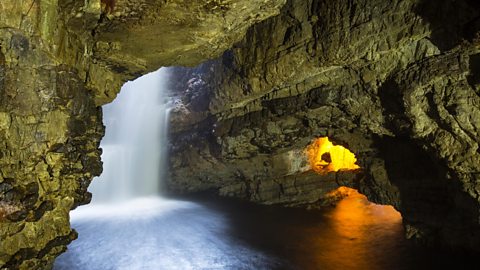
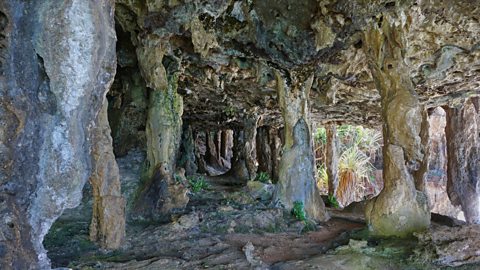
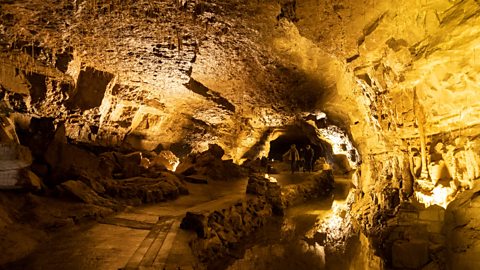
Over a very long time, the water slowly dissolves the stone around the cracks, making them wider and wider. In places where there are lots of joints and bedding planes together, the cracks can start to form a cave.
ISLA: All these cracks in the limestone explain why the caves get here and why they are full of water and underground streams. Let’s go and find them!
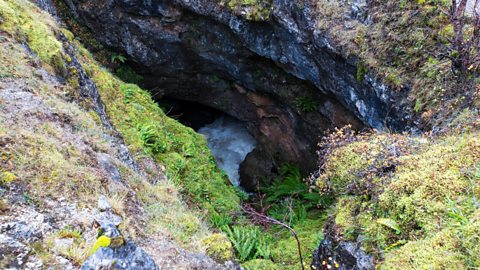
You can hear the water rushing through that pothole and down into the cave! That must be why it’s called the Cave of Roaring!
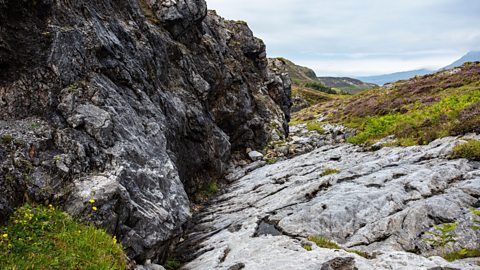
A pothole is a hole from the surface down into the cave, which the water has enlarged. So that water flows down through the pothole gradually dissolving the limestone and making this cave system, leaving the dry limestone riverbed on the surface.
The water from the stream or river effectively disappears above land, and carves out the cave system underground, before remerging downstream.
These potholes can be found as holes above ground. There’s one here at Traligill Caves. It’s really dangerous so you’ve got to watch your footing, or you’ll fall inside the cave and into the water.
CONNOR: Be careful, there are bats in there!
ISLA: As if I’m scared of a little bat!
They’re nocturnal, which means they sleep during the day and come out at sunset.
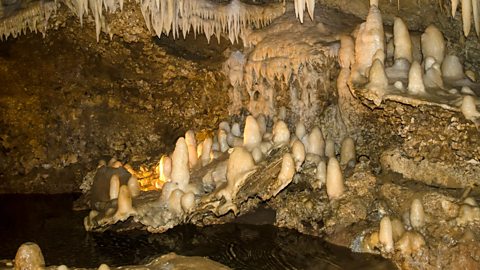
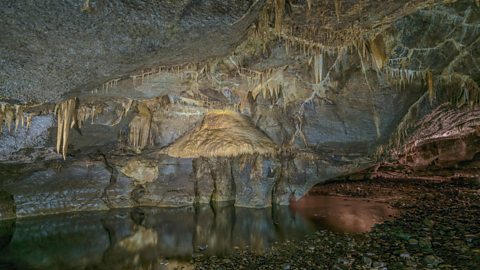
There are other things in these caves that we can’t see from the entrance. These are stalagmites and stalactites.
They are also the result of water seeping through limestone, which is made of calcium carbonate. The calcium carbonate is dissolved in the water as it seeps through to the cave.
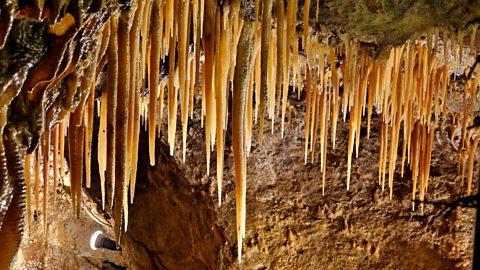
In the cave, the water evaporates and leaves behind calcium carbonate on the roof of the cavern. Over time, this builds up to create the long, thin deposits that look like icicles hanging from the top of the cave. They’re the stalactites.
CONNOR: So how about the stalagmites on the floor, how do they grow upwards?
ISLA: When water falls to the floor, it splashes and evaporates, but the splash can also leave calcium carbonate deposits. These deposits form the stalagmites.
Over thousands of years, more calcium carbonate builds up making stalactites longer and longer and stalagmites taller and taller until they eventually meet, forming a limestone column or pillar.
You can tell roughly how old they are by their size. They grow about 10cm every 1000 years.
The stalactites and stalagmites make these really dramatic limestone features inside caves. Look!
CONNOR: Ok, I think I’m going to explore more caves so I can see these for myself! Caves are actually…
PRETTY AMAZING!
What is limestone?
- Limestone is a Rock made when sediment, such as sand, mud and pebbles, forms in layers. Over time, these layers are squashed under more and more layers of sediment. Eventually, the layers turn to sedimentary rock that can be formed in deserts, lakes, rivers and seas. . It is made of A chemical compound found in minerals and rocks, like limestone, marble and chalk. which is When a solid becomes absorbed and a part of a liquid. by rainfall.
- Limestone is made up of horizontal layers called bedding planes and vertical cracks called joints.
- Water can pass through these joints and cracks. As it does, it continues to dissolve the limestone creating larger cracks and caves.
Learn more about sedimentary rock and other types of rock here: Rock types
Limestone landscape features
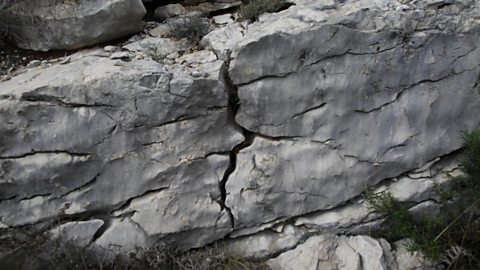
Image caption, Joints and bedding planes
Joints are the vertical cracks in limestone. This means they run up and down the rock. Bedding planes are the separate horizontal layers in limestone underground. They run along the way, not up and down like joints. (geogphotos / Alamy Stock Photo)
1 of 6
Limestone features around the UK
Limestone landscapes can be found in different places across the UK. Look out for these features:
- A surface made up of flat slabs of limestone.
- potholes or swallow holes
- caves or caverns
- stalactites and stalagmites
One way to remember the difference between stalactites and stalagmites is that the C in stalactites stands for ceiling and the G in stalagmites stands for ground.
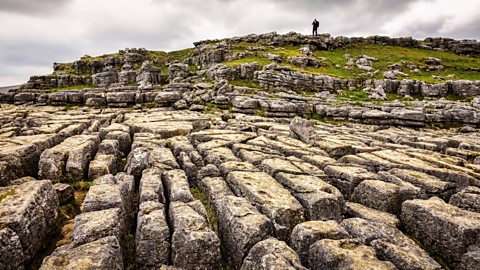
Image caption, Yorkshire Dales, England
The Yorkshire Dales National Park is famous for its limestone features, like the limestone pavements at Malham Cove. (travellinglight / Alamy Stock Photo)
1 of 4
Wildlife: Bats in Scotland

In the video at the top of the page, Isla and Connor chatted about bats that live in caves. Let's find out more about about bats in Scotland.
- Bats are Warm-blooded animals that breathe air, have a backbone, and usually have hair or fur. Female mammals produce milk to feed their babies.. They are the only mammal that can fly.
- There are around nine different types of bats living in Scotland. For example, common pipistrelles and brown long-eared bats are two kinds of bats that can be found in Scotland.
- Bats live in lots of different Where an animal or plant lives. such as caves, barns, lofts in people's houses, under bridges and in trees.
- Bats are nocturnal. This means they are active at night. This is when they hunt for their food. They eat insects like beetles and moths.

Key words about limestone landscape
- sedimentary rock - A soft rock made up of tiny broken pieces of rocks, crystals and minerals.
- limestone - A sedimentary rock created by layers of skeletons and shells of sea creatures found in ancient warm shallow seas settling and being compressed and hardened until it becomes stone.
- dissolve - When a solid becomes absorbed and a part of a liquid. For example, sugar dissolves into a hot cup of tea.
- joints - Vertical cracks in limestone.
- bedding planes - Separate horizontal layers in limestone.
- cave - A natural opening in the Earth's surface. Most caves are created when water erodes or dissolves rock, creating an opening or passage.
- pothole - A hole in the Earth's surface leading to a natural underground cave.
- calcium carbonate - A chemical compound found in minerals and rocks, like limestone, marble and chalk.
- evaporate - When a liquid turns into a gas. For example, when liquid water is heated, it can evaporate into water vapour.
- stalactites - Long, thin calcium carbonate deposits which grow downwards from a cave's ceiling.
- stalagmites - Short, wide, dumpy calcium carbonate deposits on the floor of a cave.
- limestone column - When stalagmites and stalactites grow towards one another and join to form a rock column. Also known as a pillar.
- nocturnal animal - An animal that is most active at night.
Test your knowledge
Quiz
Challenge

Create a postcard describing a limestone landscape.
Imagine you have visited one of the UK's national parks or reserves where you find limestone features.
- The North West Highlands Geopark in Scotland
- The Yorkshire Dales National Park in England
- The Marlbank Nature Reserves in Northern Ireland
- The Brecon Beacons National Park in Wales
Design and write a postcard to a friend or family member describing what you have seen. Remember your postcard will need an image on one side and a message on the other.
More on Landscapes
Find out more by working through a topic
- count22 of 25

- count23 of 25

- count24 of 25

- count25 of 25