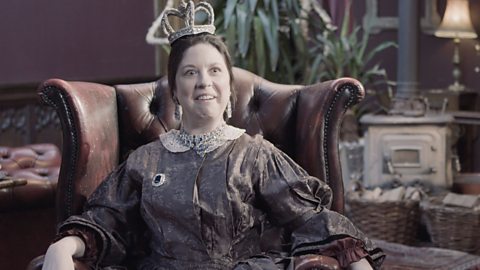
Scherrikar Bell:
Who made nursing what it is today?
Scherrikar Bell:
Well, nursing came on in leaps and bounds thanks to this woman…
Florence Nightingale:
Florence Nightingale.
Scherrikar Bell:
The lady with the lamp. Florence Nightingale: was born on the 12th May 1820 in Florence, Italy, hence the name but was raised in England. And while it's true that she was the founder of modern nursing, she did so much more than that. Florence helped the Victorian world to see that…
Florence Nightingale:
Women have just as much an important role in the workforce as men do.
Scherrikar Bell:
Growing up in an affluent family, it was expected that Florence would marry and start a family of her own but she had other ideas. From a young age she said…
Florence Nightingale:
I want to be a healer.
Scherrikar Bell:
… even though at the time nursing wasn't seen as a respectable job for anyone, let along a woman from the upper classes. Florence worked and studied hard even travelling to Germany to brush up on the latest nursing practices, as well as coming up with ideas of her own. When she got back to England, she worked in a hospital in London and within a year she became head nurse. So Florence is already killing it in the nursing world. Or rather saving lives? Not killing it. Anyway, it's going well. Then she got the call.
Voice on telephone:
Hello, is that Florence Nightingale: ?
Florence Nightingale:
Speaking.
Voice on telephone:
War's broken out in the Crimean Peninsula. We need you to get a team together and head over there, give that place some serious nursing.
Florence Nightingale:
Cool, no bother, will do. See you soon.
Scherrikar Bell:
Except, it probably wasn't a phone call because phones hadn't been invented yet, but anyway, she was asked to go to Crimea and sort out the hospitals there. The war was complicated and noted for its violence so not a great place for our mate Flo to turn up, or rather a great place since Flo was all about healing people. When she reached the distant lands of what is now Turkey, she was…
Florence Nightingale:
Shocked at the conditions of the hospitals.
Scherrikar Bell:
Florence sent the word back to England immediately via The Times newspaper.
Florence Nightingale:
The wounded are being left in dirty hospitals, being cared for by overworked staff. No one higher up in the government or the army is doing anything to help them. Infection is rife and people are dying.
Scherrikar Bell:
And she was heard.
Scherrikar Bell:
The government commissioned a pre-built hospital to be created and shipped over to help Florence. The person that designed and built that hospital was none other than Isambard Kingdom Brunel. But that guy is a whole other video. Florence kept working to improve things. Her big idea was sanitation. She realised that infection was killing more soldiers in hospitals than the wounds they were receiving in battle. It was practically more dangerous to be sent to hospital than it was to stay on the battlefield. Florence knew that basic sanitation and cleanliness would keep most of the infections away and keep hospitals safer, that means…
Florence Nightingale:
Clean water, proper working toilets and waste disposal, washed hands and clean sheets.
Scherrikar Bell:
What Florence didn't know at the time was that she was fighting tiny little bugs that we now call micro-organisms. Bacteria, viruses and fungi are all types of micro-organism.
Florence Nightingale:
These little bugs can grow and spread rapidly and some of them, not all, can be harmful to humans if they get into your body.
Scherrikar Bell:
Say, through a gaping cannonball wound? Through flaws in sanitation methods she stemmed the tide of the micro-organisms and infections. She then made sure that soldiers got healthy meals to help them recover. These might seem like simple things today but that's all because of Florence. During her time in the Crimea, hospital mortality rates decreased dramatically and her hygiene improvement saved a lot of lives. And as if that wasn't enough, when all the other nurses had finished their shifts and patients were sleeping, Florence would grab her lamp and walk around the hospital wards to check in on all in her care. She sat with anyone that needed comforting, read to them and helped them to write home, earning her nickname, "The Lady with the Lamp."
Florence Nightingale:
Or "The Angel of the Crimea," if you prefer.
Scherrikar Bell:
After the war, Florence returned home to London and set up a nursing school She taught her students how to properly care for people in hospitals and made them safer for everyone that was involved and in doing so she legitimised nursing as…
Florence Nightingale:
A career for everyone, not just for women.
Scherrikar Bell:
In 1883 Florence was the first recipient of the Royal Red Cross Medal for outstanding services in military nursing. Queen Victoria appointed her as a Lady of Grace and in 1907 she became the first woman to be awarded the Order of Merit which recognises distinguished services in the armed forces and science, amongst other things. She was highly rewarded and revered all because she had a goal to be a healer and worked hard to be the best at it. And that's why she's the founder of modern nursing.
Video summary
The lady with the lamp, or the angel of the Crimea if you prefer, either way Florence Nightingale is one of the biggest names in modern nursing.
In this short film we learn about what motivated her to do the great work that she did, the changes that she made to hospitals and the impact she had on the people she cared for.
Narrator Scherrikar Bell tell us how Florence was appalled at the conditions of hospitals when she first started nursing.
Through hard work and persistence Florence educated the world on what it takes to keep hospitals clean and help sick people recover and stay clean and healthy.
Throughout the film we touch on history and geography as we learn about the Crimean war, why it happened and who was involved. We also touch on science, sanitation and microorganisms. And why all of those thing where important when it came to changing nursing.
This short film is from the BBC series, The Victorians.
Teacher Notes
These films introduce a character that can be used as a jumping off point for cross-curricular learning. This can be applied to a variety of subjects across the Key Stage 2 curriculum.
This series of films is designed to introduce real historical figures in an engaging context that can be explored by both students and teachers to help understand a variety of subjects.
The format runs through a few key stories or elements from the lives of the historical figures and applies them to a subject that can be discussed or explored in the classroom. The films act as a catalyst to kick-start ideas and introduce students to a world that can cover all kinds of subjects.
Each film should offer you lots of opportunities to create activities and schemes of work that take an element of the film and expand on it in the classroom with a curriculum based learning objective in mind.
The films should leave the students feeling like they have both a basic knowledge of the Victorian character and that they are engaged with the fun personalities that the film portrays.
The aim is give students a context to understand a variety of subjects that co-exist in real scenarios.
Before Watching
Before getting started with the film, you could introduce your students to the Victorian era. Roughly when it took place historically, what it was like to live in that time and how it’s different from today.
Another useful approach would be to give the students a short introduction to the character, just sticking to the key points to peak their interest.
Before playing the film you should ask the children to keep an eye out for the different subjects, ideas, and objects that are spoken about in the film. At the end of the film you could ask the class to speak about what they’ve seen. This should bring up plenty of jumping off points for you to expand on.
To really bring the history to life you could set a themed day and ask students to wear costumes or adopt a special timetable to reflect the Victorian classroom.
You could ask the students what they already know about the character that features in the film to get a feel for their understanding. Then if the film mentions something they know and have mentioned they’ll feel affirmed in their knowledge and engaged with the film, but also any new information will help them to feel like their understanding has improved.
After watching
Following the film there should be activities lined up to take the learning in the film further. Introducing more detail to the stories and developing the understanding of the elements that have been touched up in the film.
These could be based around a subject. For example, the film talks about the Crimean war and the empires that were involved. This could be used as an opportunity to explore empires other than the British and the similarities and differences between their collective histories.
Florence’s film also talks about sanitation. This could be a good introduction to a subject that still has relevance and real-world impact. For younger students it could help to build a more scientific understanding of why washing hands is important, applying a subject in the film to a relatable scenario.
The film also touches on issues gender and equality. This could be a good opportunity to raise the subject with your students and talk about the role of men and women in the workplace and if those roles are different or the same.
Next Steps
The next step should be to take the understanding of the subject that is in the Victorian context in the film and develop it into a deeper understanding of the subject that is required by the curriculum.
This short film is suitable for teaching at Key Stage 2 in England, Wales and Northern Ireland and Curriculum for Excellence First and Second Level in Scotland.
Charles Darwin – The biggest name in Victorian science. video
A short film exploring the life and work of Charles Darwin and explaining his theory of evolution.
Isambard Kingdom Brunel – A total genius of engineering. video
A short film exploring the life and work of Isambard Kingdom Brunel, explaining who he was and what he did to build Victorian Britain.
Pablo Fanque – The greatest Victorian showman. video
A short film about the life and work of Pablo Fanque, a famous equestrian performer from the Victorian era.

Queen Victoria – The ultimate Victorian. video
A short film about Queen Victoria, explaining the curiosities and inventions that arose during her reign as well as what made her a brilliant monarch.