The challenge
Hello everyone, my name is Cel Spellman and it is so great to be with you today. I'm an actor, I'm a presenter, and I'm also very passionate about the environment and sustainability. But what comes with having all those jobs is something that we all have in common. Something everyone has to do, and that is that we pay all the right taxes.
Now I know what you're thinking, taxes, oh Cel, that's a little bit boring. And I'll agree with you it is, but it's something that we all have to do and know about. Plus, there's some super cool things we can do with taxes.
So most people pay two types of tax. There's income tax, which comes out of your wage. How much you pay is based on how much you earn, and that goes towards things like schools, healthcare, and emergency services. There is also council tax. That is a fixed amount of money you pay each month. That's based on where you live and how much your house is worth. Council tax goes directly to your local council, then they work out what to spend on all the different things your area needs. People also pay national insurance. That also comes out of your wage and that helps fund things like the NHS and other benefits like pensions.
So I want you to think about what you would do if you had the power to spend the council tax in your area. Now the average household in England pays one thousand nine hundred and sixty-six pounds a year to their local council. That's to help fund things like youth services, libraries, park spaces, open spaces, galleries, roads, public transport, leisure facilities, which would include things like swimming pools and recreation centres, rubbish collection, street cleaning, and other important environmental issues. Social care for older people, children, and other vulnerable members of the community.
Now, remember, I want you to think about everybody who lives in your community. How would you split the money? And why? To help our work in percentages, that way you don't have to worry about how much things cost, rather the value you will place on them in comparison to others. Now be prepared to justify your choices and remember to think about global issues everybody faces, from climate change to social issues, when you're making your decisions.
Video summary
Actor and presenter Cel Spellman explains how the government collects taxes to pay for schools, hospitals, the police, the army and other public services.
Workers pay income tax on any earnings over a certain amount. Most people over the age of 18 pay council tax, to fund street cleaning, waste collection and the care of vulnerable people. As well as petrol and car taxes, there's stamp duty, a tax on house sales.
We pay VAT (Value Added Tax) on many things we buy. Taxes on alcohol, smoking and sugary drinks aim to discourage what the government views as harmful behaviour.
£915 billion is raised annually in tax, or around £13260 per person (correct as of March 2023.) But in most years, this won't cover all the government's spending and it borrows money to make up the deficit.
All information correct as of March 2023.
Challenge round-up
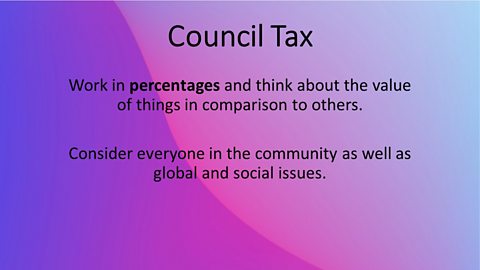
Cel Spellman summarises the key considerations for the challenge.
Right, that is your time up, my friends.
How did you get on? Did you remember to think about how to make your community as sustainable as possible, thinking about public transport, green spaces, recycling, and reducing carbon emissions? Did you think about older people as well as younger people? What ideas did you come up with that will positively impact your community as a whole?
Now I know what you're thinking, and I thought the exact same: paying tax can feel like a right pain. And it's quite confusing and scary, but trust me, it's so important that we understand it and we all pay our tax because when you think about how much it benefits society and everybody in it, it's actually pretty cool.
Teacher notes
Watch the video and then split the class into pairs or groups to work on the task set in Part 1 of the film. After the activity time has passed re-group and watch Part 2 of the video to see how Cel would have gone about things.
Also choose from a selection of activities to help students learn more about tax.
Before watching
Questions to get the class thinking and talking:
- What is tax?
- What taxes do we pay?
- Why do we pay taxes?
Establish tax is money we pay the government to fund public services.
Using the film
You may wish to play the films twice: once straight through and once with pauses, to take students' comments and questions. Encourage the students to make notes as they watch.
After watching
- Role-play - Ask the students to work in pairs. Two workers compare their payslips. They've both had £400 taken this month in income tax and national insurance. One worker complains about the money taken. The other tries to justify it, pointing out what our taxes pay for.
Activity ideas
Tax quiz - Students could use the video transcript to devise multiple-choice questions about the taxes we pay, for instance: 'What are the two types of taxis called? (A) Income Tax, (B) Stamp Duty, © Council Tax, (D) Community Charge. Answer (A and C)'.
Glossaries - Students could compile glossaries of financial terms used in the film clip, along with their own definitions. This encourages them to clarify their understanding of key vocabulary. Terms might include: 'Income Tax', 'council tax' ‘pension’.
Tax take - Students could calculate the monthly tax take for various workers, at the 2023 rate of 20% on earnings above £12,570 a year (below that, you don't pay income tax). People earning between £37,701-150,000 a year are taxed at 40%.
Figures to work from: a part-time cleaner earns £12,000, a junior salesperson £19,000, an office manager £34,000 and a Head Teacher £54,000 a year
- New tax? - No tax is ever popular, but how do we decide what is taxed? Students could work in pairs to come up with an idea for a new tax, to either discourage harmful behaviour or encourage positive action.
Who would pay this tax? How would it be collected? Should someone's ability to pay be considered? Students could make one-minute presentations of their tax proposals to the class.
- My tax week - Students may not yet pay income or council tax, but they do pay other taxes. Ask them to list what they have paid tax on (for instance 15p for a plastic bag, VAT at 20% on most purchases and 18p per litre on sugary drinks). What taxes do their parents or carers pay on their behalf (car tax, fuel tax)? Challenge students to estimate how much their personal tax bill has been this week.
- Debate - Ask, 'Which would you rather have? Lower taxes or more money for services?' Gather the students' responses and prompt further debate with:
- Should we look after everyone's welfare? Or should people look after themselves?
- Are there benefits to society from public services?
- Should we be able to personally choose the services our taxes fund?
- Do lower taxes inspire people to work harder?
- Would you value school more if you had to pay for it yourself?
- What should never be taxed?
At the end of the debate, the class could take a vote on whether they would prefer higher taxes and better services, or lower taxes and poorer services.
Supported learning and SEN
Each year in the UK, we pay around £11,000 tax per person. If it was up to you to decide what your tax was spent on, what would you choose? Ask students (with any necessary support) to draw and colour a pie chart showing what fraction of their £11,000 they would spend on schools, hospitals, the army, police, etc.
Follow-up task
Students could find out more online about what our taxes fund. They could use search terms such as 'UK government spending' and 'how our tax is spent'. Students could write a short report on what they discover.
This short film meets and extends curriculum requirements for financial literacy at:
- Key Stage 3 and Key Stage 4 in England (Citizenship and Personal, Social, Health and Economic Education)
- Wales (Mathematical Development and Personal and Social Education)
- Northern Ireland (Mathematics and Numeracy and Learning For Life and Work)
- Third and Fourth Level and the Senior Phase in Scotland (Mathematics and Numeracy, Social Studies and Learning, Life and Work).
Where next?
University budget challenge with Cat the Vet. video
Vet and TikTok star Cat Henstridge (Cat The Vet ) offers tips on budgeting for university, before setting a related challenge for students.
Party budget challenge with Gayle Chapman. video
Food vlogger Gayle Chapman explains how borrowing money works, before setting students a party budget challenge.

Long-term saving challenge with Iona Bain. video
Financial journalist and author Iona Bain explains the importance of saving and sets a long-term saving challenge.
Sticking to a budget challenge with Liam MacDevitt. video
Former professional footballer Liam MacDevitt sets students a challenge to plan and stick to a budget ahead of a trip with friends to a football match.

Iona Bain's money jargon busters. video
In these short videos for secondary schools Morning Live's financial expert Iona Bain clearly explains pensions, mortgages, inflation, interest rates, credit and pensions.

Financial literacy with Steph McGovern. collection
In these short films for secondary schools Steph McGovern breaks down some key areas of study for the topic of financial literacy. These four short films will provide secondary students with a good understanding of credit, debt, pensions and how interest and taxation works.