The challenge
Hi guys, Liam MacDevitt here, and I'm an ex-professional footballer turned TV presenter. I've played for loads of teams here in the UK, including Yeovil Town, Bury, and Bristol City, and even two teams in New Zealand. I've appeared on various TV programmes such as Football Focus, Match Of The Day X, BBC Two, and CBBC.
Now, I love nothing more than going to watch my favourite team play with my friends, but going to watch live sport can be expensive. Most people plan ahead so that they can afford everything on the day to have the best time possible. So I'm going to set you a challenge. Today, I thought you could work in teams to plan a day out to see some live sport. It could be basketball, cricket, football, whatever you fancy, but you're gonna need to budget how much everything costs to make sure you can afford the best day possible.
Think about how you would get to the game. Will you all club in for a taxi? Or get public transport? Which is gonna be cheapest, but also think about which is gonna work best for you? What are the best seats in the ground? And how do the prices differ to other places in the stadium? Are you gonna get food at the match or stop off and get cheaper snacks on the way? Now think about any souvenirs you might want if you've got any money left over. It could be a match programme or a scarf to support your team.
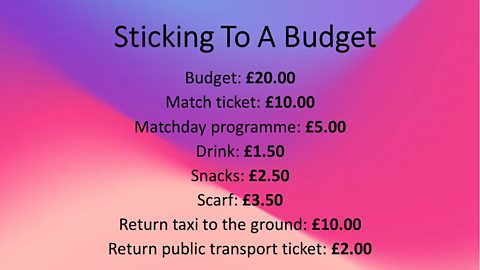
You'll be set a budget of twenty pounds by your teacher, but here's how much each item costs. Your match ticket is gonna cost you ten pounds, a programme's gonna cost you a fiver, a drink's gonna cost you one pound fifty, some snacks are gonna cost you two pounds fifty, a scarf's gonna cost you three pounds fifty, a return taxi to the ground is going to cost you a tenner, and public transport's gonna cost you just two pounds. Remember to make this the best day you can with the money you've got.
We'll break up now into groups and have a go at the challenge. In thirty minutes, I'll be back to find out how you got on and how I would've gone about the challenge. Good luck and see you soon.
Video summary
Former professional footballer Liam MacDevitt explains how budgeting is an essential skill that can help you plan and manage your expenses effectively, including when it comes to leisure activities such as attending a football match.
If you're planning to go to a football match with friends it's important to set a budget beforehand to ensure that you don't overspend and put yourself in financial trouble.
This could involve looking up the ticket prices, transportation costs, and other related expenses such as food and drinks. You may also want to consider alternative ways of reducing costs, such as public transport or bringing your own snacks.
By creating a budget and sticking to it, you can enjoy the game without worrying about the financial consequences.
Challenge round-up
Liam MacDevitt summarises the key considerations for the challenge.
Time's up guys; did you think about how you could get into the ground for the least amount of money possible? If it was me, I would have taken public transport. It could be a train, a bus, or a tram, and I'd have ditched those snacks too. If your budget's running low, you could also not buy a matchday programme or a scarf. So you've got enough money to get into the ground to see the game and a load of goals and get home afterwards.
In your day-to-day life, all sorts of things need budgeting for so you don't fall short when it comes to a big day out with your friends. Hopefully, today's session has given you food for thought when it comes to thinking about what you might like to save for. So that brings us to the end of our financial challenge session. I hope you found it interesting and informative, and I'll see you soon.
Teacher notes
Watch the video and then split the class into pairs or groups to work on the task set in Part 1 of the film. After the activity time has passed re-group and watch Part 2 of the video to see how Liam would have gone about things.
Choose from a selection of activities to help students learn more about budgeting for a day out.
Before watching
Questions to get the class thinking and talking:
- What are the benefits of researching prices before leaving the house?
- What should you consider before going to a match?
- Which is better on your budget, taxis or public transport?
Using the film
You may wish to play the films twice: once straight through and once with pauses, to take students' comments and questions. Encourage the students to make notes as they watch.
After watching
- Ask students to discuss times they have had to work to a budget – what is challenging about it and how did they make decisions? What advice would they give someone else on sticking to a budget?
Activity ideas
- Ask students to work in small groups to create their own budgeting task with which to challenge another group in the class. They should think of an event they have attended in the past and the costs incurred and lay out the options like in the football match task.
- Now ask students to think about budgeting for everyday life. Give students a monthly income amount and present the options for renting properties, bills, taxes and other expenses such as owning a car or pet, food shopping and subscriptions and ask them to consider how they would manage budgeting to live when they are working full time.
Alternatives – Research the biggest fees paid for sports stars around the world in various sports. Such as football, basketball, American Football and baseball. Students could debate whether or not such salaries are appropriate for a job of this kind in comparison to jobs such as doctors and teachers etc.
Supported learning and SEN
Present students with typical amounts for items within a weekly food shop and a budget for which they much purchase all their meals for a week, Ask them to create a shopping list and to discuss what hard choices they had to make to stay within budget.
Follow-up task
Ask the class to research online the average salary of a worker in the UK. They could research the minimum wage and the living wage and discuss how these salaries impact quality of life linked to budgeting. They could research the average salaries of the careers they are considering to see how they compare.
This short film meets and extends curriculum requirements for financial literacy at:
- Key Stage 3 and Key Stage 4 in England (Citizenship and Personal, Social, Health and Economic Education)
- Wales (Mathematical Development and Personal and Social Education)
- Northern Ireland (Mathematics and Numeracy and Learning For Life and Work)
- Third and Fourth Level and the Senior Phase in Scotland (Mathematics and Numeracy, Social Studies and Learning, Life and Work).
Where next?
University budget challenge with Cat the Vet. video
Vet and TikTok star Cat Henstridge (Cat The Vet ) offers tips on budgeting for university, before setting a related challenge for students.

Tax budget challenge with Cel Spellman. video
Actor and presenter Cel Spellman explains how the tax system works and sets a related tax budget challenge.

Party budget challenge with Gayle Chapman. video
Food vlogger Gayle Chapman explains how borrowing money works, before setting students a party budget challenge.

Long-term saving challenge with Iona Bain. video
Financial journalist and author Iona Bain explains the importance of saving and sets a long-term saving challenge.

Iona Bain's money jargon busters. video
In these short videos for secondary schools Morning Live's financial expert Iona Bain clearly explains pensions, mortgages, inflation, interest rates, credit and pensions.

Financial literacy with Steph McGovern. collection
In these short films for secondary schools Steph McGovern breaks down some key areas of study for the topic of financial literacy. These four short films will provide secondary students with a good understanding of credit, debt, pensions and how interest and taxation works.