The challenge
Hello there. I'm Iona Bain. I'm a financial writer, speaker, broadcaster, author, and blogger who specialises in all things money. I appear regularly on TV and radio to chat about finance, and I also appear on BBC One's Morning Live show as their financial expert in residence.
Now, I've learned a lot about how to manage money over the years, and I absolutely love the confidence and power that having a healthy relationship with money can bring you. So I want to share with you all the things I've learned. Now, saving is a great way to help you achieve your long-term goals. You can do this at home, for instance, by stuffing your money under the mattress or putting it in a piggy bank, but the best way to save is to put it in a bank account.
Now, there are three reasons for this. Number one, your money is safe. It's not going to get nicked. The second reason why you should save in a bank is that you actually get paid to save by your bank, and this is known as an interest rate. It's calculated as a percentage of the money that you save. The higher the interest rate, the more that your bank is paying you to save. And the third reason why you should save is choice. This is my favourite reason because, actually, if you spend money now, that's it. The money's gone. You can't get it back. Whereas if you save it up, you give yourself money in the future. You give yourself more options. Now, I'm a savings fan girl, but it's really important to understand the main trade-off with saving, and if you want to figure this out for yourself, it's really as simple as imagining a seesaw. One side has to be higher than the other, and the main trade-off to think about with saving is a trade-off between access and reward.
So the more access that you have to your account, the lower the reward. But on the flip side, the less access that you have to your account, the higher the reward. So that means if you can lock up your money for longer, you're going to get a better interest rate from your bank. However, we all need money to access in an emergency too, which is why it's a good idea to have some of your cash in an easy access savings account just in case.
So now I want you guys to work in teams and figure out how you're going to save for your big long-term goals. You'll need to think about the costs involved, i.e. how much is this goal going to cost you? And that's going to really determine how much you'll need to save along the way. Plus, you'll need to find the best possible savings account to help you build up that cash.
So when I was sixteen, seventeen years old, I really wanted to get a keyboard because I'm a musician, and I saved up for months. I had to cut back on my spending in other areas to make it happen, which was a bit painful at the time, and I also had to really think about how I was going to save the money. So I put it in an easy access account, and that meant that I could grab the money as soon as I hit that magic total that was required to buy my keyboard. And once I did, boy, did it feel amazing.
Now, for this challenge, I want you to imagine that you are saving up for two big long-term goals that are really meaningful and personal to you. They could be, like me, a musical instrument that you've always wanted, or a new phone, or a new pair of trainers, or that first holiday with your mates, or driving lessons. Now, you're going to work in teams, and I want you to really think about how you're going to save up for these big long-term goals. Are you going to be able to manage it with your current lifestyle, or are you going to have to make some changes? Are you going to have to cut back your spending elsewhere so that you can make this dream a reality?
You also need to think about how much money you'll need to save up and how long it's going to take you because that's really going to determine the kind of savings account that you pick. For instance, if you think that your goal is a few years away, then you can afford to lock up your money for longer so you can earn that better interest rate. However, if you think that you're going to smash that goal within the next few months, then you want to keep that money in an easy access account.
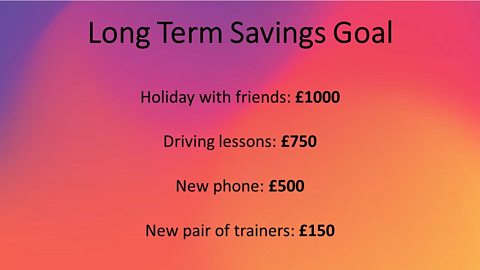
So here is how much the items that you're going to save up for are gonna cost. You're looking at one thousand pounds for a holiday with friends, seven hundred and fifty pounds for driving lessons, five hundred pounds for a new phone, and one hundred and fifty pounds for a new pair of trainers. Now's the time to break up into groups and tackle the challenge for yourselves. We'll regroup in about thirty minutes, and I'll be back to give you my thoughts on how I would've set about doing the challenge and maybe one or two things that I would have done slightly differently. Good luck, and I'll see you soon.
Video summary
Iona Bain is a prominent financial journalist and author who advocates for the importance of saving as a key aspect of financial planning.
Iona believes that savings should be a top priority for everyone, regardless of their income level or age. She emphasizes that saving doesn't have to be complicated, and that even small amounts can add up over time.
This is a challenge around saving towards a large long-term goal.
Challenge round-up
Iona Bain summarises the key considerations for the challenge.
Times up guys. So did you think about how to cut back on expenses so you could save more? What did you come up with? So a few things that I thought of to save money include using public transport and walking where it's safe to do so, maybe getting a bike if you can afford that as well. Preparing packed lunches and coffees before you head out the door instead of buying food and drink on the go. That can save you a heck of a lot of money.
Also, think about maybe a movie night in with your mates instead of going to the cinema, having a clothes swap party which can be really fun, and buying stuff second hand. This is something I love to do because it's not just good for your finances, but it's great for the environment as well.
Or maybe you thought about some ways to make a little bit of extra money, such as dog walking, washing the car, or selling old clothes and gadgets that you don't use anymore. And did you manage to find an account that would earn you some interest on your money? Maybe you thought about setting up two different savings accounts that offered you different levels of access and reward. If so, great job.
So hopefully I've shown you today that saving does not have to mean sacrifice. Yes, it does involve making smarter spending decisions. But actually, that can create choices for you and help you to achieve the things in life that really matter to you. So hopefully I've given you some food for thought on how you can achieve your long-term goals with saving. Thanks very much, and hopefully see you again soon.
Teacher notes
Watch the video and then split the class into pairs or groups to work on the task set in Part 1 of the film. After the activity time has passed re-group and watch Part 2 of the video to see how Iona would have gone about things.
Choose from a selection of activities to help students learn more about credit and debt.
Before watching
Questions to get the class thinking and talking:
- What are the benefits of saving?
- Which is best saving or getting into debt?
- What should you consider before borrowing money?
Establish that: Saving and using credit are two different approaches to managing your finances, and each has its own virtues. However, when it comes to building long-term wealth and financial stability, saving has clear advantages over relying solely on credit.
Using the film
You may wish to play the films twice: once straight through and once with pauses, to take students' comments and questions. Encourage the students to make notes as they watch.
After watching
Role-play - You are a financial educator, and the students are a group of high school students who are about to graduate and start college soon. The students are worried about how they can save money for college, manage their expenses and avoid falling into debt.
Challenge: During the role play, you should try to demonstrate your ability to:1. Engage their partners in a friendly and interactive conversation about saving, budgeting and managing expenses.2. Explain the importance of setting financial goals and creating a budget to achieve them.3. Provide practical advice on how to save money for college, including tips on reducing expenses, finding scholarships, and applying for financial aid.4. Highlight the risks of using credit cards or taking out loans without careful planning and consideration.5. Encourage the students to ask questions, share their own experiences and engage in critical thinking about their financial future.
Activity ideas
- Glossaries - Students could compile glossaries of financial terms used in the film clip, along with their own definitions. This encourages them to clarify their understanding of key vocabulary.
Terms might include: 'credit', 'debt', 'interest', 'interest rate', 'Annual Percentage Rate (APR)', 'overdraft', , 'loan'.
- APRs - Working in pairs, students could use an online loan repayment calculator to explore borrowing £100 at a range of different APRs. For each APR, they should note the length or 'term' of the loan, the monthly payment, total interest and total amount repayable. They should explore banks and ‘payday loan’ options as well as online shopping options offered on websites.
Point out that, even if the APR and monthly payments seem low, when a loan runs for a long time it ends up costing a lot to borrow a little.
Invite each pair of students to draw leaflets advertising three loans from their imaginary bank. Each loan has a different APR and a different term. Their classmates must try to spot the best deal (the one that will cost them the least in the end) for borrowing £100.
- Alternatives - Ask the question 'are there alternatives to saving money?' The class could list suggestions, such as: 'wait until you've been paid, cut back on other spending, do some overtime, sell something to raise the cash, choose a cheaper item, or consider if you really need to buy something at all.'
Supported learning and SEN
Students could (with any necessary support) take a screengrab from Iona Bain’s film and add their own speech bubble, e.g., 'Access and Reward means…’. A collection of 'Iona says' captures and captions could form a financial education comic strip.
Follow-up task
Ask the class to research online the differences between various savings accounts.
This short film meets and extends curriculum requirements for financial literacy at:
- Key Stage 3 and Key Stage 4 in England (Citizenship and Personal, Social, Health and Economic Education)
- Wales (Mathematical Development and Personal and Social Education)
- Northern Ireland (Mathematics and Numeracy and Learning For Life and Work)
- Third and Fourth Level and the Senior Phase in Scotland (Mathematics and Numeracy, Social Studies and Learning, Life and Work).
Where next?
University budget challenge with Cat the Vet. video
Vet and TikTok star Cat Henstridge (Cat The Vet ) offers tips on budgeting for university, before setting a related challenge for students.
Tax budget challenge with Cel Spellman. video
Actor and presenter Cel Spellman explains how the tax system works and sets a related tax budget challenge.

Party budget challenge with Gayle Chapman. video
Food vlogger Gayle Chapman explains how borrowing money works, before setting students a party budget challenge.

Sticking to a budget challenge with Liam MacDevitt. video
Former professional footballer Liam MacDevitt sets students a challenge to plan and stick to a budget ahead of a trip with friends to a football match.

Iona Bain's money jargon busters. video
In these short videos for secondary schools Morning Live's financial expert Iona Bain clearly explains pensions, mortgages, inflation, interest rates, credit and pensions.

Financial literacy with Steph McGovern. collection
In these short films for secondary schools Steph McGovern breaks down some key areas of study for the topic of financial literacy. These four short films will provide secondary students with a good understanding of credit, debt, pensions and how interest and taxation works.