Where do minibeasts live?
MADDIE: Are there any under there? What about over there? Or in those plants?
Minibeasts are all around us but sometimes they’re hard to spot! They’re very good at hiding in small spaces and staying out of sight, even though you might not see them, minibeasts are always close by! Where do you think minibeasts live?
CHILD: Underground?
CHILD: In hedges?
CHILD: What about in our homes?
MADDIE: Yes, those are all right answers! Minibeasts can live in lots of different places. We call the homes or environments that they live in ‘habitats’.
Animals are all uniquely suited to living in their own individual habitat. Within the UK we have lots of different habitats that suit different minibeasts. These could be grassy fields, rivers and ponds, or forests. We also have micro-habitats, which are smaller areas - such as the roots of a tree - where you might find woodlice or slugs.
Habitats need to have certain things for animals to live there happily. They must have a supply of food; water to drink; shelter for rest and enough space to move around freely. Lots of minibeasts like to live underground, like worms or ants. The soil provides nutrients for the worms to eat, and ants can build chambers underground to store food and rest in. Other minibeasts - like butterflies and grasshoppers - prefer wide open spaces. A field of wildflowers suits these minibeasts as there are plenty of plants and flowers to feed on.
CHILD: What other habitats do minibeasts live in?
MADDIE: Some minibeasts build their own home. Bees and wasps live in groups called colonies and they construct hives and nests to live in and to stay safe. Garden spiders often weave a new web everyday to live on and to catch prey, while woodlouse spiders use their silky thread to line their daytime hiding places.
And some minibeasts even live right alongside us in our homes. House flies and house spiders are minibeasts you might see inside your house. The flies look for old food to feed on, while the spiders try to catch the flies for food. Minibeasts can look very different in different parts of the world. You may have seen small spiders around your home, but spiders - like this tarantula - with her handler don’t live in the wild in the UK.
CHILD: I think she likes to live in a rainforest.
MADDIE: Yes, in the wild this type of tarantula lives in the rainforests of Brazil. They live in burrows, usually near plants that might attract other smaller insects for them to eat.
CHILD: This Giant African Millipede also lives in a rainforest habitat.
MADDIE: Millipedes like this one are found in the rainforests of Africa. All of his legs help him to burrow underground to find a safe place to rest.
CHILD: What other minibeasts live in far away places?
MADDIE: The Antarctic midge is the only minibeast that can be found in Antarctica due to the harsh weather conditions. The midge’s body does not freeze even in the very cold temperatures. This is how the midge is suited to its habitat. Some minibeasts even live in the sea - like starfish, crabs and sea snails. Like other minibeasts, crabs are invertebrates, which means they don’t have backbones. Some crabs are suited to their ocean habitat because they can breathe underwater, and they have a hard-shell, exoskeleton, to protect them from predators. Let’s hear about more minibeast habitats from our expert!
YUSSEF: Hi, I’m Yussef. I’m a minibeast expert and these are baby stick insects. Stick insects are known for their amazing camouflage. These guys come from Australia; they live in trees, and thanks to their brown spiky look they blend in absolutely perfectly!
Minibeasts here in the UK are well suited to their habitats too. Woodlice for example like to live in dark, damp places - like under rocks or under tree roots - and they love to eat vegetation and dead plants, and there’s plenty of that on the ground where they live.
MADDIE: Can you tell which of these minibeasts is suited to which habitat?
CHILD: This stick insect is suited to living in the jungle because it’s camouflaged to blend in with the plants.
CHILD: This starfish has loads of little suction cups that can stick on to the rocks under the water, so it won’t get washed away.
CHILD: This moth is the same colour as the tree. It blends in with the bark - it’s a great disguise!
MADDIE: Yes! All of those minibeasts are suited to their environment, making it the perfect habitat.
Video summary
Download/print a transcript of the video.
A group of children find out about the range of habitats that support minibeasts.
Through exploration and expert insights, children learn about the contrasting habitats that support minibeast communities around the world, from underground burrows to lush rainforests and underwater ecosystems.
Teacher notes
Download/print the Teacher notes for this unit.
Discussion points:
1. Understanding minibeast habitats:
- Define habitats as the environments where animals live and explore the different types of habitats that support minibeast communities.
- Discuss the importance of habitats in providing food, water, shelter, and space for minibeasts to thrive.
- Ask – ‘What are habitats, and why are they important for minibeasts?’
2. UK habitats for minibeasts:
- Explore various habitats found in the UK, such as grassy fields, rivers, ponds, forests, and microhabitats like tree roots.
- Discuss the characteristics of each habitat and the minibeasts that inhabit them.
- Ask – ‘Can you name different habitats where minibeasts live in the UK?’
3. Global minibeast habitats:
- Introduce children to minibeast habitats in different parts of the world, such as rainforests, deserts, polar regions, and underwater ecosystems.
- Highlight examples of minibeasts adapted to survive in extreme environments.
- Ask – ‘Can you name some different habitats where minibeasts live around the world?’
4. Minibeast adaptations:
- Discuss some of the physical adaptations that minibeasts have developed to survive in their specific habitats.
- Encourage children to observe and identify adaptations in different minibeasts.
Suggested Activities:
1. Invertebrate habitat maps:
- Provide images of different habitats and ask children to identify and mark areas where minibeasts might live.
2. Minibeast habitat dioramas:
- Invite children to create dioramas showing minibeast habitats using art supplies and natural materials.
3. Minibeast habitat scavenger hunt:
- Organise a scavenger hunt in outdoor spaces where children search for minibeasts and their habitats.
- Provide guidebooks or identification sheets to help children identify minibeasts and learn about their habitats.
4. Cross-curricular science and geography projects:
- Encourage children to research and present information about minibeast habitats in different regions of the world.
Curriculum Notes:
This video supports learning objectives related to science in KS1 within the national curriculums of England and Northern Ireland, and 1st Level in Scotland.
Links
Minibeasts - BBC Teach
Characteristics of minibeasts - BBC Teach
Animals - BBC Teach
What are minibeasts? - BBC Bitesize
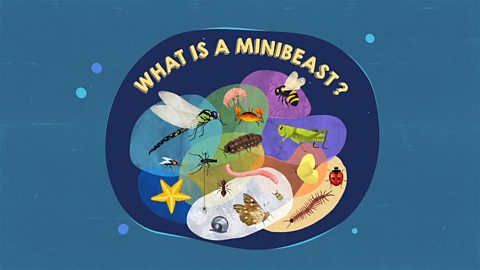
What is a minibeast? video
Identifying the characteristics of small invertebrates, including snails and spiders.
Do minibeasts have superpowers? video
Discovering some of the extraordinary abilities and behaviours of minibeasts.