Do minibeasts have have superpowers?
MADDIE: Hello! Who likes superheroes?
CHILDREN: We do!
MADDIE: Did you know that some minibeasts have superpowers?
CHILD: No way! Like what?
MADDIE: Lots of minibeasts can fly, or breathe underwater, or run really fast… But some minibeasts have special powers that help them to do a job, or defend themselves, or help them get food. Can you think of any examples of minibeasts that do a job that helps us?
CHILD: Bees make honey that we eat.
MADDIE: That’s right! Bees can collect flower nectar from plants and store the sugars inside the honeycomb of their hives. Here, they turn it into honey, and when it’s ready, bee-keepers can harvest some to eat. Yum! As the bees are going from plant to plant collecting the nectar they are also doing another really important job: spreading the plant’s pollen, and this helps new plants to grow. This is why bees are a vital part of our ecosystem. Can you think of any other minibeasts that help us?
CHILD: What about worms? They help the soil.
MADDIE: Yes, earthworms help to aerate the soil. This means they loosen, mix and add oxygen to the soil as they move through it. This makes the soil better for growing plants, so farmers and gardeners like to have lots of earthworms in their soil.
Some minibeasts have superpowers to help protect themselves. To understand why minibeasts need to protect themselves, it helps to look at where they sit in the food chain. A food chain describes the order of living things and how they depend on each other for food. Minibeasts are often low on the food chain. Because they are small, many bigger animals look at them as food. This means lots of minibeasts use their superpowers to protect themselves from predators. For example, Hawthorn Shield Bugs live here in the UK and mostly eat hawthorn berries. But birds want to eat the shield bugs so they defend themselves by spraying a smelly liquid. It puts off the hungry predators. This is why they are also sometimes called stink bugs.
What other superpowers can minibeasts use to defend themselves?
CHILD: This jungle nymph comes from the tropical rainforests of Southeast Asia and uses its camouflage to turn nearly invisible!
CHILD: It looks just like a leaf!
MADDIE: Jungle nymphs are a type of stick insect, which all use their camouflaged appearance to blend in with their jungle habitats. This helps them to avoid predators. Some minibeasts use their superpowers for hunting and for protection, like this Asian forest scorpion. Its natural habitat is the tropical rainforests of Southeast Asia. He has a venomous stinger in his tail, which can be used to hunt and to fend off predators such as owls or bats.
CHILD: Cool, so they use their superpower to defend themselves from bigger animals!
MADDIE: Exactly! Even some of the smallest minibeasts have surprising superpowers - like these ants. Ants have super strength: a single ant can carry 50 times its own bodyweight, and they can work as a group to move even bigger objects! This dung beetle is the world’s strongest animal by size! It can push over one thousand times its own weight, which is the equivalent to a human pulling six double decker buses! Let’s hear from our expert about his favourite minibeast and its superpower!
YUSSEF: Hi, I’m Yussef and I’m a minibeast expert. And I want to tell you about a minibeast that has a very special superpower: the glow-worm. Glow-worms are not actually a type of worm at all: they’re a type of beetle. And they come out at night when it’s dark so it can be quite tricky for them to find each other. Luckily, the females have a very special superpower that helps them with this problem: they can make their bottoms light up, a bit like a torch. They have a special chemical inside their bottoms and when it mixes with the oxygen in the air it creates this miraculous green glow that makes them easier to spot. The scientific name for this is bioluminescence, and it’s just one of the many superpowers that minibeasts have.
MADDIE: Minibeasts have all kinds of superpowers, but sometimes they need our help to survive. Do you have any ideas of how you might help minibeasts in your local environment?
CHILD: We’re putting out a bug hotel so the minibeasts have somewhere safe to live.
MADDIE: Clever! Minibeasts will love crawling into all those little spaces!
CHILD: Or we can let an area of garden grow wild!
MADDIE: Even a small wild area of garden at your home or your school, could attract lots of minibeasts. By adding piles of leaves, or stones, you can provide a habitat for minibeasts, allowing them make the most of their superpowers!
Video summary
Download/print a transcript of the video.
A group of children discover that many minibeasts have surprising ‘superpowers’.
They discover how minibeasts use their extraordinary abilities for various purposes including defending themselves against predators.
Expert insights and engaging demonstrations highlight the diversity of minibeast superpowers and their significance in ecosystems.
Teacher notes
Download/print the Teacher notes for this unit.
Discussion points:
1. Introduction to minibeast superpowers:
- Discuss the concept of superheroes and superpowers. Ask – ‘If you had a superpower what would it be and why?’
- Introduce the idea that minibeasts possess extraordinary abilities that help them survive and thrive in their habitats and we can call these ‘superpowers.’
- Ask – ‘Why are minibeast superpowers important for their survival in their habitats?’
2. Minibeast defence mechanisms:
- Investigate the different defence mechanisms used by minibeasts to protect themselves from predators, such as camouflage, chemical defences, and venomous stingers. Ask the children to name some specific examples.
- Explore how these adaptations help minibeasts survive in their environments.
3. Minibeast hunting abilities:
- Examine how certain minibeasts use their ‘superpowers’ for hunting prey, including venomous stingers in scorpions and formidable strength in ants and dung beetles.
- Discuss the role of these hunting abilities in the minibeast food chain, asking pupils for examples of how minibeasts with these abilities capture their prey.
4. Minibeasts helping humans:
- Explore examples of minibeasts that perform valuable tasks beneficial to humans, such as pollination by bees and soil aeration by earthworms.
- Discuss the importance of these minibeast contributions to ecosystems and to the wellbeing of humans.
Suggested activities:
1. Minibeast superpower showcase:
- Encourage children to research and create presentations or posters showcasing different minibeast superpowers and their significance.
- Provide resources for children to explore various adaptations, defence mechanisms, and hunting abilities.
- You could create ‘Minibeast Top Trumps’ as a variation of this activity.
2. Minibeast habitat enhancement:
- Guide children in designing and building bug hotels or wild garden areas to provide habitats for local minibeasts.
- Discuss the importance of creating suitable environments for minibeasts to thrive.
3. Invertebrate stories:
- Invite children to write creative stories or narratives featuring minibeast characters and their adventures in their habitats.
- Encourage children to incorporate scientific facts about minibeasts and their superpowers into their stories.
4. Minibeast observation and documentation:
- Organise outdoor excursions for children to observe minibeasts in their natural habitats.
- Provide journals or observation sheets for children to record their findings and document minibeast behaviours and adaptations.
5. Cross-curricular integration:
- Science and literacy: Children can create informative posters or brochures about minibeast superpowers, integrating scientific knowledge with literacy skills.
- Art and design: Encourage children to illustrate their stories or create artwork depicting minibeasts and their habitats, fostering creativity and artistic expression.
Curriculum Notes:
This video supports learning objectives related to Science at KS1 within the National Curriculums of England and Northern Ireland, and 1st Level in Scotland.
Links
Minibeasts - BBC Teach
Characteristics of minibeasts - BBC Teach
Animals - BBC Teach
What are minibeasts? - BBC Bitesize
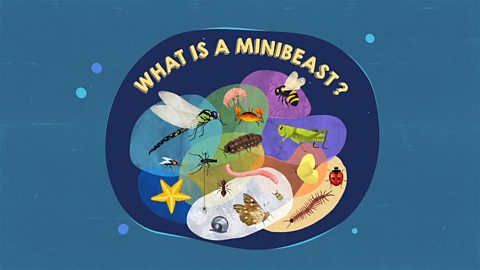
What is a minibeast? video
Identifying the characteristics of small invertebrates, including snails and spiders.
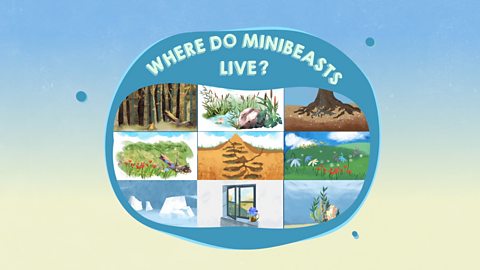
Where do minibeasts live? video
Exploring the differing habitats that support a variety of minibeasts around the world.