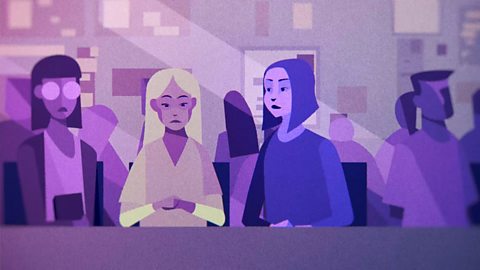
Eleanor:
My difficulty started around the age of 11, and the transition between primary and secondary school was a massive change for me. The workload, the change in friendship groups, the change in school environment, and my whole routine all changed at the same time. And that was quite stressful for me. I think that's when I started to feel I was losing control. I don't think it was conscious at first. I started restricting my food intake. I think one of the first things my parents noticed was, sort of, both how withdrawn I'd become from the family, but also my decreasing weight.
Eleanor:
I felt isolated from my family and my friends as well. My behaviours and my mood wasn't typical to that of my peers. I didn't feel enjoyment from going to school like I used to when I was younger. I wasn't getting out of bed most days. I wasn't making plans with my friends like I used to. And although I was achieving, it didn't feel good enough anymore. I wasn't enjoying things anymore, and I didn't relate to people.
Eleanor:
When you're in your glass box and it's all clouded up, no matter how many people might be on the other side, you can't see them. And you don't know they're there anymore. That's when I lost sight of the hope on the outside. 'Cause all I could see back at me was myself and how unhappy I'd become. And I didn't see myself ever changing. I felt I should be happy that people of my age didn't have a reason to feel depressed. But there's not always a reason.
Eleanor:
Before I was aware of my mental illness, I was in a group of quite sporty, quite popular people. I quickly lost the support of that group… 'cause I didn't fit their ideal of what a perfect 12, 13-year-old should look like.
Eleanor:
I engaged in CAMHS therapy. CAMHS stands for Children and Adolescents' Mental Health Service. I think I was struggling mainly with the isolation I felt from my peers.
Eleanor:
At my lowest point in my mood, when my suicidal ideations were at their worst, I would sneak out of my house without my parents knowing and stand at the side of this main road, often with the intention to really injure myself or even kill myself by jumping in front of a car or a moving vehicle. Sometimes, if I went on a walk, at my halfway point was a bridge over this main road. And a couple of times, I stood over the barrier. I was very close to jumping off the bridge and trying to end my life.
Eleanor:
When I highlighted that to my CAMHS therapist, that was what was flagged, and then I was admitted for my first depressive-related hospital admission.
Eleanor:
When I came back to school, I felt very closely scrutinised by a lot of my teachers, who were aware of my diagnosis of mental health conditions. I felt quite judged by them. Again, I felt put back in my glass box. I felt like they disregarded me and didn't offer me as much support because they didn't feel I had as much potential. I started to feel quite isolated again. It was the complete sense of just the mess of what was going on, and all my thoughts and all my feelings, and not being able to process. I couldn't label, right, I'm feeling anxious. Or, right, I'm feeling confused. I didn't… I'd lost that vocabulary. Everything was a complete disorganised jumble that wasn't what I was used to.
Eleanor:
Cognitive behavioural therapy was probably the best intervention that I engaged with throughout my ongoing recovery. Because it makes sense to me on a logical level. It explains to me how my emotions are linked with my behaviours, and how it links with my thought processes. So, seeing that really logical process to me was really really beneficial. And once I began to see little changes, I saw myself making bigger changes. And that really really helped me. So, I feel like I'm nearing a much brighter future for me and my mental health. And I hope that I can use my journey, especially sort of my darkest ages, to help inform others as part of that brighter future.
Video summary
Narrated in first person, this film explores what it can be like to battle with depression and suicidal thoughts and the effect it can have on your life.
Eleanor’s testimony is open and honest, and creates an intimate portrait into life at school when you are battling with your mental health.
She traces the root of her low mood to the change in her routine in the move from primary to secondary school and the feeling of losing control.
She felt isolated and began withdrawing further and further, until she couldn’t even see any help or hope on the other side.
She was alone with her depression.
Her mood dropped to the point where she was regularly having suicidal thoughts and couldn’t make sense of her emotions.
It was CBT (Cognitive Behavioural Therapy) which ultimately helped Eleanor the most, and so the film highlights some key forms of help which can be really useful for someone in that position, including her CAMHS (Child and Adolescent Mental Health Services) key workers.
Eleanor’s story touches on many issues that affect young people in the transition from primary to secondary school.
It really illuminates how a change like this can totally turn someone’s world upside-down.
From a new environment, to a heavy workload and new friends, changes can affect people very differently.
It also raises the issue of how hard it can be to try and function with a mental health problem when you are not receiving the right care.
The feelings can be hard to process, it can be hard to function, to see you friends, or even just get out of bed, you can even feel judged by others.
In this way, Eleanor’s story acts as a powerful lens into what this can be like.
Due to the sensitive nature of the subject matter, we strongly advise teacher viewing before watching with your pupils.
Teacher Notes
Key Stage 3
Eleanor’s glass box image is very powerful.
Pupils could be given the net of a cube.
On one side (which will be the inside where Eleanor was in her depression) pupils could write how she was feeling, i.e. the symptoms of depression. (They may need to research this first to extend their understanding from Eleanor’s experience).
She said she knew hope was on the outside of the box but it was clouded up and she could only see herself.
On the other side of the net (i.e. the outside) write or draw the good things you would like Eleanor to see if she were in the glass box.
What would you want to see in your future that gives you hope and motivation to look after your own health and wellbeing?
Pupils could then make the box and discuss how the depression has now been closed in.
Keeping feelings and depressive thoughts closed in like this will not allow the person to get through their mental illness.
Thoughts and feelings need to have ways to be expressed, so talking to someone you trust is a good start.
Being able to visualise positive, enjoyable, happy things in your future is a way to train the mind to be positive.
Eleanor talks about CBT.
Why not go into more detail about this, what the therapy does and discuss the benefits of this as a form of therapy.
Students could research into the local and national support available.
Key Stage 4
Students could try practising breathing techniques to help calm their minds in order to observe their thoughts as they arise.
If they can do this easily they are better able to recognise thoughts that can drag them down or trigger low mood or depression, press their own pause button and then change these thoughts for a different outcome.
Practise giving students a scenario, they identify the thoughts in one of the characters and speculate as to the emotions that the character may be feeling and what the consequences might be if this thoughts and feelings combination are allowed to continue.
This could be represented in a flow chart.
Can they suggest a different thought process that would trigger different emotions and lead to more positive consequences/outcomes? A new flow chart.
Students could explore/research the extent and causes of depression and how broad these can be.
Look into the symptoms of depression and the signs you might spot in yourself or others.
This short film is suitable for teaching PSHE at KS3 and GCSE in England, Wales and Northern Ireland and Modern Studies at National 4 and 5 in Scotland.
Dealing with an eating disorder - Jack's Story. video
Jack’s story explores what it can be like to battle with an eating disorder in school.
Addiction - Chloe's Story. video
Chloe’s story explores how neglect and abuse led to an addiction to drugs.
The effect of being bullied - Ryan's Story. video
Ryan’s story explores how being bullied at school and feeling alone in his family triggered serious problems with his mental health.
Anxiety - Aneeka and Sam's Story. video
Aneeka and Sam’s story explores what it is like when you are battling anxiety and the different reasons it can develop.
Self-harm - India's Story. video
India’s story explores what it can be like to battle with severe anxiety and self-harm.