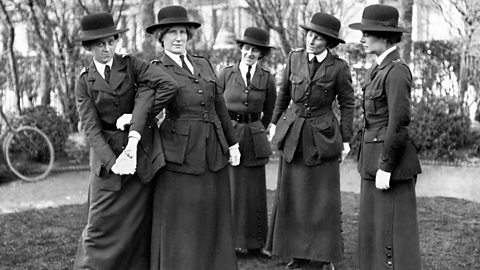
As the 1st World War neared its end, women were involved in almost every area of life on the Home Front. But Britain’s women were still denied the right to vote.
The very issue that sat at the heart of the Suffragettes’ campaigning.
Deep within the all-male Parliament, there existed a place which epitomised the status of women in public life: the Ladies’ Gallery.
The original Ladies’ Gallery was destroyed by bombing in the Second World War, but today’s press gallery occupies a similar position.
It was a cramped space; hot and stuffy. And there was a metal lattice grille which obstructed the view of the House of Commons below. Though it was originally installed so that the men below would not be distracted by the ladies above. The Suffragettes regarded it as a symbolic cage, which separated them from the business of politics.
In 1908 Suffrage Campaigners padlocked themselves to the gallery’s grille in protest at their exclusion from parliament. The grille was removed with the women still attached. After their release it was immediately reinstalled and there it remained, physically and symbolically excluding women from the world of politics.
Before the war, Winston Churchill argued that “women are well represented by their fathers, brothers and husbands”.
But many of those men were overseas now and potentially ineligible to vote. The Government contemplated changing the law on voting qualifications.
And the suffrage campaigners scented a chance to press their case to include women.
The new Prime Minister was David Lloyd George. He offered a more sympathetic ear to the campaigners – no-one knew better what invaluable work they’d done in the factories. Emmeline Pankhurst was pragmatic. She urged him to speed the legislation and said “whatever can be passed in war circumstances, we are ready to accept”.
On the 19th of June 1917, the Ladies’ Gallery was packed with women eager to hear the Commons debating a new bill:The Representation of the People.
Even the most optimistic couldn’t have predicted the outcome of the vote…
55 against. 385 in favour.
The tide had finally turned.
The Representation of the People Act became law in 1918.
It granted the vote to women over thirty who were householders or the wives of householders, or graduates.
The First World War had delivered a partial victory for Britain’s women.
There’s no escaping the fact that MPs saw the vote for women as a prize rather than a right.
As one woman put it, “Rather like a biscuit given to a performing dog that has just done its tricks particularly well." The majority of the women who worked in the factories were under thirty and not householders, so they remained without a vote.
One reminder of that tumultuous time is hidden away in the basement of the Houses of Parliament.
A few weeks after the vote, the notorious grille which had caged in women in the Ladies Gallery was quietly removed.
Here’s a section of it – a symbol of the struggle by women to achieve their rights.
Video summary
Kate Adie shows how women won the right to vote in 1918.
David Lloyd George, as the newly appointed Prime Minister, was a sympathetic ear towards the Suffragette’s campaign for equality; as many of the voters were away at war it allowed women to state their case.
The Representation Act is explained, while the Ladies Gallery in Parliament is shown as an illustrative symbol of the oppression that women faced.
Teacher Notes
Could be used to begin a concluding debate or research about how far women had really progressed in society during World War One.
This clip will be relevant for teaching History at KS3, KS4/GCSE, in England and Wales and Northern Ireland.
Also at Third Level, Fourth Level, National 4 and National 5 in Scotland.
This topic appears in OCR, Edexcel, AQA, WJEC, CCEA GCSE and SQA.
How the suffragette movement changed at the start of WW1. video
Kate Adie examines how the suffragette movement shifted focus at the outbreak of World War One.
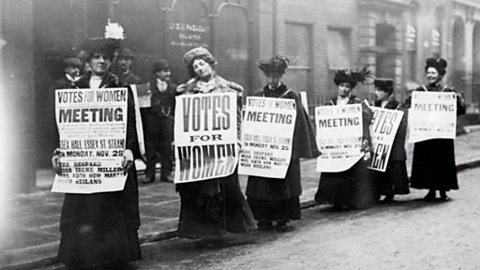
How women joined the war effort in World War One. video
Kate Adie explores how women of all classes joined the workforce overseas and on the Home Front.
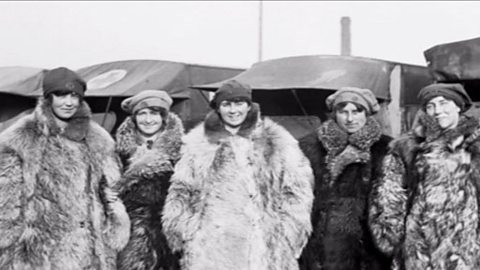
How women's football thrived in World War One. video
Kate Adie explains how women's football teams, such as The Blyth Spartans and star player Bella Raey, thrived in WW1.
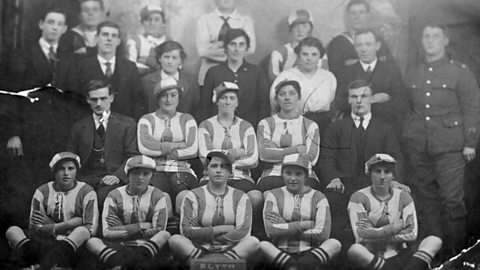
Women in medicine and health in World War One. video
Kate Adie explains how women staffed the medical services and broke down social attitudes during WW1.
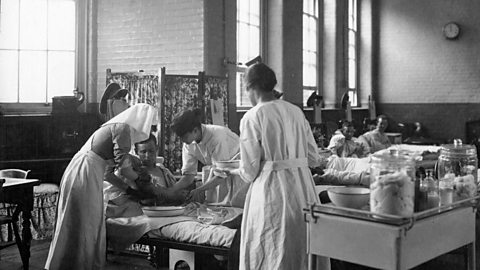
The rise of the girls' night and the first women's police force in WW1. video
Kate Adie explains the story of Margaret Damer Dawson, the Women's Police Service and the rise of the girls' night out in WW1.