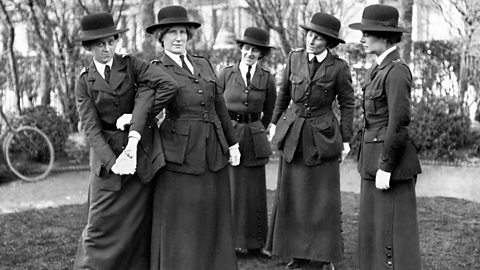
To be a woman in 1914 in Britain, your life was defined more by what you couldn’t do than what you could.
You couldn’t read the lesson, you couldn’t preach in church, certainly not in the pulpit. Indeed, you couldn’t hand out the hymnbooks, take the collection. Or even ring the bells.
Away from church, if you spoke about women’s rights in public, you were likely to be jeered, or have stones thrown at you – not for what you said, but for having the temerity to speak in public. If you were arrested, it would be by a man.
All police officers were male.
Into court, the lawyers, the jury, the judge, all were men.
It remained very much a man’s world.
For over a decade, women’s suffrage campaigners had battled to overturn this man’s world. They argued nothing could change in women’s lives until they were given the right to vote in parliamentary elections.
Women engaged in campaigns of protest and violence. They endured imprisonment and hunger strikes, to force the men in Government to back down.
Nothing, it seemed, would stop the suffragettes until women had the vote.
But then Germany invaded Belgium…
When war was declared in August 1914, the suffrage campaigners were faced with a quandary.
Should they support the men in Government, their sworn enemy, and suspend their campaign for the vote? Something which a few months earlier would’ve seemed unthinkable.
The Militant Suffragette Organisation was the women’s social and political union led by Emmeline Pankhurst and her daughter Cristabel.
Its motto - ‘Deeds not Words’.
They saw violent action as a necessity and the resorted to bombings and arson to get their case heard. Many spent time in prison and were subjected to brutal treatment and force feeding in response to their angry demands to vote.
Then the declaration of war intervened, Emmeline Pankhurst wasted no time coming to a decision. Within days of war being declared, she suspended their campaign of militancy with immediate effect.
The suffrage campaigners showed their new patriotic commitment by renaming their newspaper: ‘The Suffragette’ became ‘Britannia’. And it bore a new motto – instead of ‘Deeds not Words’, it was now: ‘For King, For Country, For Freedom’.
What is the point of fighting for the vote asked Mrs Pankhurst if we have not got a country to vote in. She was a pragmatist. Her message to her supporters was clear, it was time to transfer their energies to the national cause.
Video summary
Looking at the position of women in pre-war Britain and the suffrage campaign, this is a scene setting, context establishing piece.
The start of World War I brought about great social changes for Britain across all the classes; working class women had paid opportunities to work in the factories, while middle class women joined the Women’s Volunteer Reserve.
Kate Adie explores these changes from the women’s perspective, but also the men’s.
There are some upsetting scenes in this clip. Teacher review recommended prior to use in class.
Teacher Notes
The class could be spilt into groups and take part in a role play activity.
One to support a continuation of civil disobedience. A second to advocate suspending the action and support the government.
A third to represent the government’s efforts to convince the suffragettes to help.
The non-performers can be the public and vote for the most convincing arguments.
This clip will be relevant for teaching History at KS3, KS4/GCSE, in England and Wales and Northern Ireland.
Also at 3rd Level, Fourth Level, National 4 and National 5 in Scotland.
This topic appears in OCR, Edexcel, AQA, WJEC, CCEA GCSE and SQA.
How the first women gained the right to vote in 1918. video
Kate Adie discovers how the Representation Act gave some women the right to vote at the end of Word War One.
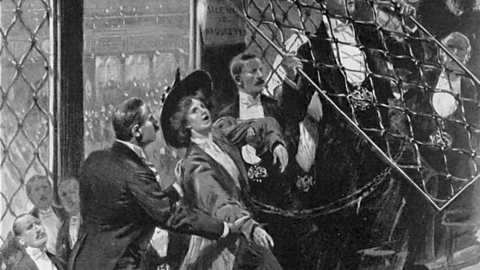
How women joined the war effort in World War One. video
Kate Adie explores how women of all classes joined the workforce overseas and on the Home Front.
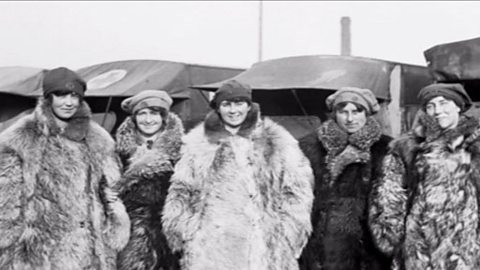
How women's football thrived in World War One. video
Kate Adie explains how women's football teams, such as The Blyth Spartans and star player Bella Raey, thrived in WW1.
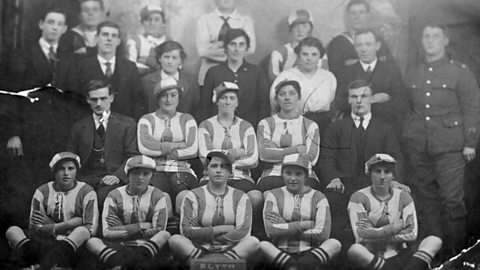
Women in medicine and health in World War One. video
Kate Adie explains how women staffed the medical services and broke down social attitudes during WW1.
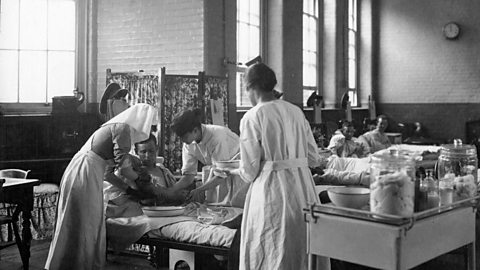
The rise of the girls' night and the first women's police force in WW1. video
Kate Adie explains the story of Margaret Damer Dawson, the Women's Police Service and the rise of the girls' night out in WW1.