During the 1st World War many working class women had their first taste of social freedom, instead of being at home under father’s watchful eye they discovered the forerunner of girls' night out.
The press went into overdrive, with stories of “giddy factory girls” frittering money in pubs with men.
The Aberdeen Journal reported that they had “More money in their hands than usual, and there were only too many ready to help them to spend it in the wrong way.”
The Munitionettes were experiencing a liberation they hadn’t expected. They were aping their betters – out and about, with a little money to spend. Traditionalists were outraged. Not for the first time in the war, there was a bout of moral panic. Women were getting out of control.
More worldy-wise women, such as Margaret Damer Dawson, set out to protect women, as well as cautioning their behaviour.
Dawson approached the Commissioner of Police in London for permission to create a voluntary body of trained and uniformed police women.
He declared himself “not at all averse to the idea”, as long as they remained separate from his force. The result was the foundation of Britain’s first Women’s Police Service, the WPS.
Margaret Damer Dawson was a tough character. Her friends called her ‘Fighting Dawson’.
Her first recruits were mainly educated middle-class women, trained in first aid and a little ju-jitsu. But they faced a battle to be taken seriously by the men. When one male police officer when asked if women would ever be police constables, he laughed and said “No, not if the war lasts fifty years”.
The WPS were not granted the power of arrest, and were expected to deal solely with women and children.
Most male constables thought that Dawson’s “Copperettes”, as the Sussex Times called them, should be deployed only to protect Britain’s men from the temptations of women.
Dawson’s patrols were not popular with the women they policed.
One fourteen year old girl said she’d been told off for crimping her hair, and “dressing up and walking about in order to attract the attention of men”.
Many men disliked having to deal with women. Especially in the factories, where huge numbers now worked making munitions.
Many of the women were rowdy and tough. When disputes arose, managers, more used to obedient wives and daughters,had no idea what to do.
The Prime Minister David Lloyd George turned to Margaret Damer Dawson’s women police.
He deployed nearly a thousand of them to keep order in the munitions factories.
Policewoman Gabrielle West kept a diary, describing her experiences.
Her initial impressions of the workers at the Pembrey Munitions Factory in South Wales were not favorable: “They are full ofsocialistic theory & very great on getting up strikes. But they are easily influenced by a little oratory, & go back to work like lambs when you shout at them long enough. Rather than being a social leveler as it’s often portrayed, life in the munitions factories relied on the class system to maintain law and order."
Within weeks of the war ending, the Metropolitan Police announced plans to train women to become paid constables for the first time. What followed was humiliation for Margaret Damer Dawson. Her well trained and capable volunteers were rejected as candidates – resented by male constables as too well educated and confident.
As a final blow, Dawson was ordered to wind down the WPS.
Margaret Damer Dawson died in 1920, aged 45, of a heart attack, it was said brought on by the hostility she faced from the male police establishment. She’d tried so hard to gain acceptance.
Just before she died, she got to the heart of the problem of policing women: “In the realm of morals”, she said, “we have not advanced beyond Adam and Eve”.
Video summary
Kate Adie explores the creation of the first police service for women, the Women Police Service (WPS), setup by the formidable Margaret Damer Dawson.
From keeping order of women who had found freedom during the war with absent male chaperones, to disciplining the munitions factories, the WPS, created huge societal change, which culminated in the rejection and discouragement of female police officers once the war was over.
The conflict between the existing male police establishment and the new female version is considered by Adie.
Teacher Notes
Pupils could draft a set of rules and guidance for the new female police force based on the evidence provided.
For instance, who they will be targeting and who they cannot arrest. How they will work with the existing male service and so on.
This clip will be relevant for teaching History at KS3, KS4/GCSE, in England and Wales and Northern Ireland.
Also at Third Level, Fourth Level, National 4 and National 5 in Scotland.
This topic appears in OCR, Edexcel, AQA, WJEC, CCEA GCSE and SQA.
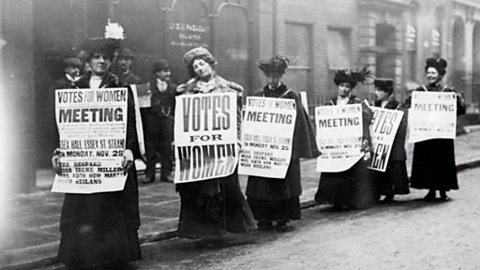
How the suffragette movement changed at the start of WW1. video
Kate Adie examines how the suffragette movement shifted focus at the outbreak of World War One.
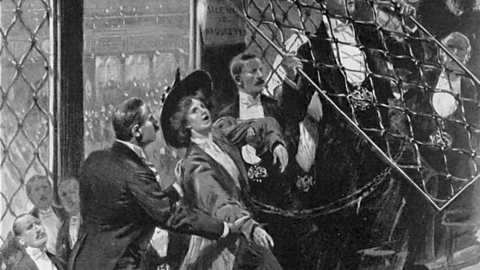
How the first women gained the right to vote in 1918. video
Kate Adie discovers how the Representation Act gave some women the right to vote at the end of Word War One.
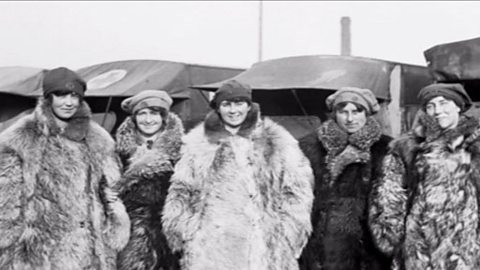
How women joined the war effort in World War One. video
Kate Adie explores how women of all classes joined the workforce overseas and on the Home Front.
How women's football thrived in World War One. video
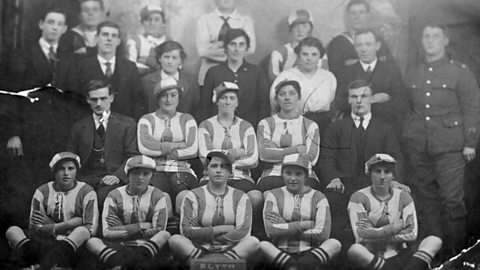
Kate Adie explains how women's football teams, such as The Blyth Spartans and star player Bella Raey, thrived in WW1.
Women in medicine and health in World War One. video
Kate Adie explains how women staffed the medical services and broke down social attitudes during WW1.