BRASS BAND MUSIC
NARRATOR:'During the Second World War coal production was crucial to the war effort.
NARRATOR:'High demand continued after the war. When coal supplied both Britain's re-emerging industries and people's homes.
NARRATOR:'In 1947 when the Labour government nationalised 800 private coal companies to create a state-owned industry.
NARRATOR:'Miners hoped they'd finally be safer better paid and more secure in their jobs.
NARRATOR:'But the boom wasn't to last.
NARRATOR:'The 1960's saw the start of the gradual shut down of Britain's mining industry.'
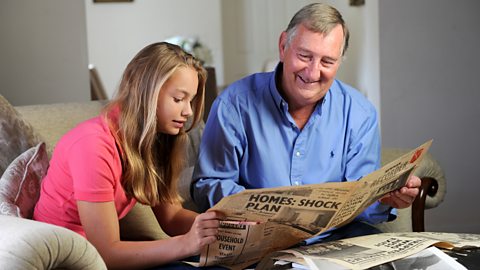
NARRATOR:'15 year old Sophie from York has a particular reason to want to know about this boom and later decline.'
SOPHIE:My grandpa Roger Hampson was an industrial artist in the post war period. Painting pits and mills.
SOPHIE:I'm interested to find out more about what was inspiring his work. And what happened to the pits after he finished painting.
NARRATOR:'Roger Hampson is part of the Northern School of British Painters.
NARRATOR:'Who were inspired by L. S. Lowry.
NARRATOR:'He captured a way of life that by the 1960's was slowly dying.
NARRATOR:'Sophie never knew her grandad. So she's meeting art historian Peter Davies, who did.'
SOPHIE:How was he affected by the area that he grew up in?
PETER DAVIES:When you look at the artists from this area who were all working after the war.
PETER DAVIES:In the shadow of L. S. Lowry they were all perused that industrial landscape as a theme. Because it was true to them, it's what they'd grown up with and you know it was the immediate environment.
PETER DAVIES:And despite the kind of poverty there was a kind of beauty there, you know a wild beauty. This kind of amazing industrial architecture.
PETER DAVIES:Of the colliery and the structure silhouetted against the sky. It's almost like an industrial cathedral.
SOPHIE:He defiantly has a strong connection and respect for the miners and the industry that’s happening at the time I'd say.
SOPHIE:Do you think these paintings are good at reminding people of a time like that then, in the 20th Century?
PETER DAVIES:I think his very faithful, documentary recording of the visual beauty of this environment and the people that were conditioned by that environment.
NARRATOR:'Sophie's come to Tyldesley. A former cotton and mining town. Where her grandad was born.
NARRATOR:'She's visiting Burt Willcocks who first went down a mine in 1951, at her age.'
MUMMBLED SPEECH
BURT:A yard high. That high.
BURT:You were on your shoulder.
BURT:And you had ten yards of that to get out.
NARRATOR:'When Burt worked underground controlled explosions were used to extract coal from the scene.'
BURT:I used to go in, make myself as small as a mouse.
BURT:It would fall.
EXPLOSION NOISE
BURT:And it would nearly blow your face.
BURT:Terrible and I'd dream about that yet.
BURT:And wake up sweating.
BURT:That was a miner.
NARRATOR:'Burt left mining in 1962. Shortly after, the local pits began to close.'
SOPHIE:So how's it different now in Tyldesley to how it was?
BURT:It was a really nice place.
BURT:It's a shame really Tyldesley, everybody knowed one another.
BURT:If you worked down the colliery you'd knew everybody. If there were 500 people you'd probably knew them all.
BURT:You know because you saw them every day you went down the shaft with them then everybody would come up the shaft every day.
MINERS TALKING
BURT:You know like you go in a pub… Any pub you went to "Aye, aye, aye. Burt yep? Having a drink? Yes."
BURT:You were made welcome. Even strangers were made welcome.
BURT:There's not now, because nobody goes out.
BURT:Every clubs closed.
BURT:Even Tory club's closed.
NARRATOR:'Since Roger Hampson's day all the mines and cotton mills have gone. Along with the communities that surrounded them.'
BURT:You could stand in the middle of my allotment and count about 23 big tall chimneys.
BURT:There were factories, coal mines, engineering break works, the lot.
BURT:What is there today? Nothing. Only trees and grass.
SOPHIE:Would you rather be surrounded by factories then?
BURT:No!
BURT:I'd rather be surrounded by people working.
NARRATOR:'Sophie wants to find out whether the experience in the northern mining communities is typical.
NARRATOR:'She meets with historian, Selina Todd.'
SELINA TODD:For people in the 1950's looking back to the 1930's. The 30's were a decade of poverty of mass unemployment of hunger, of uncertainty.
SELINA TODD:And the 1950's and the 1960's, in contrast to that, were a period of great prosperity.
SELINA TODD:That said, life didn't change all that much for everybody. And the kinds of improvements that McMillians speech was alluding to and all the, "Never had it to good.", the kind of images of the motor car for every family and new fashions and so on.
SELINA TODD:Many of those innovations were confined to towns and cities in South East England.
SELINA TODD:When then as now were far more prosperous than the cities and towns in the north. That were reliant on old industries like coal.
SELINA TODD:So it was certainly still a very divided country in the 1950's and 1960's.
NARRATOR:'A few miles from Tyldesley was the Astley Green Colliery.
NARRATOR:'The workforce fought to keep the pit open but found it impossible to meet the production targetsimposed by the national coal board. And it was eventually closed.
NARRATOR:'Sophie's speaking to mechanic Cliff Graham. Who serviced the steam engine which produced the power that brought the coal and men up from the ground.'
SOPHIE:So I've got a picture with me of my grandpa and he's actually drawing the colliery and the caption says that, "It's under threat of being closed" so do you remember when this was?
CLIFF:1969.
CLIFF:They were closing it in the end of 1969 but we were on reprieve for six months. On a target that we couldn't reach so they closed it in 1970.
SOPHIE:What exactly was it that you did working here at the mine?
CLIFF:I was a colliery mechanic I used to service all the machinery on the service on the ground.
CLIFF:Half of the colliers in the Manchester area would sell steam.
CLIFF:I still love steam.
SOPHIE:Was it a good job did you–
CLIFF:I thought it was, it was interesting. There was always a variety and you were never in the same place twice. And I used to like it.
NARRATOR:'Most of the local mines were closed in the 60's and 70's.
NARRATOR:'Dr Stephen Catterall has researched the reasons behind the closures in South Lancashire.'
SOPHIE:The colliery was closed because it didn’t make its targets do you think this was the right decision to make?
DR STEPHEN CATTERALL:I think that the government could have done a lot more in the 1950's and 60's than they did.
DR STEPHEN CATTERALL:The government was wedded to two ideas. One was for mines to be profitable and also this idea of modernisation was never fulfilled in these areas.
DR STEPHEN CATTERALL:So it talked about putting industry into this area. Both parties did both, Labour and Conservative but it never actually came to fruition it never happened.
NARRATOR:'So with coal production declining Britain was reliant on imported oil.
NARRATOR:'This left the UK vulnerable when oil producing countries greatly increased the cost of oil in 1974.'
SELINA TODD:By the 1970's that idea of, "We've never had it so good." begins to fall apart completely.
SELINA TODD:Overseas competition becomes a much bigger factor. Countries like Germany are forging ahead.
SELINA TODD:And so when the crunch came in the early 1970's There was really nothing for British industry to fall back on because they hadn't really undertaken any innovation.
SELINA TODD:And British industry, ordinary British workers really suffer as a result.
SOPHIE:There was such a strong community there and they all did lots of things together and even though I wasn’t there at the time just from speaking to people who were you really do feel that sense of community.
SOPHIE:From going to the places my grandpa lived and seeing what he saw I feel like I can relate more with his painting and see why he chose to paint certain streets and certain subjects,
SOPHIE:how the industry closing down affected the miners and the community around here and it's not something I'd learnt before.
HORN MUISIC
Video summary
Fifteen-year-old Sophie follows in the footsteps of of her grandfather Roger Hampson, who drew pictures of the mining communities in the north of England in the 1960s.
He was one of the Northern School of British painters, who followed the work of LS Lowry in capturing the day-to-day life of the industrial landscapes surrounding them.
We see many of his paintings, and hear how the post-war mining boom was beginning to decline by the start of the 1960s.
Sophie meets miner Bert Wilcox in her grandfather’s home town of Tyldesley near Wigan, who tells her about the danger of the explosions underground, but also the intense sense of community of those times.
He explains how the industrial landscape of his youth - mines, cotton mills and brickworks - has completely disappeared, along with the jobs.
Dr Selina Scott from Oxford University quotes Prime Minister Harold Macmillan in 1957 when he said “We’ve never had it so good” about the British economy.
She qualifies the comparative wealth of the 50s and 60s by saying it mainly affected the South-East of the country.
By the early 1970s, international competition meant British industry and British workers were suffering. Sophie talks to a former mechanic at Astley Colliery who talks about its closure in 1970 due to a failure to meet impossible targets.
Teacher Notes
This could be used to set up a discussion based around coal mining and the differences between 1960s Britain and modern Britain.
Students could write a postcard from the 1960s explaining what life was really like.
This short film is relevant for teaching history at Key Stage 3 and Key Stage 4 / GCSE in England, Wales and Northern Ireland and National 3, 4 and 5 in Scotland.
Some of the social issues highlighted could also be relevant for teacher Citizenship, PSHE or Modern Studies.
The Foundation of the National Health Service. video
Teenager Kirsty finds out about life before and after the foundation of the National Health Service by talking to her grandmother and a group of nurses from the time.
Teenagers and Mod Culture in the 1960s. video
Teenager Mitchell talks to his grandmother Jacki and other Mods about being young in the 1960s and being part of the Modernist youth movement.
Poverty and overcrowding in London’s East End. video
Teenager Nicole talks to her grandfather about the photos he took of poverty and overcrowding in the East End in his work as a newspaper photographer in the 1960s.