CLASSICAL PIANO MUSIC
NARRATOR:'In the 1960's people in the East end of London were still living with the consequences of the Second World War.
NARRATOR:'The East End had been badly bombed because the port of London handled most of the goods that came in and out of the country.
NARRATOR:'By the 1960's much of the bomb damage had yet to be cleared. And thousands of families struggled in substandard housing.
NARRATOR:'15 year old Nicole has a special reason to want to know more about the area.'
NICOLE:My Grandfather grew up in the East End of London. He became a photographer and I'd like to find out a bit more about his job and the history of the East End of London.
NARRATOR:'Nicole's Grandad Steve worked as a photographer on the Ilford Recorder.
NARRATOR:'In those days thriving local newspapers, like the Recorder, campaigned for social change.'
NICOLE:So what sort of things were happening at that time that you found interesting?
STEVE:Obviously being in the East End of London there was a lot of what we'd call "hard news".
STEVE:There were bank robberies there were murders there were all sorts of things like that.
STEVE:Although you weren’t working on a national newspaper some of the stories we did were very hard-hitting.
STEVE:Housing was a big problem.
STEVE:It says here that there were "23 men, women and children were living In that one house".
STEVE:The headline: "Close Down These Awful Homes". That’s what we were trying to get them to do.
STEVE:This lady here, picture with her five children in the bedroom. She has to share with three of them.
STEVE:And she's hoping to be rehoused. Now that particular place we actually got that closed down.
STEVE:We did the last families that were living in Nissen Huts. They'd been built by the Italian prisoners of war.
NARRATOR:'Nissen Huts were temporary homes made from corrugated iron sheets.'
STEVE:Could you imagine a bomb hitting your row of houses and then the council coming along and they put you in a Nissen Hut?
STEVE:Saying that you were only going to be there for a short time. 25 years later, these people were still living in there.
STEVE:And this was an area we were always going back to in West Ham, called Manor Row buildings.
STEVE:We were trying to show there that these families they're trapped families. Who just exist because there was just nowhere for them to go.
STEVE:And right next to there… Was this bomb site and that was their playing area.
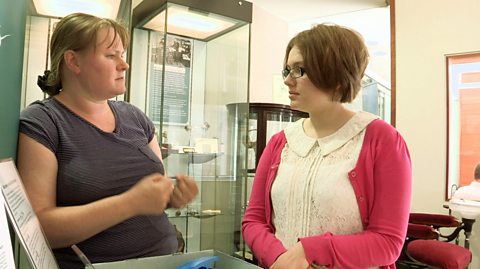
NARRATOR:'Nicole has come to speak to Ann and her daughter Debbie. Who were photographed by Steve in 1968. When Debbie was just four years old.
NARRATOR:'They still live in the East End.'
NICOLE:What jobs did you and your husband have?
ANN:My husband worked down the dock. It's The Royal Albert Dock.
ANN:And you could only get in the docks if it ran through the family. Because you had to have a dockers card to get a job in there.
ANN:Everyone in this area of sort of East London All the men were dockers. They used to have to stand on the cobbles early in the morning and wait to be called out.
DEBBIE:And if you weren’t called you didn’t get no work.
ANN:Didn’t get no work.
DEBBIE:You know, that's how it worked.
NARRATOR:'Employment in Britain's ports was casualised. Which meant workers were employed on a daily basis.
NARRATOR:'And dockers received no compensation for industrial accidents or death at work.'
DEBBIE:They thought that was unfair so he set up what they call like a distress fund for the dockers. So everyone was entitled to it and my dad done that for years and years.
ANN:It was a close community the dockers Deb wasn't it? All the dockers always stuck together.
NICOLE:Can you remember what you said this day?
ANN:No, not really. What did I say?
NICOLE:It says here that you said "How can you bring up kids properly in a dump like this?"
ANN:Did I really?
ANN:Is that what I said?
ANN:Well it was rough round there Debbie, wasn’t it?
DEBBIE:Yeah it was rough but as kids we enjoyed it.
NOISY CHILDREN PLAYING
DEBBIE:Downstairs was the back yard where everyone…
DEBBIE:Hanged their clothes but we used to play down there.
DEBBIE:We used to have ropes hanging from the balcony so we could swing at the bottom. We used to play Tim-Tam-Tommy that was with an old tin. We used to find old matrices and pile them up?
DEBBIE:And we used to jump from the shed onto the mattresses. And do summersaults.
DEBBIE:We used to play in derelict cars there was always dumped cars.
DEBBIE:We made our own play.
NARRATOR:'Ann had a job as a barmaid and was able to leave the children with her neighbour.'
DEBBIE:And that was our next door neighbour Hazel.
ANN:They used to run in and out of her house. Hazel sort of looked after you's didn’t she?
DEBBIE:Yeah.
ANN:When I was at work I didn’t just leave them, go out and leave them.
DEBBIE:Hazel, Hazel was the main one that used to look out for us. If we wanted anything we'd go to her. She used to give us something to eat and drink and you know.
DEBBIE:If we happened to fall over or hurt ourselves or anything she was there.
DEBBIE:She was our mum while our mum was at work.
DEBBIE:The only ones that were overcrowded was with people that had loads of kids.
DEBBIE:So obviously they felt they was overcrowded and it weren’t fit enough for them to live in but we lived fine.
DEBBIE:I mean I remember our house being nice it was always nice and clean. You was a very clean person but then you had the families that weren’t. But they were the families with loads of kids.
CLASSICAL PIANO MUSIC
NARRATOR:'Nicole wants to know more about the campaigning role of local papers. And has come to meet hes grandad's colleague.
NARRATOR:'Former news editor, Jeff Compton to find out more.
NARRATOR:'Jeff was born in West Ham. Where half the houses, including his own, were bombed.'
JEFF:This was probably the most pressing issue. It's one we return to week after week. We were constantly beating the drum for better accommodation.
JEFF:For action by the local authority to do more of course their hands were tied.
JEFF:Because they in turn were receiving money from the government and although Britain was on the winning side in the war the country was pretty broke.
NICOLE:Ann who I met who lived in one of these flats it says that she said that the place was really bad. But when we asked her about this, she actually told me that housing was actually alright.
JEFF:Well this particular building, Manor Row buildings they had a very bad reputation. I mean they were fairly poor these families. Had very little of anything.
JEFF:The accommodation itself probably wasn't that bad.
JEFF:But there was a kind of stigma attached to actually being there.
NICOLE:Ann talked a lot about the docks.
NICOLE:She mentioned that you wouldn't know if you were going to get a job.
JEFF:No.
NICOLE:You'd que up… And they'd pick people for the job?
JEFF:That’s right and my grandfather was one of those men.
JEFF:It was a very, very tough system they used to call it "the lump".
JEFF:And men would actually turn up in the morning. They form a crowd and the overseer would come out and he would say "Right I want you, you, you and you".
JEFF:And the rest you can go home. So there was this terrible, terrible uncertainty you know.
JEFF:The families at home wouldn’t know whether their father, husband was going to bring home a wage that day. Or that week, it was a very precarious existence.
JEFF:The conditions in the docks were very, very hard.
JEFF:Men worked manually they did very, very long hours lifting very, very heavy weights. There wasn’t very much attention to their safety, their health.
JEFF:So it was a very, very tough life.
JEFF:As a result of this there was a lot of union activity in the docks.
JEFF:There was lots of disputes.
JEFF:There was a famous union leader called Jack Dash who I spoke to on many, many occasions.
JEFF:Who was really fighting for better conditions for the working man in the docks.
JEFF:This didn’t make him very popular with the government.
JEFF:But he was certainly a champion of ordinary working men.
NICOLE:The things I found out from my grandad and Jeff were more negative things about the East End. Like the poor housing conditions and bad conditions for the dockers.
NICOLE:Before I'd been told stuff like the "swinging sixties" and they made me think differently from that.
NICOLE:Ann and Debbie they told me a lot more positive things like helping out look after children for free.
NICOLE:Like setting up a dockers fund, just to help the community.
NICOLE:They are forgetting some of the negative things. But I do believe that the community was close and people did a lot of things for each other.
Video summary
Over archive footage, we hear how in the 1960s much of the bomb damage from the Second World War in the East End still hadn’t been cleared.
Teenager Nicole talks to her grandfather Steve, who took photos of poverty and overcrowding as part of a social change campaign for the Ilford Recorder local newspaper.
The photos show families living in overcrowded housing, people still living in temporary Nissen huts 25 years after the war ended, and children playing on bombsites.
Sophie meets Ann and Debbie, a mother and daughter featured in Steve’s photos.
They remember a strong sense of community, and we see images of the estate children playing together, and hear how neighbours pulled together to help each other.
Sophie meets a former local newspaper editor, who talks about the poor living conditions and the tough working conditions for dockers, who were on zero hours contracts with no compensation if they were injured and poor health and safety.
He recalls trade union activity at the time to try and improve the workers conditions.
Teacher Notes
This could be used to show the different types of historical source material: eyewitness testimony, newspaper articles, photographs and interviews.
This could also be used to set up a discussion on poverty in the UK.
This short film is relevant for teaching history at Key Stage 3 and Key Stage 4 / GCSE in England, Wales and Northern Ireland and National 3, 4 and 5 in Scotland.
Some of the social issues highlighted could also be relevant for teacher Citizenship, PSHE or Modern Studies.
The decline of the industrial North of England
Teenager Sophie follows in the footsteps of her grandfather Roger Hampson, who drew pictures of the mining communities in the north of England in the 1960’s.
Women in the workplace in the 1950s and 1960s. video
Teenager Amba talks to her grandmother about the job opportunities available to her and other women in post war Britain.
The Foundation of the National Health Service. video
Teenager Kirsty finds out about life before and after the foundation of the National Health Service by talking to her grandmother and a group of nurses from the time.