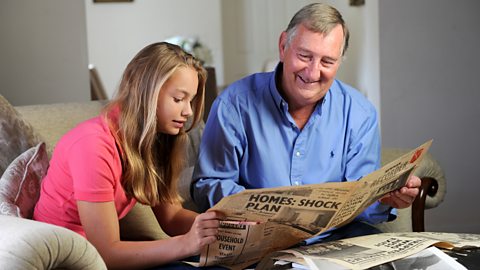
REPORTER:'On July 5th the new National Health Service starts. Providing Hospital and specialist services. Medicines drugs and appliances. Care of the teeth and eyes and maternity services.'
NARRATOR:'After the Second World War, Britain changed dramatically. And so did the lives of its people.
NARRATOR:'One of the most significant developments was a new National Health Service. Which began in 1948.
NARRATOR:'It meant that for the first time, anyone who was ill could be treated for free. And the health of the nation improved dramatically.'
NARRATOR:'15 year old Kirsty from High Wycombe has good reason to be grateful to the NHS.
NARRATOR:'It saved her life when she was rushed to hospital with suspected meningitis.'
KIRSTY:That made me realise quite how amazing the doctors were.
KIRSTY:So that's when I decided I wanted to be a doctor.
NARRATOR:'Kirsty wants to investigate what impact the NHS had on people's lives.
NARRATOR:'Sixty years ago Ilene, Kirsty's grandmother owed her life to the new service.'
ILENE:Oh this one is taken over at Peppard with my mother.
KIRSTY:To me you look quite healthy.
ILENE:Yeah, well I mean I don’t think I've ever looked Ill, when I am ill.
NARRATOR:'Back In 1952, although Ilene felt healthy She took up the offer of a free test.
NARRATOR:'By one of the new NHS mobile x-ray units. Set up across Britain to identify individuals who were sick.'
ILENE:They just took a small x-ray. About a couple of weeks later I had a letter saying would I attend the chest clinic at Wycombe Hospital.
ILENE:There was a shadow, on my right lung.
NARRATOR:'The x-ray revealed that Ilene had TB or Tuberculosis.
NARRATOR:'A highly contagious disease that was responsible for ten thousand deaths a year.
NARRATOR:'She was forced to spend the next six months in isolation in a sanitorium.
NARRATOR:'Many of the patients in these long term hospitals were children. Who ended up missing months or even years of school.
ILENE:Of course once the NHS came in where you didn’t have to worry about paying.
KIRSTY:So you're thankful, obviously.
ILENE:Yes I mean, I didn’t have any idea when I went. That um…
ILENE:There was anything wrong with me.
NARRATOR:'Kirsty's come to meet three former nurses who work for the new health service. To find out how the NHS changed Britain.'
ELIZABETH:Families were very poorly off because they used to save up for the doctor to come. There's no doubt about that.
ELIZABETH:Money was put on the shelf in the kitchen. Just in case the doctor had to be called.
JENNY:Prior to the health service you know some people sort of paid in kind rather than
JENNY:If they didn’t have the money, that sort of thing.
ELIZABETH:A dozen eggs or whatever they could afford vegetables for the garden. All came our way.
ELIZABETH:I think vast amounts of the population probably fell through the net. And were not treated.
ELIZABETH:And therefore, this was why Mr Attlee decided that really a national health service for all was the one thing that he strove to produce.
NARRATOR:'A new Labour Prime Minister, Clement Attlee and his government had established the NHS in the face of considerable opposition.
NARRATOR:'And It wasn't long before he too required treatment from the new service.'
JENNY:I nursed Clement Attlee in Amersham.
JENNY:He wouldn't go into side ward. He said, "Oh no I'm very pro the health service".
JENNY:This long 25 bedding Nightingale ward. He was about four beds down on the right, on this ward. Chatting to all the other people and so on.
JENNY:He felt very strongly that he had pioneered for the NHS. And he wanted to be like every other patient. And be treated like everybody else.
NARRATOR:'Kirsty wants to find out more about life before the NHS. And has come to see medical historian Dr Carole Reeves.'
KIRSTY:So what were people's health expectations?
DR CAROLE REEVES:Obviously people who had money and they
DR CAROLE REEVES:tended to be the upper class and the middle class people they didn’t have to worry too much about being ill.
DR CAROLE REEVES:Because they knew that they could always afford to pay for doctors or hospitals.
DR CAROLE REEVES:But if you were a working class person it was very different and your expectations generally were, quite low.
DR CAROLE REEVES:You didn’t expect to feel well all of the time. As soon as 1948 happened and the NHS happened all the patients who previously couldn’t afford to come to the doctors came and saw doctors or hospitals.
KIRSTY:So were people generally grateful?
DR CAROLE REEVES:Yes, hugely grateful.
NARRATOR:'But although patients welcomed the new health service Many of the doctors who were treating them were less enthusiastic.'
DR CAROLE REEVES:They thought that they wouldn't get paid as much money. Because all of their patients were private and they could pretty much charge what they liked. So that was something they didn’t want to lose.
DR CAROLE REEVES:And what the NHS said to them were let you keep your private patients and you can treat them in NHS hospitals.
DR CAROLE REEVES:And we'll just give you some salary but we won't stop youtreating private patients.
DR CAROLE REEVES:So they actually did very well out of it and what Aneurin Bevan said the Minister for Health at the time, he said, "He was going to choke their mouths with gold".
DR CAROLE REEVES:I order for them to agree to the National Health Service.
KIRSTY:Bit of a bribe?
DR CAROLE REEVES:A lot of a bribe.
NARRATOR:'The public now had access to all kinds of health professionals. Including doctors, opticians and dentists.
NARRATOR:'Kirsty's meeting Rachael Bearstone from the British Dental Association. To find out about the state of the nation's teeth in 1948.
RACHAEL BEARSTONE:This might be an extreme example but we can certainly say that peoples teeth were not in a good state.
BOTH:Not at all
RACHAEL BEARSTONE:The average… Person, could not access dental care prior to the NHS. I think you can say people weren’t smiling?
NARRATOR:'Ordinary people flocked to receive free dental treatment. And the system fought to catch up on the years of neglect. Starting with false teeth.
RACHAEL BEARSTONE:Basically in the first nine months of the NHS they're making 33 million sets.
LAUGHS
RACHAEL BEARSTONE:It's a lot!
KIRSTY:Yeah.
RACHAEL BEARSTONE:I mean I think from a service that set out to help mothers and children. And to carry out conservation of teeth that’s what they wanted to do that was their ideal.
RACHAEL BEARSTONE:Actually they ended up treating a back log if you like of a nation's awful teeth.
RACHAEL BEARSTONE:And so this really what made the NHS have to stop and say, we need to introduce charges.
RACHAEL BEARSTONE:There was always controversy if you like over how that was gonna work how dentists were paid. So these were the initial problems that the NHS had to face.
REPORTER:'It will be a long time before she'll need false teeth. Yet many children are among the people in Britain "nearly half the population who do wear false teeth".
NARRATOR:'Over the years, governments have introduced charges in the NHS. Including paying to see the dentist.
NARRATOR:'But the basic principle of the National Health Service, that you can go and see a doctor without paying whenever you are ill, remains.
It was a complete change of the way people thought about themselves and began to have much higher expectations of their health. They began to demand good health as their right. Which of course we all expect now.
KIRSTY:I thought it was very shocking that before the establishment of the NHS most people expected to be ill.
KIRSTY:I think the government realised that there was a big issue that needed to be sorted.
KIRSTY:I think the prime minster at the time was very enthusiastic. Pushed it through and so did Bevan.
KIRSTY:People today do criticise the NHS. But I think that they need to look at what happened before.
KIRSTY:Yes they do have to pay for it in taxes
KIRSTY:and it's not the quickest thing.
KIRSTY:But overall you're getting treated when you need to get treated.
KIRSTY:I really realise now quite how lucky grandma was. That she had TB after the NHS was established. She might not have been able to afford the treatment before the NHS.
KIRSTY:It's really made me want to fight. For being a doctor.
Video summary
A 15-year-old girl called Kirsty explores how the National Health Service was founded in 1948 and the effect it had on the health of British people.
She talks to her grandmother, who was diagnosed with tuberculosis following a routine NHS x-ray, and received free treatment that she would not otherwise have been able to afford.
Kirsty meets three nurses, who talk about health before the service was introduced, and how many people could not afford medical treatment. One of them recalls treating Prime Minister Clement Attlee in an NHS hospital.
Medical historian Dr Carole Reeves puts these memories into context, talking about the political difficulties of getting the NHS introduced, and the opposition from doctors at the time.
Kirsty then visits the British Dental Association, and finds out about the poor state of the nation's teeth at the time. The huge backlog in people needing dental treatment led to a charge for dentist appointments.
Teacher Notes
This clip could be used to set up a discussion about the NHS. Students could write a list of positive and negative points for having a national health service.
This short film is relevant for teaching history at Key Stage 3 and Key Stage 4 / GCSE in England, Wales and Northern Ireland and National 3, 4 and 5 in Scotland.
Some of the social issues highlighted could also be relevant for teacher Citizenship, PSHE or Modern Studies.
Women in the workplace in the 1950s and 1960s. video
Teenager Amba talks to her grandmother about the job opportunities available to her and other women in post war Britain.
The decline of the industrial North of England
Teenager Sophie follows in the footsteps of her grandfather Roger Hampson, who drew pictures of the mining communities in the north of England in the 1960’s.
Poverty and overcrowding in London’s East End. video
Teenager Nicole talks to her grandfather about the photos he took of poverty and overcrowding in the East End in his work as a newspaper photographer in the 1960s.