Although the war ended in 1945, it was still another nine years before rationing was stopped. For many young people, the austerity that had seeped into everyday life was stifling. By the late 50s, the majority of youngsters who'd left school at 15 had jobs and money in their pockets and were keen to break away from the conformity of the austerity years, forming a subculture known as Mod.
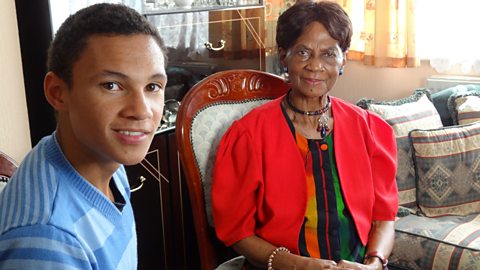
Mitchell is 15 and from Walsall near Birmingham. Two of his family were mods. Darts has always been his main sporting passion. His grandad was a great darts player but never actually went into it. It's pure skill, and if you're good, you'll win. His other passion is probably music, which has been passed down from his dad. Some of it has really sunk in on him and had a real impact on his life. He knows his nan was a mod in the '60s and would like to know about the original mods and find out more about them.
In the late 50s, groups of youngsters in London were influenced by modernist architecture, jazz, and Italian and French fashions. They started to call themselves modernists, later shortened to mod, as what began as an in-crowd cult developed into a mass movement. The original mod movement ran for about a decade until the late 60s.
Mitchell's Grandma Jackie was a Walsall mod and a regular at Bloxwich Baths dances where local bands played. She recalls the excitement of going to these events, where the atmosphere was electric, and everyone was dressed in the latest fashions. Jackie also remembers the hairstyles of the time, like the bob, which was popularized by Vidal Sassoon and Mary Quant.
Mitchell wants to know how Jackie, who left school at 15 with no qualifications, was able to finance this lifestyle. On leaving school, Jackie found work immediately in a local factory. For a time, she worked at the family-run Crabtree's, which employed thousands of local women making light switches. With a thriving post-war economy, unemployment nationally stood at just 1%, compared to over 8% today.
Mitchell's looking into the Wolverhampton Express and Star's archives to find out just how plentiful jobs were. He was initially sceptical but found pages and pages of job listings, showing that it was indeed possible to walk into a job any day you liked.
Next, Mitchell tracks down another Walsall mod, Dave, who travelled slightly further afield than Jackie. Dave worked as a warehouseman, doing a 42.5-hour week. He found the work monotonous but looked forward to the weekends when he could escape and enjoy mod culture. Dave bought his scooter in 66, which gave him independence and the freedom to travel.
Dave explains that being a mod was about being an individual and standing out from the crowd. He got into modernism around 65 and was particularly interested in the fashion. He would often travel to London to buy the latest clothes from places like Carnaby Street and Lord John. The mod movement was about expressing individuality through fashion and music.
Mitchell meets Professor Keith Gildart to find out what happened to the movement. Gildart explains that commercialisation played a crucial role in the development of the mod movement. As mod became more prominent in the media, it was used to sell products, which led some original mods to break away, feeling that it had lost its individuality.
Historians have different views on the impact of commercialisation on youth subcultures. Some argue that it sapped the rebellious energy of young people, while others believe that subcultures like mod provided an alternative education for those who felt failed by the traditional education system.
Mitchell reflects on how learning about mod culture has changed his perspective. He now sees older people, like his nan, as having had rich and interesting lives, full of experiences that shaped who they are today. He appreciates that his nan was part of something significant and national, which is an amazing legacy to have.
Video summary
Teenager Mitchell talks to his grandmother Jacki about the Mod culture she was a part of in the 1960s.
We hear how Modernism was a break away from austerity, and how the music and fashion were funded by the plentiful supply of cheap jobs available to young people without qualifications.
Jacki takes Mitchell to a dancehall she used to frequent, and describes her drastic bob-style hair and how her parents reacted to it.
Mitchell looks in archive newspapers, and sees the huge array of jobs on offer at this time of 1% unemployment.
He talks to warehouseman Dave about the scooter he bought with his earnings in 1966, the freedom it gave him and the trips he took to London to update his wardrobe on Carnaby Street.
We hear how the later commercialisation of Mod culture made some young people turn away from it.
Professor Keith Gildart University of Wolverhampton gives some academic theories about Modernism in the UK – that capitalism made youth rebellion less likely as they had more money, and could also have provided an alternative education to those who left school at 15.
Teacher Notes
This could be used to start a discussion about changing youth culture since this time.
This short film is relevant for teaching history at Key Stage 3 and Key Stage 4 / GCSE in England, Wales and Northern Ireland and National 3, 4 and 5 in Scotland.
Some of the social issues highlighted could also be relevant for teacher Citizenship, PSHE or Modern Studies.
Women in the workplace in the 1950s and 1960s. video
Teenager Amba talks to her grandmother about the job opportunities available to her and other women in post war Britain.
Poverty and overcrowding in London’s East End. video
Teenager Nicole talks to her grandfather about the photos he took of poverty and overcrowding in the East End in his work as a newspaper photographer in the 1960s.
Immigration to London from Ghana and Jamaica. video
Teenager Elliott talks to his grandfather about his first impressions of London as an immigrant from Ghana, and his grandmother about the racism they experienced because of their mixed race marriage.