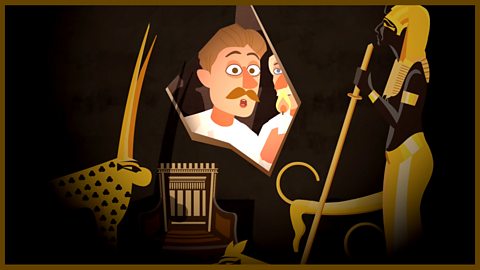
This story - based on fact - follows Hussein, a young water carrier working at Howard Carter's excavations in the Valley of the Kings in 1922.
Hussein: Welcome to The Valley of the Kings. In this valley archaeologists have found more than 60 tombs were Ancient Egyptian pharaohs and members of their royal families were buried.
The royal tombs are decorated with stories of Egyptian mythology that tell us about the beliefs of the people who lived here more than 3 000 years ago.
I'm Hussein and it's my job to bring water to the site of a new discovery in the middle of the valley.
The team are led by a British man called Howard Carter. They've uncovered a few small tombs before now. This latest one seems to be different.
They say it's the tomb of a pharaoh called Tutankhamun and it doesn't look like this one has been badly disturbed by robbers, so most of the precious items should still be inside.
There are rumours of a curse on this tomb, so I'm keeping my distance. But I was there the day they made a big discovery.
In fact, it was me that found it! I stumbled right on it!
That Saturday morning I arrived on site as normal and started to set up beside the first tent.
I always dig holes in the sand to make the water jars sit upright, but that day when I was brushing the sand away I noticed a stone that looked smooth and different from the other rocks around.
I ran to tell one of the workers and before I knew it Mr Carter was clearing the area and instructing his team.
It didn't take them long to uncover the full stone and realise that it stepped down to another one just like it.
I was staying back out of the way, but I heard them say it looked like the start of a staircase.
There was a lot of excitement as they discovered that the steps lead to the sealed entrance of a tomb and a door marked with the seal of King Tutankhamun.
From what I hear the first room was filled with rubble and broken pieces of jars and pots. But last Sunday they found a second sealed doorway inside the first chamber. Mr Carter himself made a small hole in the doorway and lifted his candle to look in.
It was as if everybody was holding their breath.
Not one sound could be heard until another British man called Lord Carnarvon broke the silence to ask Mr Carter if he could see anything…
Howard Carter: Yes wonderful things…wonderful things!
Hussein: This is as far as I go. Through there is where the pharaoh's mummy was found and I don't want to risk the curse.
Howard Carter: The team have just started the removal and cataloguing of the finds, which could take us many years as there might be as many as 5 000 items in here.
Hussein: That's a ushabti.
The pharaoh's tomb was full of these little statues. They would normally have been of a servant or farm worker.
Do you see the little tools they're holding? Well that's because Ancient Egyptians believed the statue would come to life in theafterworld and then do any work that was needed.
Here they come! I better get back to work!
Hussein - The Water Carrier
Video summary
This story follows 12-year-old Hussein, a water carrier working at Howard Carter's excavations in the ‘Valley of the Kings’ in 1922.
It tells us of Hussein’s role in discovering the tomb of King Tutankhamun. We hear how Hussein uncovered a stone which was the first of a number of steps leading to the entrance of the tomb.
Our character Hussein is based on the real-life figure Hussein Abdul-Rasoul. There is a photograph of Hussein wearing a necklace from Tutankhamun's tomb and in his diaries Carter wrote that the child had been chosen as the model for the photograph in recognition of his important role in the discovery of the tomb. Hussein maintained in later life that his contribution was to uncover the very first step leading to the tomb and, although Carter's diaries do not confirm this be the case, it has been widely accepted as most likely true.
We explore how exciting and important this particular discovery was. Hussein shows us inside the excavated tomb and tells us how it felt to be a part of such a special discovery which found the majority of items and artefacts untouched for 3000 years.
We learn about Howard Carter and his team and their dedication and persistence in uncovering this tomb and all its riches.
Pupils will gain an understanding of what it felt like to be involved in discovering this important tomb as well as practical information about what they uncovered during their excavation.
Teacher's Notes
This video helps pupils to explore the discovery of the tomb of King Tutankhamun from a different perspective. It tells the story through the eyes of a local 12-year-old boy who worked with the discovery team carrying their water.
As the video progresses it helps pupils to consider the roles of others within the story. The story highlights how all members of a team have a valuable role which contributes to the overall achievements.
This resource provides an opportunity for pupils to learn about the importance of historical sources and how these are used to help us to learn about the past.
After watching the animation there are opportunities to explore and develop creative writing, oracy, comprehension, capacity and measuring with activities based on life at the excavation site in 1922. They can also begin to explore through ‘Personal and Social Education’ the importance of a team and its members.
Points for discussion (History Linked)
- How did Hussein feel during his daily work?
- Do you think his thoughts and feelings changed when he discovered the tomb?
- How would you feel if you had been Hussein and made this discovery?
- Why was King Tutankhamen’s tomb so special?
- How many items did Howard Carter believe they had to catalogue from the tomb?
- What kind of things did they find in Tutankhamun’s tomb?
- Why are sources important to help us to find out about the past?
Suggested activities (Cross curricular opportunities):
Creative Writing – Development of a diary entry or journal as various characters from the clip. Pupils can take the role of Hussein, Howard Carter or others involved. Through their writing, they can explore how the characters felt, what happened during their time and the impact of the discoveries on them.
Role Play – Pupils to develop a role play activity to re-create the scenes from the animation taking the roles of various characters. Using freeze frames to explore the feelings and emotions of the characters in more detail throughout the performances.
Designing a Ushabti- Pupils to develop designs on a ushabti in the style that they found in King Tut’s tomb. Pupils to research Ancient Egyptian art and artefacts to encompass this into their work. Pupils can explain their designs orally to their peers.
Exploring Sources - Pupils to be presented with illustrations of various items from the excavation. (Photographs, artefacts, diary entries etc). They must match these to whether they are a visual, physical or written source.
Where is Egypt? - Pupils to use a base map of Egypt and atlases (pitched at the correct level) to plot key parts of Ancient Egypt (the River Nile, key cities, Valley of the Kings etc). Can pupils use coordinates to specify the location of these points correctly?
Volume and Capacity – Pupils are given a variety of images of measuring jugs, marked with varying scales. Can pupils add the waterline to show the amount that would be in each jug from the labels? Can the pupils convert the ml to litres. Could the pupils read scales from the jugs and note the volume of liquid contained in each jug? Could the pupils explore and compare units between ml and litres to find out which volumes are larger? Can they order jugs in terms of volume mixed between ml and litres?
This film is relevant for teaching History at KS2 in England, Wales and Northern Ireland and 2nd Level in Scotland.
Nanu - The Farm Girl. video
Nanu is 12 years old and works at home on the farm - but she longs to train as a doctor.
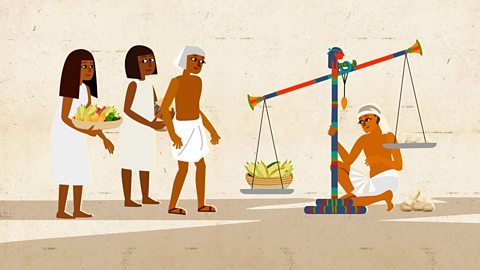
Society and culture. video
A deben weight is the historical artefact leading to an exploration of Society and culture.
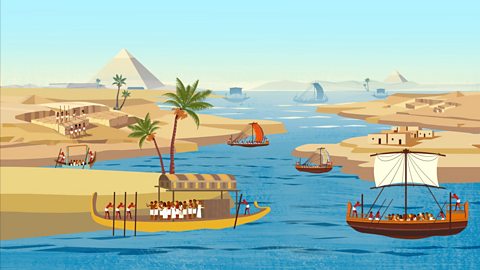
The River Nile. video
Understanding the key role of the River Nile in the establishment and success of Ancient Egypt.
See also...
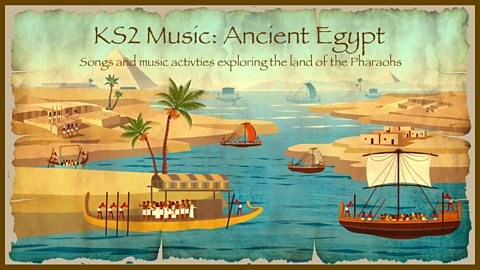
KS2 Music: Ancient Egypt. collection
A collection of fun, catchy songs and activities to help you consolidate your study of Ancient Egypt.
Song: 'Out of the gloom, Tutankhamun'
Join in with a song about the discovery of King Tutankhamun's tomb in 1922.