The song and other video content covers what we know about the life and death of Tutankhamun and the discovery of his tomb by Howard Carter in 1922.
Out of the gloom, Tutankhamun
Out of the gloom, Tutankhamun
Here in the desert Valley of Kings
Researchers find 'wonderful things'
Buried in rocks, here is a tomb
Uncover steps to Tutankhamun…
Out of the gloom, Tutankhamun
Out of the gloom, Tutankhamun
Out of the gloom, Tutankhamun
Out of the gloom, Tutankhamun
Follow a passage, dark shadows loom
Candle flame flickers into a room
Caskets and artefacts shining like new
A body embalmed and mummified too…
Out of the gloom, Tutankhamun
Out of the gloom, Tutankhamun
Out of the gloom, Tutankhamun
Out of the gloom, Tutankhamun
Made a young king at nine years old
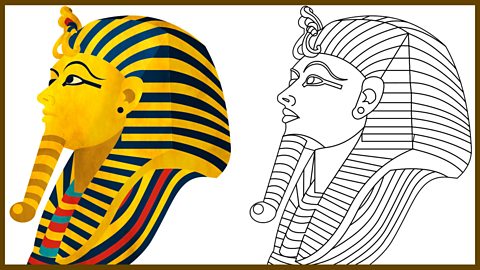
Now see his mask, gleaming with gold
Pierced ear, long beard and painted eye
Blue glass and lapis lazuli…
Out of the gloom, Tutankhamun
Out of the gloom, Tutankhamun
Out of the gloom, Tutankhamun
Out of the gloom, Tutankhamun
Refer to the Teacher's Notes for more information about the song, including follow-up music activities based on it and suggestions for cross-curricular study.

Who was Tutankhamun? How do we know about him?
This is an artefact from Ancient Egypt. It's called a shabti and this little statue tells us about the beliefs and rituals of the AncientEgyptians.
Shabti were buried in tombs with important members of Egyptian society.
They were made holding little tools, so they'd look like mini servants and agricultural workers and that's because the people at the time believed that the statues would come to life in the afterworld and do all the work that was needed.
In 1922 - after searching for six years - a team led by the British archaeologist, Howard Carter, discovered the tomb of King Tutankhamun.
And inside they found more than four hundred shabti.
In total, there were over 5,000 objects in that tomb which took eight years for Carter and his team to remove and catalogue.
The tomb had four chambers, each filled with a huge range of objects including gold jewellery, chariots, model boats, a tiny thrown and paintings.
One of the most amazing items was King Tutankhamun's golden mask, which weighed a whopping ten kilograms and was found on his mummified body in the innermost coffin.
Tutankhamun became pharaoh around 1333 BC and ruled for about ten years. We know he was eighteen whenhe died, so that tells us he was only eight when he became the pharaoh.
Inside his tomb the archaeologists found child-sized thrones as well as games and puzzles all helping to tell the story ofthe child pharaoh ruling over his kingdom.
King Tutankhamun: I win! Now I want a snack.
Recent scans of the mummified remains of Tutankhamun help us to understand what he looked like when he was alive.
They show that he was born with a misshapen left foot and a twist in his spine. So he used sticks to help him walk.
Lots of those sticks were found in his tomb. We also learn about the pharaoh from tomb paintings and carvings on temple ruins.
It appears that Tutankhamun and his dad Akenaten and did not agree on their favourite god.
So when Tutankhamun became pharaoh, he set about changing all things Aten to all things Amun starting with his own name - and moving on to demolishing his father's prized temple and even moving his body from the sacred ground of Aten to the sacred ground of Amun.
Tutankhamun was reported to have had a wicked temper.
Paintings in the tomb of General Horemheb, who later became pharaoh himself, recorded that he was the only one brave enough to talk to Tutankhamun when he was angry.
King Tutankhamun: Oh it's not fair, get out of my way I'm the king!
From mummified body, personal items and paintings inside Tutankhamun's tomb we learn a lot about his life, but we also learnabout his death.
Scans of his mummified remains show that shortly before his death he broke a bone in his left leg.
This, along with damage to his ribcage led some experts to believe he was killed in a chariot crash or perhaps even a hippopotamus attack. What a way to go!
But experts now think it was more likely to have been a fall.
Today King Tutankhamun is one of the most famous Ancient Egyptian pharaohs, mostly thanks to the determination andpersistence of Howard Carter.
Carter and his team unearthed an ancient tomb, so full of artefacts that it transports us back over 3 000 years, bringing to life another world, where the child king ruled.
King Tutankhamun
The video gives pupils an understanding of the life and death of Tutankhamun, who became pharaoh aged about eight years old and who died when he was about 18. It explains how we have been able to find out about life in Ancient Egypt by the things that were buried with pharaohs, like Tutankhamun.
We learn about the discovery of his tomb in 1922 by Howard Carter and his team and we explore a key artefact called a shabti - small statues that were buried with the pharaohs, which tell us about the beliefs and rituals of the Ancient Egyptian people.
The video also explores the difficulties King Tutankhamun had with regard to his mobility, due to a misshapen foot and curved spine, and the reported difficulties he had in managing his anger!
Hussein: Welcome to The Valley of the Kings. In this valley archaeologists have found more than 60 tombs were Ancient Egyptian pharaohs and members of their royal families were buried. The royal tombs are decorated with stories of Egyptian mythology that tell us about the beliefs of the people who lived here more than 3 000 years ago.
I'm Hussein and it's my job to bring water to the site of a new discovery in the middle of the valley.
The team are led by a British man called Howard Carter. They've uncovered a few small tombs before now. This latest one seems to be different. They say it's the tomb of a pharaoh called Tutankhamun and it doesn't look like this one has been badly disturbed by robbers, so most of the precious items should still be inside.
There are rumours of a curse on this tomb, so I'm keeping my distance. But I was there the day they made a big discovery. In fact, it was me that found it! I stumbled right on it!
That Saturday morning I arrived on site as normal and started to set up beside the first tent. I always dig holes in the sand to make the water jars sit upright, but that day when I was brushing the sand away I noticed a stone that looked smooth and different from the other rocks around.
I ran to tell one of the workers and before I knew it Mr Carter was clearing the area and instructing his team. It didn't take them long to uncover the full stone and realise that it stepped down to another one just like it. I was staying back out of the way, but I heard them say it looked like the start of a staircase.
There was a lot of excitement as they discovered that the steps lead to the sealed entrance of a tomb and a door marked with the seal of King Tutankhamun.
From what I hear the first room was filled with rubble and broken pieces of jars and pots. But last Sunday they found a second sealed doorway inside the first chamber. Mr Carter himself made a small hole in the doorway and lifted his candle to look in. It was as if everybody was holding their breath. Not one sound could be heard until another British man called Lord Carnarvon broke the silence to ask Mr Carter if he could see anything…
Howard Carter: Yes wonderful things…wonderful things!
Hussein: This is as far as I go. Through there is where the pharaoh's mummy was found and I don't want to risk the curse.
Howard Carter: The team have just started the removal and cataloguing of the finds, which could take us many years as there might be as many as 5,000 items in here.
Hussein: That's a ushabti. The pharaoh's tomb was full of these little statues. They would normally have been of a servant or farm worker. Do you see the little tools they're holding? Well that's because Ancient Egyptians believed the statue would come to life in the afterworld and then do any work that was needed.
Here they come! I better get back to work!
Hussein - The Water Carrier
The animation follows 12-year-old Hussein, a water carrier working at Howard Carter's excavations in the ‘Valley of the Kings’ in 1922. It reveals Hussein’s role in discovering the tomb of King Tutankhamun. We hear how Hussein uncovered a stone which was the first of a number of steps leading to the entrance of the tomb.
Our character Hussein is based on the real-life figure Hussein Abdul-Rasoul. There is a photograph of Hussein wearing a necklace from Tutankhamun's tomb and in his diaries Carter wrote that the child had been chosen as the model for the photograph in recognition of his important role in the discovery of the tomb. Hussein maintained in later life that his contribution was to uncover the very first step leading to the tomb and, although Carter's diaries do not confirm this be the case, it has been widely accepted as most likely true.
Hussein shows us inside the excavated tomb and tells us how it felt to be a part of such a special discovery, which found the majority of items and artefacts untouched for 3,000 years.
Resources
Song: 'Out of the gloom, Tutankhamun' - Instrumental
Out of the gloom, Tutankhamun
Out of the gloom, Tutankhamun
Here in the desert Valley of Kings
Researchers find 'wonderful things'
Buried in rocks, here is a tomb
Uncover steps to Tutankhamun…
Out of the gloom, Tutankhamun
Out of the gloom, Tutankhamun
Out of the gloom, Tutankhamun
Out of the gloom, Tutankhamun
Follow a passage, dark shadows loom
Candle flame flickers into a room
Caskets and artefacts shining like new
A body embalmed and mummified too…
Out of the gloom, Tutankhamun
Out of the gloom, Tutankhamun
Out of the gloom, Tutankhamun
Out of the gloom, Tutankhamun
Made a young king at nine years old
Now see his mask, gleaming with gold
Pierced ear, long beard and painted eye
Blue glass and lapis lazuli…
Out of the gloom, Tutankhamun
Out of the gloom, Tutankhamun
Out of the gloom, Tutankhamun
Out of the gloom, Tutankhamun
Teacher's Notes. document
Information and guidance on the songs and other content in KS2 Music: Ancient Egypt
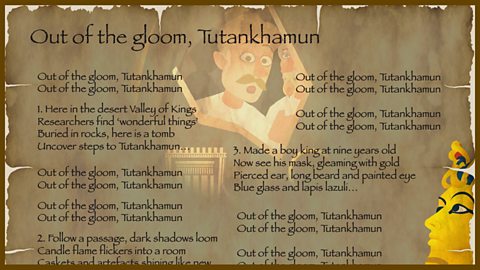
Out of the gloom, Tutankhamun - Lyrics. document
Print / download the lyric sheet (pdf)
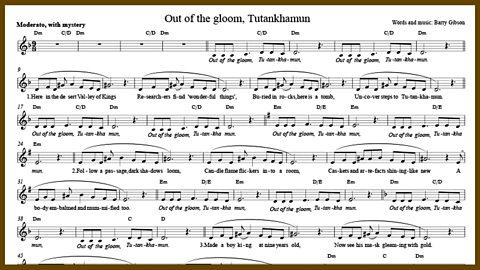
Out of the gloom, Tutankhamun - Music. document
Print / download the music sheet (pdf)
Download audio
Download the backing track of the song (mp3)

King Tutankhamun's mask. image
Click to display the image full-size
More from KS2 Music: Ancient Egypt
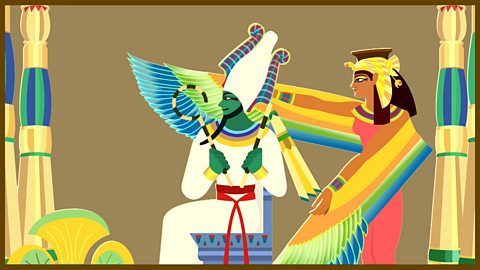
So many gods and goddesses
Covers the rituals and beliefs of the Ancient Egyptians, including their many gods and goddesses.
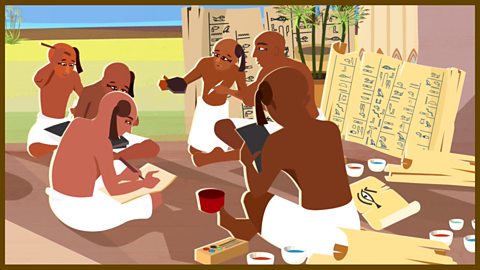
Amulets and hieroglyphs
The song and other video content explores what we know about Ancient Egyptian society and culture.
Living, living River Nile
Exploring the critical importance of the River Nile to Ancient Egyptian civilisation - including trade, food and irrigation.