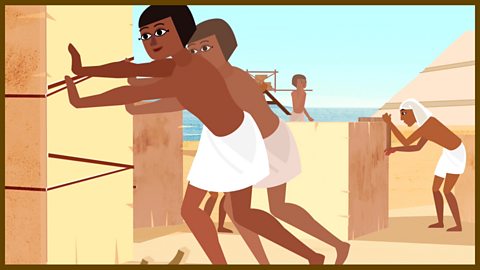
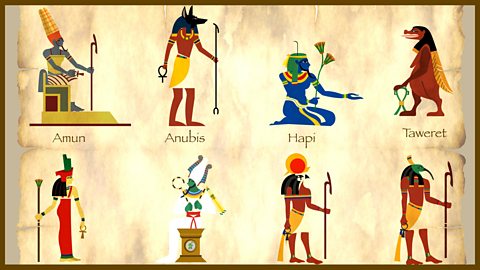
The song and other video content covers the names and characteristics of a number of important Ancient Egyptian gods and their significance to the Ancient Egyptian people.
So many
Gods and goddesses
In Ancient Egypt
Tell us your stories, into the past we go…
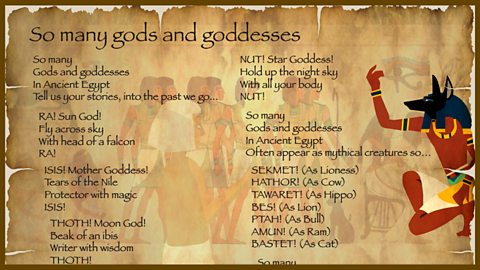
RA! Sun God!
Fly across sky
With head of a falcon
RA!
ISIS! Mother Goddess!
Tears of the Nile
Protector with magic
ISIS!
THOTH! Moon God!
Beak of an ibis
Writer with wisdom
THOTH!
ANUBIS! Death God!
Guider to next world
Head of a jackal
ANUBIS!
NUT! Star Goddess!
Hold up the night sky
With all your body
NUT!
So many
Gods and goddesses
In Ancient Egypt
Often appear as mythical creatures so…
SEKMET! (As Lioness)
HATHOR! (As Cow)
TAWARET! (As Hippo)
BES! (As Lion)
PTAH! (As Bull)
AMUN! (As Ram)
BASTET! (As Cat)
So many
Gods and goddesses
In Ancient Egypt
Tell us your stories, into the future, GO!
Refer to the Teacher's Notes for more information about the song, including follow-up music activities based on it and suggestions for cross-curricular study.

Who were the main gods and goddesses in Ancient Egypt? What did the Ancient Egyptians believe?
This is a bronze hook from Ancient Egypt.
This object or artefact takes us back over three thousand years to the New Kingdom. In Ancient Egypt, when someone important died, their body was mummified to prepare them for burial.
To start with embalmers removed all moisture from the body, including the organs which they placed in special containers - called canopic jars - to dry. That's where our artefact comes in: it was used to pull the brains out through the dead person's nose. Uh, yuck!
The heart was the only organ left in place and that's because the Ancient Egyptians believed the 'essence' or 'soul' of a person was in their heart.
The mummification process took seventy days to complete. It involved lots of different stages, including rubbing the body with oils and wrapping it in linen.
But why did they go to all that effort? Well, that comes down to their religion which celebrated lots of different gods and goddesses each with their own role to play.
Ancient Egyptians believed they would be judged by their gods and goddesses to see if they could move on to the afterlife. Mummification was just one step in preparing for the afterlife.
Osiris was chief god of the dead and one of the most popular gods. He's usually shown as a mummified human wearing a white crown and holding two farming tools in his hands: the crook and the flail. His skin is often green because he was also the god of vegetation growth and rebirth. He's described as a judge in the 'Hall of Truth', where the heart of the dead person was weighed against a feather to see if they were good enough to pass on to the afterlife.
Osiris: Oh dear! No afterlife for you I'm afraid. Next! Oh excellent, welcome to the afterlife.
Nephthys, wife of Osiris, was known as friend of the dead because she looked after the souls of the dead in the afterlife. She was one of the few goddesses, worshipped throughout the entire 3000 year period, so her image has been found by archaeologists at many tombs and temples, including the tomb of King Tutankhamun.
But the gods and goddesses that the Ancient Egyptians worshipped were about more than just the afterlife. They controlled every part of nature and daily life.
Tawaret was a goddess of childbirth and a protector of women and children. She was thought to be a ferocious demon as well as a protective and caring goddess. Do you know anyone else like that?
Lady: Hey!
Anyway, Tawaret had the body of a hippo, the legs of a lion and the tail of a crocodile. These were animals that were equally feared and respected by the Ancient Egyptians.
As well as the 'state gods' that everyone knew about, people had their own local gods and goddesses and those worshipped in one village can be very different from the next village.
Traveller 1: Who's that guy?
Traveller 2: Montu? Never heard of him!
If a particular person or city became the most powerful then their local gods became the 'state gods'. This meant that a particular god or goddess could be popular for a few decades, then they would go out of fashion, the temple pulled down and the stone reused.
Around 1353 BC the Pharaoh Akhenaten tried to change the way gods were worshipped in Egypt. Instead of having multiple gods and goddesses, each with different roles, he placed one god, the god Aten, above all others and introduced a Atenism.
This was not a popular decision, so after he died Akhenaten's monuments and statues were destroyed and hidden and his namewas removed from the list of rulers.
Religious beliefs changed a lot during Ancient Egyptian history. But what remained the same was the important role that gods and goddesses played in people's lives, their deaths and their journey onto the afterlife.
Gods and goddesses
This video gives pupils an introduction to the role of religion and gods / goddesses in Ancient Egyptian society.
It helps pupils to explore the process of mummification and how pharaohs were believed to become gods and goddesses after death.
We explore an artefact to help unearth the story of the past and find out more about how people lived and what they believed in.
The video explains the various roles that gods and goddesses had in Ancient Egyptian society and how each had a distinct purpose, with some of these being more important to the Ancient Egyptians than others.
It also explores how the roles of gods and goddesses changed over the centuries and how the beliefs and feelings of different pharaohs caused particular gods / goddesses to fall in or out of fashion.
Resources
Song: 'So many gods and goddesses' - Instrumental
So many
Gods and goddesses
In Ancient Egypt
Tell us your stories, into the past we go…
RA! Sun God!
Fly across sky
With head of a falcon
RA!
ISIS! Mother Goddess!
Tears of the Nile
Protector with magic
ISIS!
THOTH! Moon God!
Beak of an ibis
Writer with wisdom
THOTH!
ANUBIS! Death God!
Guider to next world
Head of a jackal
ANUBIS!
NUT! Star Goddess!
Hold up the night sky
With all your body
NUT!
So many
Gods and goddesses
In Ancient Egypt
Often appear as mythical creatures so…
SEKMET! (As Lioness)
HATHOR! (As Cow)
TAWARET! (As Hippo)
BES! (As Lion)
PTAH! (As Bull)
AMUN! (As Ram)
BASTET! (As Cat)
So many
Gods and goddesses
In Ancient Egypt
Tell us your stories, into the future, GO!
Teacher's Notes. document
Information and guidance on the songs and other content in KS2 Music: Ancient Egypt
So many gods and goddesses - Lyrics. document
Print / download the lyric sheet (pdf)
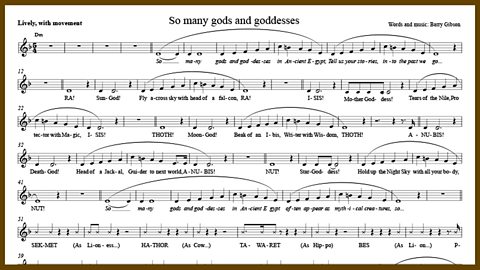
So many gods and goddesses - Music. document
Print / download the music sheet (pdf)
Download audio
Download the backing track of the song (mp3)

Some important gods and goddesses. image
Click to display the image full-size
More from KS2 Music: Ancient Egypt
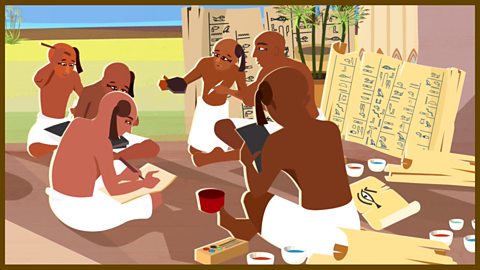
Amulets and hieroglyphs
The song and other video content explores what we know about Ancient Egyptian society and culture.
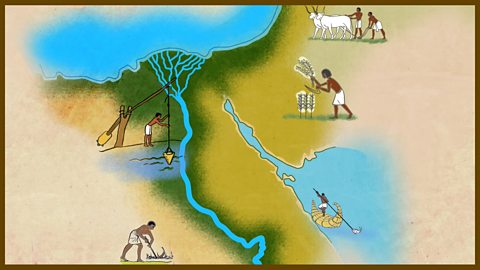
Living, living River Nile
Exploring the critical importance of the River Nile to Ancient Egyptian civilisation - including trade, food and irrigation.
Build that pyramid
A lively, energetic work song covering the building and function of the pyramids and their changing styles.