A deben weight - an ancient artefact - is the springboard for an exploration of Ancient Egyptian society and culture.
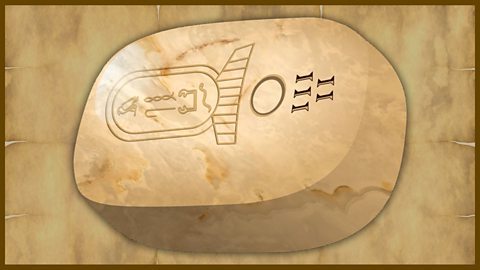
This is a five deben weight. It's an artefact from Ancient Egypt.
An artefact is an item from a particular time or place that tells us something about life in that time.
Deben weights like this one tell us about the achievements of Ancient Egyptian society.
The first deben weight that we know about dates all the way back to eighteen hundred BC.
Back in Ancient Egypt there was no such thing as money. If Ancient Egyptians wanted something they didn't have they had to tradesomething they did have to get it.
Debens were used to measure out produce in the same way that we use grams or kilograms today.
Each deben weighed exactly the same so that meant it could be used to set a price and ensure a fair exchange.
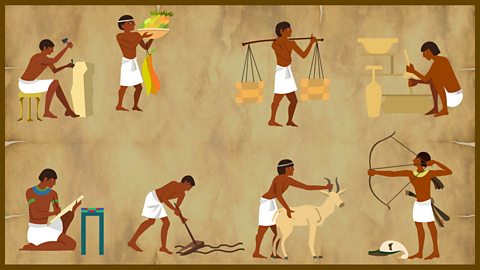
The fact that Ancient Egyptians could exchange their produce or their skills in this way, meant that they were able to specialise in aparticular job or craft.
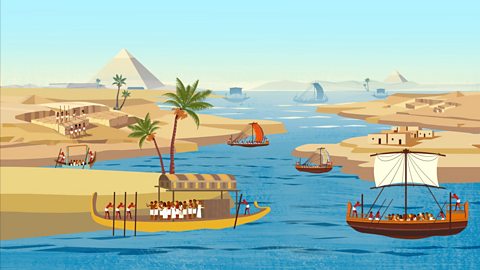
It also meant the average diet was really quite varied and nutritious. Ancient Egyptian society started because groups ofpeople were attracted to the River Nile as a source of food and water.
These people built villages along the river and learnt how to farm and use boats to travel.
Eventually the northern areas where most people lived were united under one pharaoh who was called Narmer.
This was the start of a state that lasted for almost three thousand years.
By the time the final pharaoh, Cleopatra VII, was in charge the building of the pyramids was already ancient history.
Over the years there were many wars and revolutions, the shape of society changed quite a lot.
Well, three thousand years is a long time.
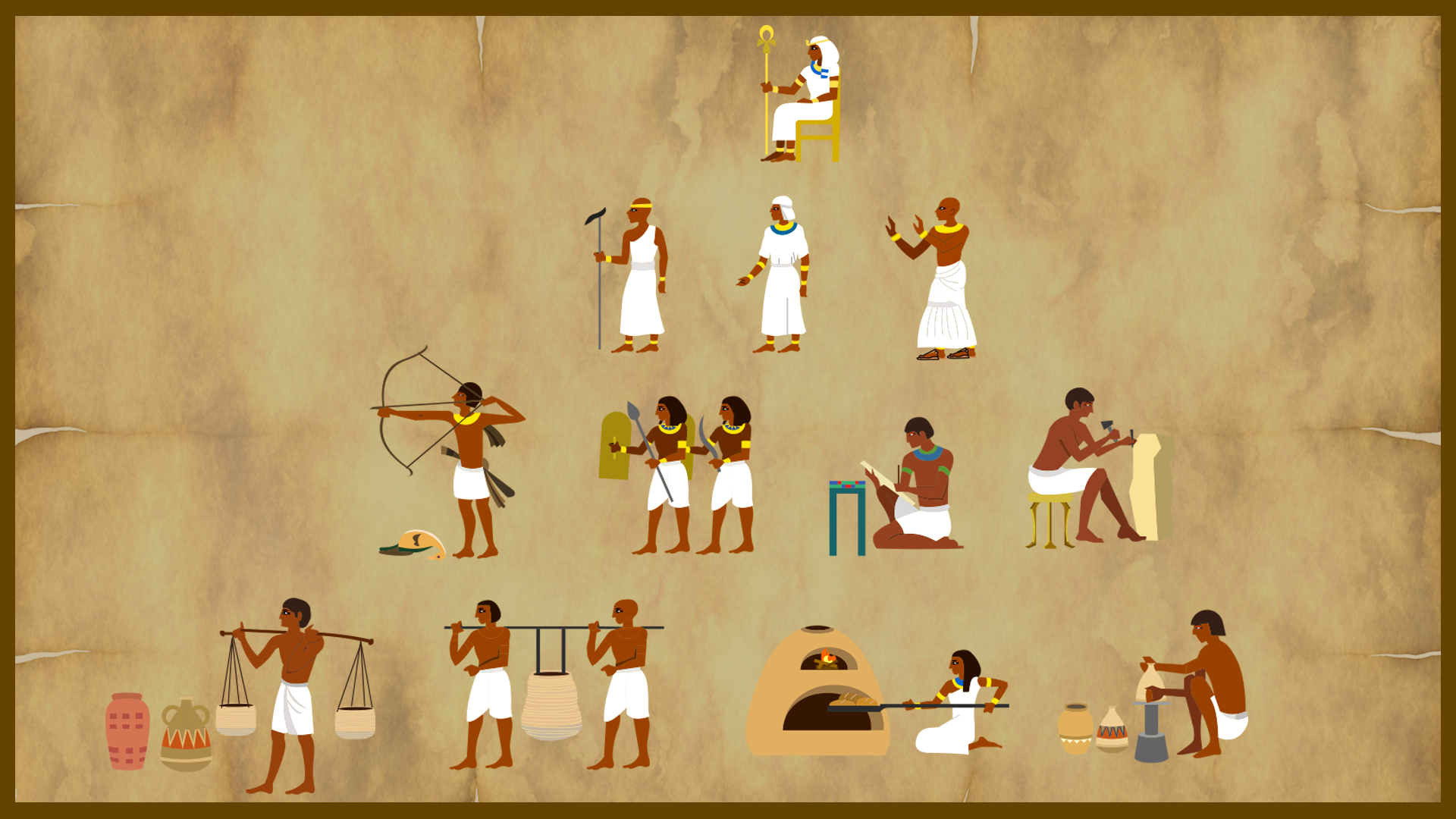
But, one thing stayed the same: the pharaoh was always the most powerful and important person in Egyptian society.
In fact, pharaohs were considered so important that it was believed that they could turn into gods after death.
When one Pharaoh died it would usually be his son who became the next pharaoh.
If the pharaoh had no son a daughter might be chosen.
If there was no daughter then it was another member of the Royal Family.
After the pharaoh the next most important people in society were government officials, nobles and high priests.
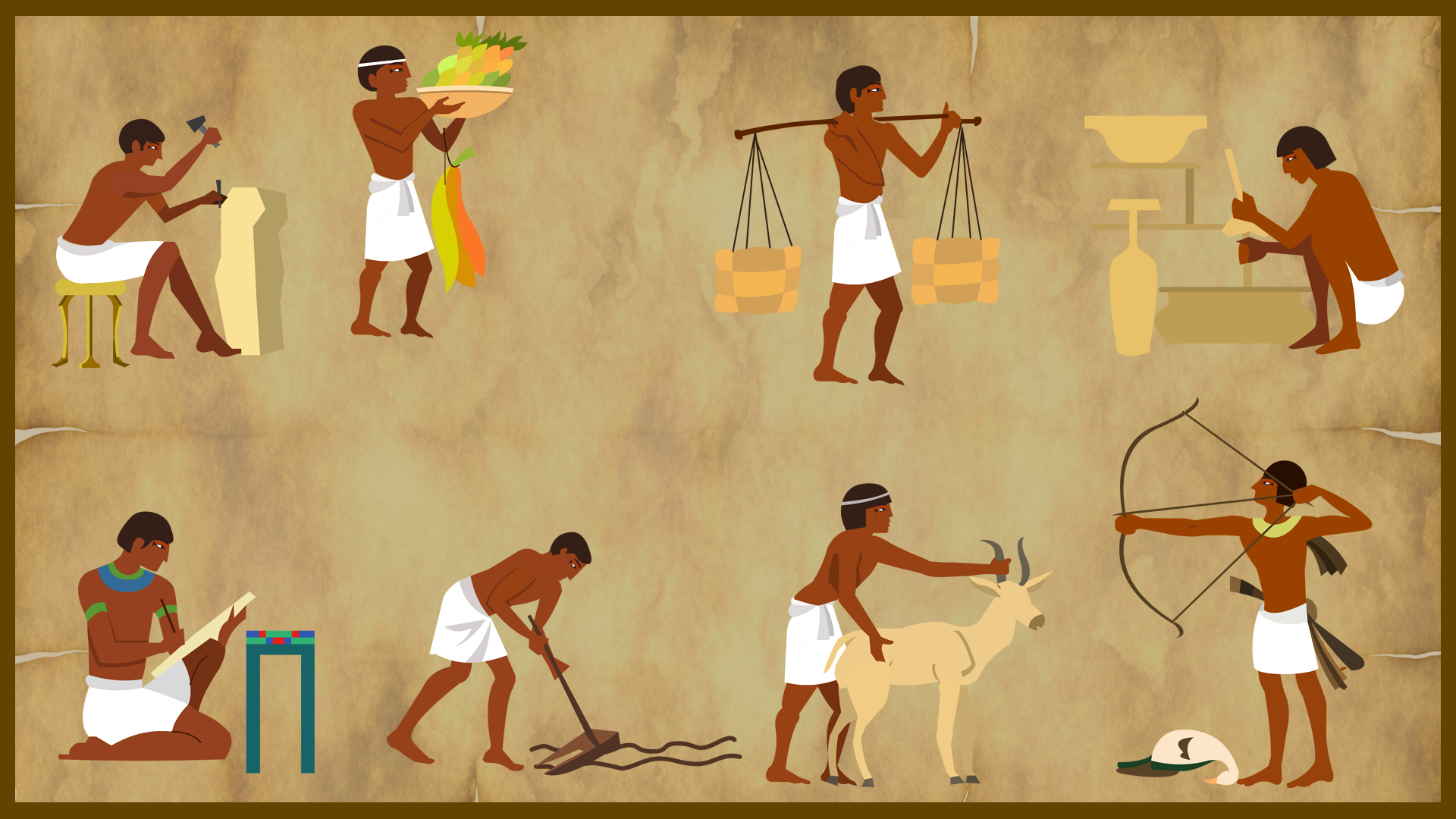
But most Ancient Egyptians were just ordinary people who did all sorts of different jobs.
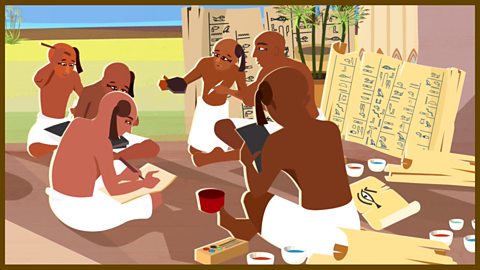
A very important job to hold was that of a scribe. These were people, usually men, who could read and write the Ancient
Egyptian style of writing called hieroglyphics.
Back then not everyone got the chance to go to school to learn to read and write.
So you were pretty lucky if you did. It was mostly the children of the rich who got to go to school - usually boys - butsome girls also learnt to read and write at home.
Poorer children were generally taught how to do their parents' jobs and most didn't get the chance to learn reading and writing.
Some Egyptian pharaohs were women - in fact, Ancient Egypt wasn't a bad place to be a woman at all, in nearly every way they were treated as equal to men.
But even so there were still some senior jobs that were reserved for men.
Actually Ancient Egypt wasn't a bad place to live for most people.
When times were good ordinary, average folk, even had time for hobbies and sports.
For less sporty types, there were board games.
Some of the pharaohs loved their board games, so much, they even had them placed in their tombs so that they could play them in the afterlife.
Ghost Pharaoh: Does anyone want to play with me?
Society and culture
Video summary
This video gives pupils an understanding of the society and culture of Ancient Egypt and helps them to understand some of the achievements of this ancient civilisation.
The video begins with a deben - a weight the Ancient Egyptians used to ensure fair and comparable trade of goods.
Moving through the video pupils will gain an overview of many of the jobs that Ancient Egyptians did and information which highlights the importance of the River Nile in the development and success of Ancient Egypt.
Further resources
The hierarchy of Ancient Egyptian society. image
Click to display the image full-size
Deben weight. image
Click to display the image full-size
Typical Ancient Egyptian occupations. image
Click to display the image full-size
Teacher's Notes
This video gives a snapshot of Ancient Egypt and explores the value of sources to historians.
It can be used to help the pupils understand how we find out about the past as well we the role of ‘place’ in historical civilisations.
If it wasn’t for the River Nile, Ancient Egypt certainly wouldn’t have been as successful as it was - and potentially may never have existed.
It also provides a platform to explore the STEM subjects in the context of Ancient Egypt, using a deben as a currency or tool for trade for example.
Points for discussion:
- What was a deben?
- What does the use of the deben tell us about the Ancient Egyptians?
- Why do you think the River Nile was so important to Ancient Egyptian life?
- Can you find out if the Rive Nile is important today?
- Who held the most powerful position in Ancient Egypt?
- What types of hobbies did the Ancient Egyptians enjoy?
Suggested activities:
Following the video teachers can explore case studies around life in Ancient Egypt.
They can use maps and atlases to explore the significance of the River Nile.
Pupils can explore the varying types of historical source and what examples of each can be found in the context of Ancient Egypt. Following this they can explore what the sources tell us about the way of life in Ancient Egyptian times.
Pupils can carry out activities to develop their numeracy skills exploring in more detail how trade worked and the role of the deben.
Pupils can use a balance scale to try balancing items against a single weight in the way that the deben was used: '5 deben of corn exchanged for 5 deben of fruit'.
Pupils can calculate distances of the River Nile and explore in more detail the length of time the Ancient Egyptian period lasted for.
Thinking to careers education and PSE activities, pupils can explore how job roles have changed since the Ancient Egyptian period.
They can find out which job roles remain and which do not, and why.
This film is relevant for teaching History at KS2 in England, Wales and Northern Ireland and 2nd Level in Scotland.
The River Nile. video
Understanding the key role of the River Nile in the establishment and success of Ancient Egypt.
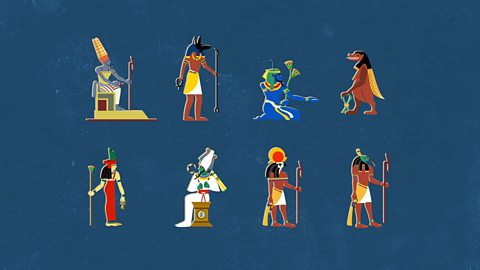
Gods and goddesses. video
Exploring the many gods and goddesses of Ancient Egypt and their various roles within society.
Pyramids. video
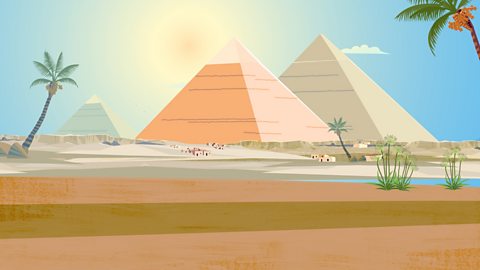
Exploring the different types of pyramids in Ancient Egypt - their construction and their purpose.
See also...
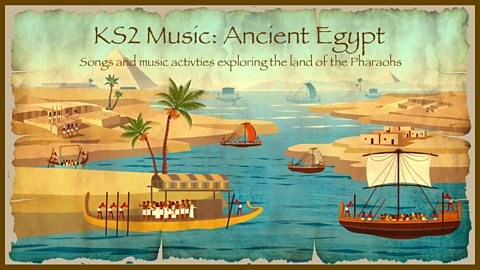
KS2 Music: Ancient Egypt. collection
A collection of fun, catchy songs and activities to help you consolidate your study of Ancient Egypt.
Song: 'Amulets and hieroglyphs'
Join in with a song about Ancient Egyptian society and culture.