SIMRAN: Hinduism is over 4000 years old. It's made up of lots of different Indian religious traditions and practices. We worship God at home every day. Absolutely love that statue of him. We believe in the one true God Brahman who has millions of qualities. These qualities are represented by millions of different gods and goddesses. Their sacred images are called murtis. When we visit them we believe we're meeting with God. There are lots of murtis at the Mandir. A Mandir is a Hindu place of worship. Vraj is going to show us around.
VRAJ: When I come to the Mandir to worship God I walk in and ring the bell to awaken God. And then I go to the gods and bow down to them and I ask for something or I will thank them for something good that's happened.
SIMRAN: We believe in one God who exists in everything.
VRAJ: To help us understand names images and qualities are given to millions of gods and goddesses. They say that there's only one because gods are gods but they've got different qualities which make people say that there's loads of gods. For example if there's a whole bunch of flowers they would say that there's one because a flower is a flower and all of them are called flowers but there's different qualities for them because they're different colours and they smell different. So the same applies with God.
SIMRAN: We often choose one god to worship. This god might have the qualities that a person admires or needs in their life or it might be the god that a family has worshiped for generations.
VRAJ: The god that me and my family worship is Shiv and we worship him because he's really special to us and he's the creator of this world. And when I've seen how many people he's helped I've been happy.
SIMRAN: Shiv also known as Shiva is one of the gods responsible for creation. I visit God at the Mandir. It's home to lots of different gods and goddesses. They each have a quality and an image to help us relate to them. For example if I wanted strength I might go to the monkey god Hanuman or if I wanted intelligence I'd pray to Ganesha the elephant god. We worship God by performing a ritual called Aarti.
THEY SING
VRAJ: At Aarti ceremony I always feel close to God because we're focusing we close our eyes we sing.
SIMRAN: Aarti's performed every morning and evening. It can be done at the Mandir by a priest… …or by us at home at our shrine. Murtis are the sacred images we use to represent God. The murtis at the Mandir are very decorative but the one we use at home is much simpler. Both are as important.
VRAJ: It's just like God and that's why we should take care of it we should treat it the same way. I wash him and I bathe him and I put some markings on him. During my exams or busy times the shrine would help me by… It would actually get my brain working and focus on my exams. Coming to the shrine makes me calmer and gives me peace as well.
Video summary
11-year-old Vraj shows us around a Hindu temple, called a mandir, and tells us about the religious statues called murtis that Hindus keep in their temples and homes.
Hinduism is over 4,000 years old and made up of lots of different Indian religious traditions.
Hindus believe in one God, Brahman, but the millions of qualities that Brahman has are represented by millions of different gods and goddesses.
Vraj compares this idea to a bunch of flowers; although every petal or flower is different, they are still one bunch.
Going to worship at a shrine is like visiting the gods and goddesses.
Mandirs are centres for the community and worship, with many murtis to pray to Vraj rings a bell to awaken god when he enters, then bows and prays to the statues ask for help or to thank them.
His family mainly worships Shiv or Shiva, the creator, but he can ask other gods if he needs particular help.
For example he might ask the monkey god Hanuman for strength, or Ganesh the elephant god for intelligence.
We see Vraj at the service of worship called Aarti, performed at least twice a day. He says it makes him feel closer to god.
This is from the series: My Life, My Religion - Hinduism
Teacher Notes
KS2 Before the clip is shown, some artefacts or pictures could be shown of some of the gods and goddesses.
With the children in pairs one could describe an artefact to the other, who has to try and draw it without seeing it, they could then come up with questions like what would you like to know about this object?
They could then watch the clip and see if their question is answered.
Pupils could consider together what Vraj says about the many gods of Hindu tradition being like a bunch of flowers, "if there’s a whole bunch of flowers we would say they’re one bunch.
They are all flowers. But each flower has different qualities, colours, petals, leaves, smell, size. Hindus think the same applies to God. Brahman is one, but contains all kinds of differences.
This is why we have many forms of the gods and goddesses to worship.” Pupils could come up with other similar ideas which might help explain Hindu beliefs: If God was a flower, it would be a bunch of flowers. If God was a colour, it would be a rainbow.
If God was a tree it would be a forest. Do they find these ideas help them to understand their own thoughts about God?
Vraj suggests 5 ways in which prayer helps him. Ask the pupils to list them, and then give their own suggestions as to how prayer can help people.
- It helps me facing my exams
- It gets my brain working
- It helps me to focus
- It makes me calm
- It gives me peace
These clips will be relevant for teaching Religious Education at KS2 in England, Wales and Northern Ireland and First and Second Level in Scotland.
Meeting two young British Hindus. video
Simran, aged 14, introduces herself and her Hindu religion. Her brother Vraj is 11.
The Cycle of Birth and Rebirth. video
Hindus believe life is a cycle of birth, death, and rebirth.

Celebrating the festival of Holi. video
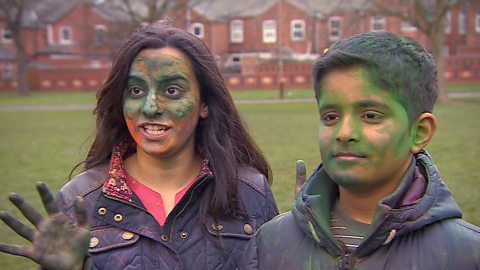
This short film explains why Hindu children throw paint and have bonfires at Holi, which is a spring festival, and explains what the celebrations are like in Leicester.
Diwali - the festival of light. video
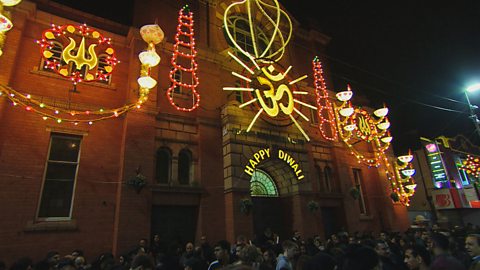
Hindus Vraj and Simran explain how they celebrate the festival of Diwali.
A Hindu wedding ceremony. video
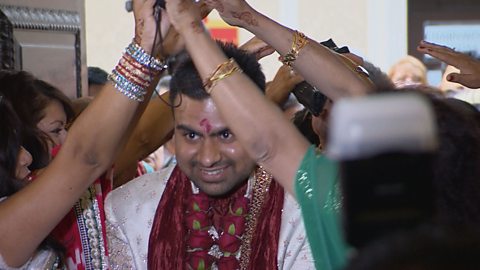
Nikki and Hemal celebrate their marriage in Hindu style.
Celebrating Raksha Bandan. video
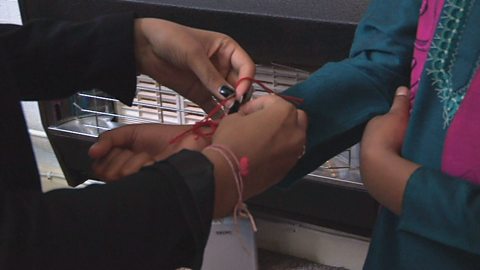
Sisters tie a Rakhi to their brothers’ wrists to celebrate their love for their family.