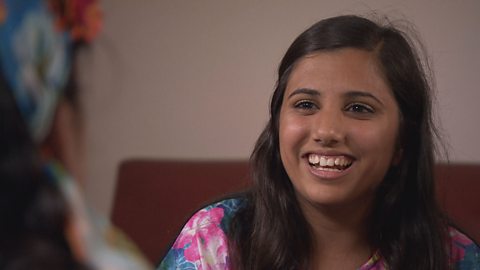
SIMRAN: Hindus believe life is a circle of birth death and rebirth and every action we make has an effect. This action is called karma. Karma can be good or bad. We get good karma if we are kind but bad karma if we are selfish. This good or bad karma impacts how I will live in my next life on Earth. If I am really good I hope to befreed from the cycle of rebirth. The actual process of that going round and round you may actually alter your state your physical state but your spiritual matter remains the same. So you may be a human being you may be an insect you may be an animal you may be a tree and it goes all the way until you have learned what you wanted to learn and you asked to learn from God.
SIMRAN: The cycle of life is nota simple idea. Karma works in many ways and the soul might be reincarnated thousands of times. Vraj loves drawing and has drawn a picture to show his understanding of karma.
VRAJ: Here is the cycle of rebirth of bad karma. So you'd start off with a baby then your turn into a child then you turn into an adult then elderly and then you would go around again. If God thinks that you have not been a very well-behaved person then you would be turned into an animal. On this one it is the opposite. This one is good karma. It is the same and if God thinks you have been a really good person you would turn back into a baby.
SIMRAN: There is an end to the cycle of death and rebirth. It is called moksha. It is reached by always trying to be the best we can be. That is the core of them being the Hindu person because they put it into practice every day of their life.
VRAJ: If you get to moksha you would be at one with God and you feel really good. It just tells me that I should always do good and I will improve and my next life will be better.
SIMRAN: The cycle of rebirth affect show we think about death. After death most Hindus are cremated. This symbolises the quick release of the soul to begin its next life. Traditionally ashes are scattered in a river like the River Soar in Leicester. I think it is special being here as we in Hinduism belief that a river flows and so do our lives so we have our ashes sprinkled into this water because we Hindus want our lives to flow on. Hemang is a Hindu priest and he helps families after the death of a loved one. Why is it important that we return to a river after death? We believe that the river is the life-source of our life because the majority of our body is made of water. So we give ashes and final essence to the water. That is why we come to a river.
SIMRAN: As a priest what do you enjoy most about bringing families here?
It is a big grief and I am finding that my job helps them a little bit towards understanding that they have not died but they have passed away. There is a big difference. They will get a new life. So we believe that that is a new beginning.
SIMRAN: In India Hindus traditionally scattered ashes in the River Ganges but there are many rivers outside of India that can be used as well.
HEMANG: All our rivers are equally sacred. That is the general idea of the faith that all rivers are created to be equal in the eyes of God. We have a mantra to prove that as well… Akashat patitam toyam yatha gacchati sagaram - all rivers merge eventually in one connection.
SIMRAN: Just as a person puts on new clothes and gets rid of the old ones the soul also takes on new bodies according to its karma.
Video summary
Simran, who is 14 and Vraj, who is 11, explain the complexities of Hindu belief in reincarnation.
They believe life is a cycle of birth, death and rebirth, with our actions in this life, our “karma”, effecting our future incarnations.
Kindness leads to good karma, whilst selfishness leads to bad karma.
The soul may be reincarnated thousands of times.
Vraj draws a picture to explain his understanding of the cycle of life.
The end of the cycle is called Moksha, which can be reached if you live the best life you possibly can.
It makes you at one with God and sets you free from having to be reborn on this Earth again.
Believing in reincarnation affects how Hindus think about death.
Bodies are burnt after death, to symbolise the quick release of the soul to begin its next life.
Simran meets Hemang, a Hindu priest, on a boat in the River Soar in Leicester.
He tells her that as our bodies are mostly water, Hindus scatter the ashes in a river after death.
He helps the families of those who die to understand that death is a new beginning for the soul of their loved one.
In India Hindus traditionally scattered ashes in the River Ganges.
Hemang says that all rivers are created equal in the eyes of god, and they all merge eventually into the oceans.
River Soar, or River Ganges, the symbol is for the way life flows on.
This is from the series: My Life, My Religion - Hinduism
Teacher Notes
Pupils could draw their own circle of life diagram, showing key moments such as birth, learning to walk, going to school, getting a job, getting married, becoming a parent, retiring, dying.
They could think about ways that people could gather good karma at each stage.
Then they could draw a second circle, considering how a person’s life could be better the second time around if they had good karma.
They could compare notes about what they think good karma means and what they like or dislike, agree with and disagree with, about Hindu ideas on life after this life.
Ask them to share all the other ideas they know of about life after this life.
Muslim Paradise, Christian Heaven, ideas about ghosts and the atheist view that this life is the only life can be explored in discussion.
These clips will be relevant for teaching Religious Education at KS2 in England, Wales and Northern Ireland and First and Second Level in Scotland.
Diwali - the festival of light. video
Hindus Vraj and Simran explain how they celebrate the festival of Diwali.
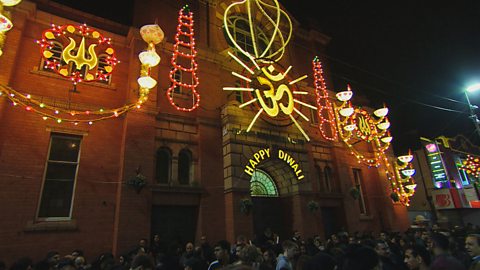
Inside a Hindu Temple. video
This short film explores Hindu religion through worship described by 11 year old Vraj. Striking visuals show what happens at a Hindu temple.
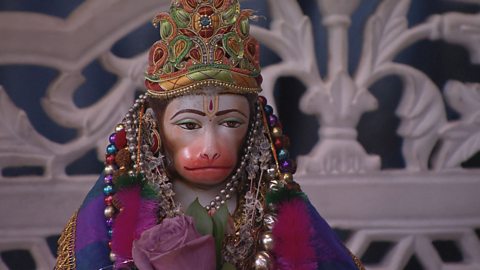
A Hindu wedding ceremony. video
Nikki and Hemal celebrate their marriage in Hindu style.
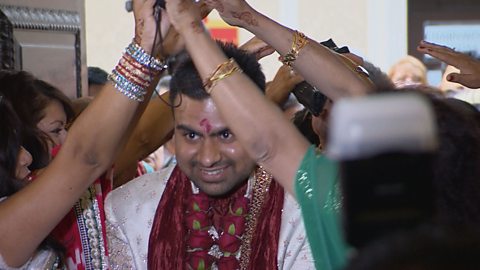
Celebrating Raksha Bandan. video
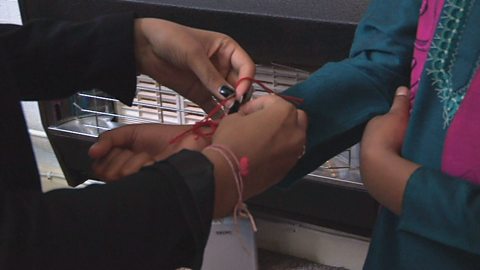
Sisters tie a Rakhi to their brothers’ wrists to celebrate their love for their family.
Meeting two young British Hindus. video
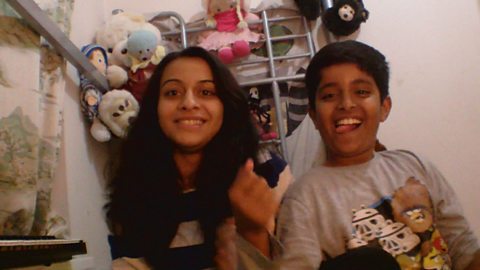
Simran, aged 14, introduces herself and her Hindu religion. Her brother Vraj is 11.
Celebrating the festival of Holi. video
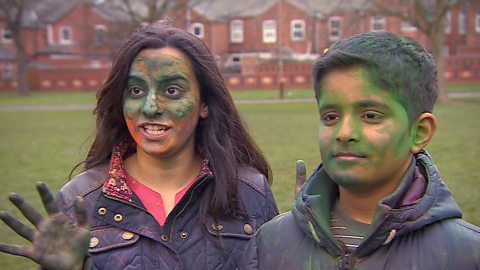
This short film explains why Hindu children throw paint and have bonfires at Holi, which is a spring festival, and explains what the celebrations are like in Leicester.
A Pilgrimage in Hinduism video
Hindu pilgrimages are many and varied. Simran and Vraj describe their experiences.