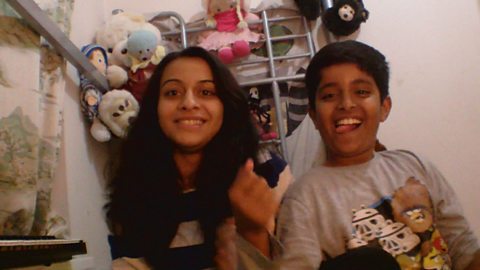
BOTH: Hi guys.
It is Holi today.
VRAJ: And we are really excited. We just don't look it because we have just woken up.
SIMRAN: Holi marks the start of spring and celebrates new life. It is a fun time for families and the whole community comes together. Holi is the most exciting festival in the Hindu calendar because you get to throw paint at people. While it is a festival where there's lots of fun there is an important religious message at the heart of it. During Holi we celebrate good overcoming evil and remember the story of Prince Prahlad. Prahlad's father the King wanted everyone is his kingdom to worship him but Prahlad refused and worshipped the god Vishnu instead. The King's sister Holika had a fireproof shawl so she tricked Prahlad into sitting on her lap in a bonfire. She wanted to destroy him but her shawl flew from her and protected Prahlad instead. Her plan failed. Prahlad came through the fire unharmed and Holika was destroyed by the flames. To remember this story bonfires are lit during Holi. The bonfires purify the air of anything evil. Hindus have a very great emphasis on fire because fire is thought to be the image of God that we CAN see.
CHILDREN SING
SIMRAN: Offerings such as popcorn coconut and chickpeas are put into the fire and people give thanks to God for the element without which the crops would not grow. We are offering something that you have already given to us God. If you had not created all this on Earth we wouldn't be able to eat it so we are thanking you by offering our first crop to you.
SIMRAN: The coconut I am going to give this in so they can put it into the bonfire and in return I am going to get a burnt one.
Holi is also known as the Festival of Colour. People throw coloured paints at one another. It is lots of fun. Some people believe this originates with Krishna who was a very playful boy and threw coloured water over milk maids. It was really fun. We love running around with our friends and we love throwing colours at each other.
SIMRAN: The best thing is that there are no rules. We are allowed to hit anyone anywhere. And you won't get told off for it. God has created colour to make the world a beautiful place to live in. And so colours are thrown saying we need to make our lives colourful we need to forget and forgive any misgivings we've had in the past and move forward.
SIMRAN: Each colour represents a virtue of the soul. Red is power. Orange is purity. Green is love. I am not sure what colours are on my face but it feels like there's a lot of it.
Throwing paint at him feels good!
VRAJ: And I can get her back.
Video summary
14-year-old Simran and 11-year-old Vraj are excited about the spring festival of Holi.
It celebrates new life, and the victory of good over evil.
We hear the story of Prince Prahlad, a pious boy who insisted on worshiping the God Vishnu instead of his father the king. Prahlad’s aunt Holika tried to kill him on a bonfire, but the flames killed her instead.
Hindus mark the festival by building bonfires which they believe purify the air of anything evil.
We see the children at a Holi bonfire, putting coconuts on the fire.
Offerings such as popcorn, coconuts and chick peas are thrown onto the fire as offerings to God, to say thank you for the spring and the crops.
Holi is also known as the festival of colour, when Hindus celebrate the beauty of colour that God has put into the world.
The children have a lot of fun throwing coloured paint at each other with their friends.
Different colours symbolise different virtues of the soul, such as power, purity and love.
On this day there are no rules, and they can throw colours at anyone without being told off.
This is from the collection: My Life, My Religion - Hinduism
Teacher Notes
Focus on the rule-breaking aspects of Holi, the paint-throwing, the bonfires and so on.
Ask them to think of festivals in other cultures where normal rules are suspended.
All Hallows Eve (Halloween) and Red Nose Day give good examples.
There are many others: on Maundy Thursday the Queen gives money away.
The Pope washes the feet of poor people.
Ask the children, for fun and understanding, to look at the school rules and devise a one-day festival of wildness for the school, where rules are all turned upside down.
It’s meant to be fun, not nasty. Sociologists of religion draw attention to this feature of festivals: normal rules are suspended for fun and for thoughtfulness.
These clips will be relevant for teaching Religious Education at KS2 in England, Wales and Northern Ireland and First and Second Level in Scotland.
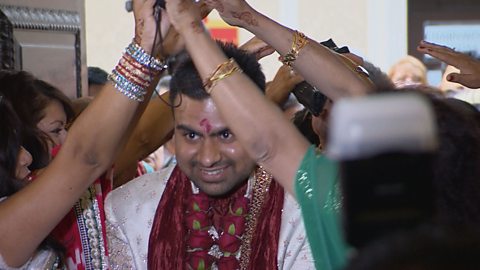
A Hindu wedding ceremony. video
Nikki and Hemal celebrate their marriage in Hindu style.
A Pilgrimage in Hinduism video
Hindu pilgrimages are many and varied. Simran and Vraj describe their experiences.
The Cycle of Birth and Rebirth. video
Hindus believe life is a cycle of birth, death, and rebirth.
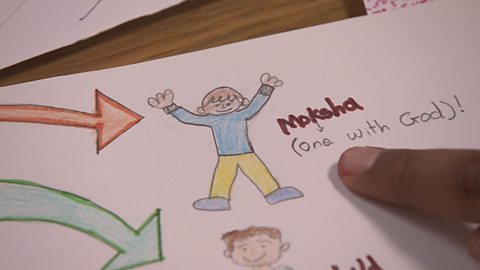
Meeting two young British Hindus. video
Simran, aged 14, introduces herself and her Hindu religion. Her brother Vraj is 11.
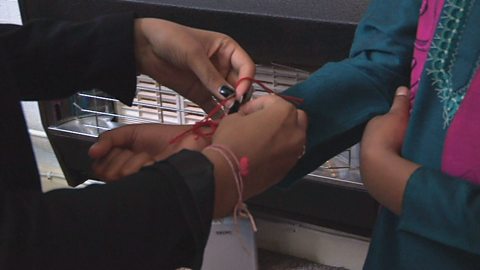
Celebrating Raksha Bandan. video
Sisters tie a Rakhi to their brothers’ wrists to celebrate their love for their family.
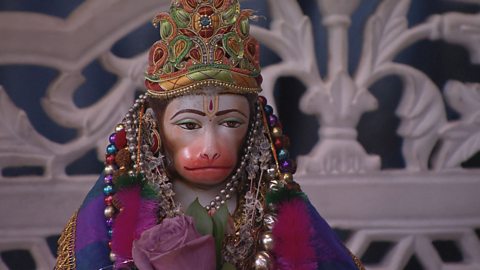
Inside a Hindu Temple. video
This short film explores Hindu religion through worship described by 11 year old Vraj. Striking visuals show what happens at a Hindu temple.
Diwali - the festival of light. video
Hindus Vraj and Simran explain how they celebrate the festival of Diwali.