VRAJ: Hey guys Raksha Bandhan today and I'm really happy and I'm going to wake my sister up.
SIMRAN: Family is really important to Hindus and once a year we celebrate the love between brothers and sisters at a festival called Raksha Bandhan.
VRAJ: Wake up!
SIMRAN: Happy Raksha Bandhan!
It's Raksha Bandhan!
VRAJ: Happy Raksha Bandhan!
SIMRAN: The word 'raksha' means protection and 'bandhan' means tie. To celebrate that we are brother and sister I tie a rakhi to Vraj. Once it's tied it's Vraj's duty to protect me. Like any other brothers and sisters we argue… Wait! What are you doing? And today's a little bit different because we have a day where brothers and sisters are meant to do things together without fighting
Look my nail just fell in!
I've come shopping with my friend Bhargavi to buy Vraj's rakhi.
BHARTI: The rakhis have developed in a massive massive way. Traditionally it used to be basically a very thin cotton if that was available. The sister would actually try and sort of you know create something out of that. And now the amount you will see the colours you will see the extent you will see it is so fantastic you just think wow!
SIMRAN: Vraj has to wear his rakhi until Raksha Bandhan next year. So I have to choose one he'll like. I think this is the one. I think Vraj will like this because it's his favourite god. Raksha Bandhan is a really important day for us.
VRAJ: Ta-da!
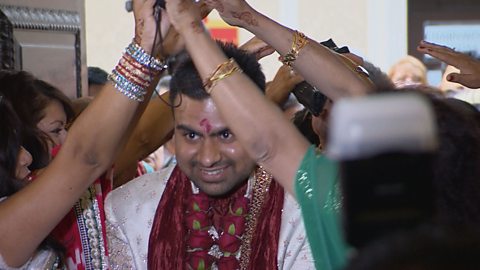
SIMRAN: We dress up in our best traditional clothes. I'm tying Vraj's rakhi on with these nails. I don't think it's going to work out!
The story of Raksha Bandhanis told in the Hindu scriptures. The god Vishnu had gone to live with King Bali. Vishnu's wife Lakshmi was sad about this so she visited King Bali and tied a rakhi to him. When he asked what she would like in return she asked him to let her husband come home. The whole meaning is about the king who was such a generous king who used to give anything that people asked him. And that's how the brother should become generous as well and the whole world should be generous.
SIMRAN: I put a tilaka on Vraj's forehead. It's made from water rice and red powder. The tilaka represents good fortune.
SHE RECITES PRAYER
As I tie Vraj's rakhi I say a prayer asking God to keep him happy and healthy in the year ahead. I then feed Vraj a sweet.
VRAJ: Tastes kind of like apple crumble.
SIMRAN: Vraj is younger than me so out of respect he touches my feet.
Be successful.
BOTH: Happy Raksha Bandhan!
SIMRAN: It's not all about Vraj though and in return for his rakhi I get a gift too. Yay! Whoo! Nail varnish. If you don't have a brother you can still celebrate at Raksha Bandhan. You can give a rakhi to your cousins or friends. Vraj will carry out his duties to protect me by being there when I'm in trouble or even if I'm not and he has the sense that I am he'd hopefully be there at the right time.
Video summary
14 year old Simran and her 11 year old brother Vraj tell us about the annual Hindu festival of Raksha Bandan, which celebrates the love between brothers and sisters.
Raksha means “love” and Bandan means “tie”. We see Simran shopping for a rakhi, or string bracelet, which sisters give to their brothers on this day.
He will wear it all year, and it symbolises that brothers should protect their sisters.
Even though Vraj and Simran often fight, it is a day when they try to get on and do things together.
Raksha Bandan is also a day to dress up in traditional clothes, and remember an ancient story from the Hindu scriptures.
The god Vishnu had gone to live with King Bali, and Vishnu’s wife Lakshmi missed him.
She visited King Bali and tied a rakhi to him, and the king asked her what she would like in return.
She asked for him to let her husband come home.
The story shows the generosity of the king, and the festival encourages Hindus to be generous.
We see the ceremony where Simran ties on Vraj’s rakhi. She puts a tilak – a red coloured mark - on Vraj’s forehead.
She prays for him, asking god to keep him happy and healthy in the year ahead.
She feeds Vraj a sweet, and because Vraj is younger than her he touches her feet.
He also gives her a gift of nail varnish. If you don’t have a brother, you can give a rakhi to a cousin or a friend.
This is from the series: My Life, My Religion - Hinduism
Teacher Notes
The festival is supposed to have four characteristics: it is about family love, fun, generosity and remembering.
After watching the clip pupils could say what they noticed about each of these four characteristics from the clip.
In small groups pupils could design and make four different rakhis – each group could get a bag containing some tinsel, glitter, glue, card, masking tape, colours etc.
Their four designs could reflect one of the values of the festival: family, love, fun, generosity, remembering.
Arrange a display of the results for a younger class to come and hear about the work from your pupils.
These clips will be relevant for teaching Religious Education at KS2 in England, Wales and Northern Ireland and First and Second Level in Scotland.
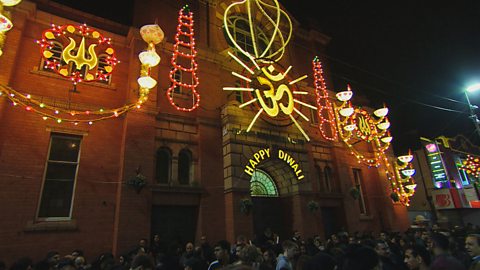
Diwali - the festival of light. video
Hindus Vraj and Simran explain how they celebrate the festival of Diwali.
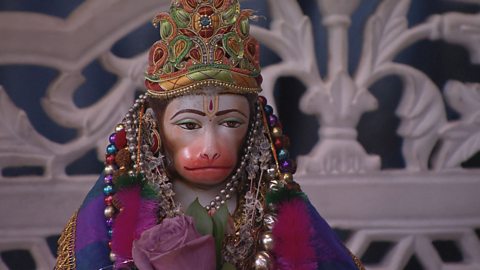
Inside a Hindu Temple. video
This short film explores Hindu religion through worship described by 11 year old Vraj. Striking visuals show what happens at a Hindu temple.
A Pilgrimage in Hinduism video
Hindu pilgrimages are many and varied. Simran and Vraj describe their experiences.
Meeting two young British Hindus. video
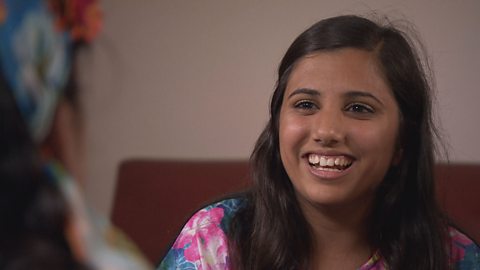
Simran, aged 14, introduces herself and her Hindu religion. Her brother Vraj is 11.
The Cycle of Birth and Rebirth. video
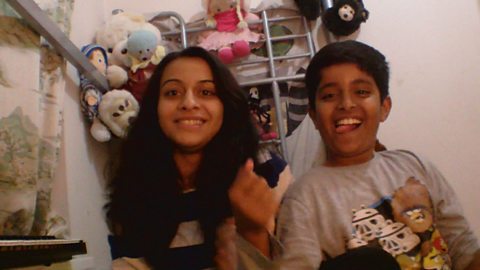
Hindus believe life is a cycle of birth, death, and rebirth.
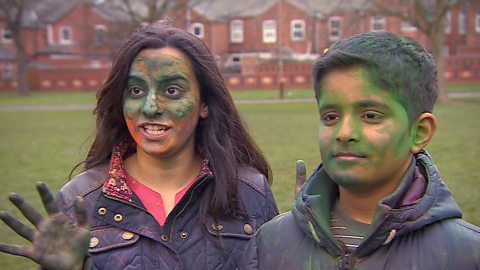
Celebrating the festival of Holi. video
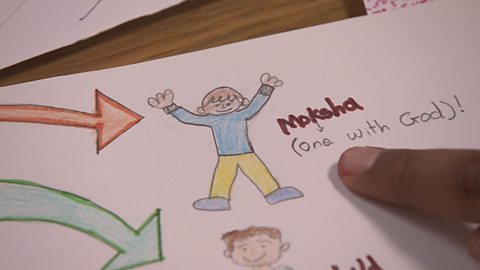
This short film explains why Hindu children throw paint and have bonfires at Holi, which is a spring festival, and explains what the celebrations are like in Leicester.