We all live with computers…but getting the most out of them… getting them to do what you need…can be kind of difficult.
But if you can understand how they process things, a computer can be the most useful housemate you’ll ever have.
Computers are good at carrying out tasks right? The answer is yes, as long as you spell out clearly what you want them to do.
One key to “Computational thinking” is turning complicated tasks into smaller tasks…by pulling them apart.
It’s called decomposition.
Ada:
What’s that smell?
Voice over:
Decomposition might sound like something that happens to old food.
Ada:
Yuck!
Voice over:
But it’s also the process of breaking down a problem into smaller, simpler parts to make it easier to solve.
Ada:
It’s time to do some shopping.
Voice over:
Take a simple everyday task like shopping. How would you ask a computer to do it?
Ada:
Will you please go shopping for a change… Agggh!
Voice over:
Shouting at computers just doesn’t work. You have to ask in the right way. You know what I mean by “Go Shopping” but computers don’t. They don’t work in English they work in ‘Computer Language’ and only understand simple instructions. So you need to break the task down into simpler parts that they do understand, by decomposing the problem… Step by step.
When you think about it - doing the shopping is actually lots of tasks done one after another – starting with the shopping list.
Ada:
Ketchup; Tomato soup; 1 loaf of bread; 2 litres of milk and 6 packs of cheesy puffs.
Voice over:
And so on for all the simple tasks that together make up shopping.
Once you break it down into things a computer can understand… it’ll get right to work!
Ada:
Err – where’s the shopping?
Voice over:
But remember… Computers can’t think for themselves, so when you decompose your task, you have to get it right. When you decompose a problem, you can’t miss anything out!
So there we go. Decomposition. Break the task down into smaller, simpler tasks that the computer can process. And the best thing about computers is… They can’t eat your cheesy puffs.
Decomposition - Breaking big tasks down into smaller ones.
Video summary
A teenage programmer discovers how decomposition works through trial and error.
She tries asking her computer to go shopping for her but he doesn't understand.
She realises she has to break down the task into a list of simple instructions to follow.
With a clear set of ordered instructions, the computer goes to the shop, collects the items, pays for them - but returns without them.
The programmer has forgotten to tell him to bring the shopping home in her instructions.
She amends her code, including all the necessary instructions.
These clips are from the series How to Think Like a Computer.
Teacher Notes
This could be used to explore algorithms through working out steps in a process, once this is done students could then write the algorithm out in pseudo code or as a flowchart.
This could be linked to an explanation of binary, as computers need everything broken down into simply, such as in 1’s and 0’s.
You could ask students to think of everyday situations and then write algorithms through decomposing the situation or problem.
Students could discuss the contributions of women in IT such as Ada Lovelace, as the main character is called Ada.
This could be used to discuss whether computers think?
Do humans think?
This clip will be relevant for teaching Computer Science at KS3 and KS4 in England, Wales and Northern Ireland and National 4 and 5 in Scotland.
Checking your algorithm. video
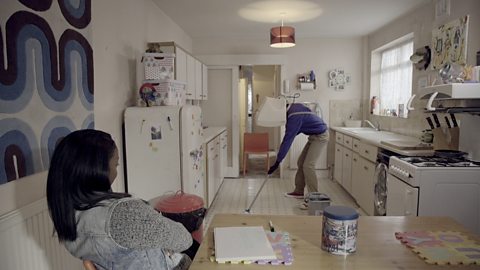
A teenage programmer tests a set of instructions she has written to get her computer to mop the floor.
Searching Algorithms. video
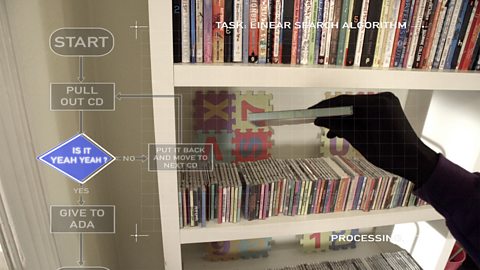
A teenage programmer tests how different types of algorithms can be used to speed up searching her massive music collection.
Sorting Algorithms. video
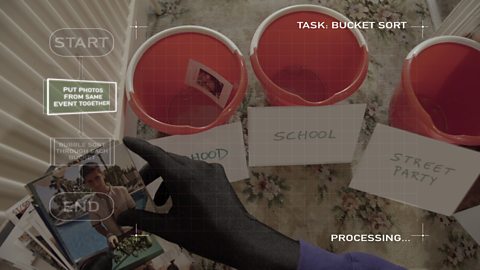
A teenage programmer enlists her computer friend to help her sort through photos and put them in a album.