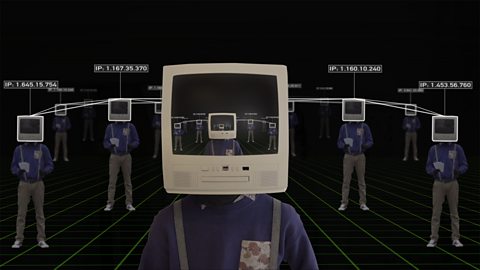
Narrator:
We all live with computers, but getting the most out of them, getting them to dowhat you need, can be kind of difficult. But if you can understand how they processthings, a computer can be the most useful housemate you'll ever have.
We can teach people to do all kinds of things if we give them a clear set ofinstructions, but some instructions are better than others. For instance, if you tellsomeone how to cook rice, you wouldn't tell them to do just one grain at a time.
Seriously. Computers need good instructions if you want good outcomes. For each taskyou want the computer to carry out, you have to give it the right list of step-by-step instructions or algorithm. Good instructions, algorithms, get the job done quicklyand don't go wrong.
So before you let your computer loose on your instructions. It'sa good idea to check your algorithm is going to do the job. What are you doing?Seriously? You need to evaluate it. Let's say you've devised an algorithm forcleaning the kitchen floor. After all, computers don't mind boring repetitive tasks.
But Before you program your computer, stop. Have you thought through whether youralgorithm is going to work?Test it. Give it a dry run and see.
Firstly, is your algorithm complete? Are there any steps missing?You might want to clear the kitchen floor before you clean it. Secondly,is the algorithm easily understood?
Sometimes instructions aren't as clear or specific as you think. Fill, bucket doesn'ttell you what with.Thirdly, is your algorithm efficient?There's often a way to speed things up.After a few dry runs, it's time to try the algorithm for real.
Thanks to our evaluation, this algorithm now works properly.Although, don't be surprised if there are still a few more problems to iron out.Muppet. Evaluating solutions, checking your algorithms before you use them.
Video summary
A teenage programmer evaluates the instructions she's written to tell her computer how to mop the floor.
She checks if they're in the right order, if she's included all the steps, and if her instructions are precise enough.
She tests them after each change to see if there is anything she has forgotten.
This clip is from the series How to Think Like a Computer.
Teacher Notes
Units of measurement can be discussed and linked to Mathematics, both for measuring the rice (cups) and also for filling the mop bucket (litres).
Students could flowchart these algorithms or write them in pseudocode and then peer assess/evaluate them for efficiency.
Discuss the contributions of women in IT such as Ada Lovelace as the main character is called Ada.
Discuss testing the algorithm during development and also after development.
Discuss the reason for efficiency in an Algorithm.
This clip will be relevant for teaching Computer Science at KS3 and KS4 in England, Wales and Northern Ireland and National 4 and 5 in Scotland.
What is abstraction? video
A teenage programmer finds out how to use abstraction in programming.

Searching Algorithms. video
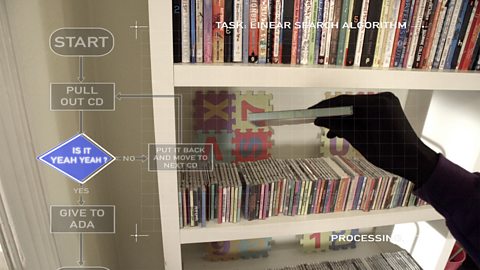
A teenage programmer tests how different types of algorithms can be used to speed up searching her massive music collection.
Online Safety. video
A teenage programmer (Ada) learns the importance of of being safe online with her friend Computer Head.