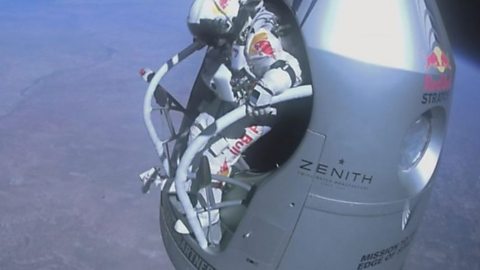
Narrator:Felix Baumgartner is attempting to break the record for the longest, furthest and fastest freefall. But before he even jumps, he will have to survive a trip through a death zone. An environment so inhospitable that it's impossible for any human to survive unaided.
Narrator:Felix isn't the first person to attempt to break the skydive record set by test pilot Joe Kittinger over 50 years ago.
Narrator:Not long after Joe set the record, another man tried to break it. But he wasn't as prepared for the hazards of high-altitude flight.
Narrator:Nick Piantanida was a 35-year-old skydiver 'who had dreams of beating Joe's record. Like Felix, Nick had no experience of working at extreme altitude.
Narrator:Life support engineer Mike Todd, who's responsible for the equipment that will help keep Felix alive, was also involved in Nick's attempt.
Mike Todd:Nick was going to 125,000ft. We supplied him with a parachute. Didn't quite have the backing that we have on this project.
Narrator:On the 1st of May, 1966, Nick took off in his gondola. A recording of his communication with mission control has survived.
Narrator:Midway through his journey, something went terribly wrong.
Mike Todd:He was probably up around 50,000ft. And some way or another, the visor was either opened accidentally or intentionally, we really don't know. The people on the ground immediately cut the balloon away from the gondola. By the time they got to him they found him outside of the gondola with the visor partially open.
Narrator:Nick was in a coma, caused by a condition known as hypoxia. He died four months later.
Mike Todd:So we're talking about the medical and physiological considerations of an extreme altitude jump.
Narrator:Felix's medical team want him to understand the risks of hypoxia and the other life-threatening conditions he will face at altitude.
Mike Todd:A definition of hypoxia, it's a deficiency of oxygen, these are the symptoms.
Mike Todd:You may get impaired efficiency, drowsiness, poor judgement, visual blurring, extreme fatigue. You're not really functional at that point.
Narrator:The lack of oxygen in the thin atmosphere at high altitude means Felix is at risk of hypoxia. He will need to breathe from a cannister throughout his mission. If this equipment failed above 45,000ft, he would fall unconscious in under 15 seconds.
Felix Baumgartner:If something goes wrong, you're all by yourself. And that is really scary. This is what I'm thinking about all the time.
Narrator:There's another danger Felix has to prepare for. It's called decompression sickness, or the bends. A condition also faced by divers.
Narrator:Air contains both nitrogen and oxygen, but nitrogen expands faster as pressure falls. When a person travels quickly from a relatively high-pressure environment to a relatively low-pressure environment, the result can be fatal.
Art Thompson:When you look at the bends, there's an example when you're diving, if you go down into the bottom of a pool, and you blow a bubble, that bubble is this big when you blow the bubble out, by the time it reaches the top, it's this big. So the nitrogen that's trapped in solution in your body, in your blood, if you go up too quickly that gas bubble is gonna expand, but it's in your veins, it's in your tongue, it's in your head. So you get the bends.
Narrator:Felix wears a spacesuit to protect against decompression sickness, but he also takes one final precaution to reduce the risk of nitrogen bubbling out of his blood at altitude. For an hour before his flight, he breathes pure oxygen.
Dr Jonathan Clarke:Oxygen pre-breathe is really important for this mission because it washes out nitrogen. So you breathe oxygen, wash out nitrogen, and reduce the chance of decompression sickness.
Narrator:But pre-breathing cannot protect Felix against the final and most terrifying danger he faces on his balloon trip to the edge of space.
Narrator:As Felix rises above 63,000ft, he passes through what's called the Armstrong Line. Above this point, atmospheric pressure becomes so low that all of the gases in his body will try to escape. It's a condition called 'ebullism'.
Art Thompson:The gas is trying to find the fastest path out of your body. You will start to ooze from your eyes, you'll start frothing at the mouth, out of every orifice you have, you'll start to ooze. It's like the worst possible horror film.
Narrator:On the day of Felix's record-breaking jump, his pressure suit and oxygen supply worked perfectly. All of the team's precautions and hard work paid off. And Felix got safely up to 128,000ft.
Video summary
This short film, first published in 2012, is for teachers and review is recommended before use in class.
Please note that Felix died in July, 2025, aged 56.
As Felix Baumgartner made his ascent to 128,000ft, he risked several life-threatening conditions. The atmosphere at the edge of space is so inhospitable that it would be impossible for any human to survive unaided. As he traveled upwards, the oxygen in the upper atmosphere became increasingly sparse and he risked a condition known as hypoxia. His body would have not been able to supply his tissues with enough oxygen and he would have quickly lapsed into unconsciousness.
Pressure also decreases at extreme altitude and, without specialist equipment, Felix could have suffered two other lethal conditions. As the pressure fell, the nitrogen trapped in solution in his body would bubble out, leading to decompression sickness; a condition more commonly known as the bends. However, at 63,000ft, Felix passed through the Armstrong line, a deadly threshold where all the gasses trapped in the body begin to escape. Without protection Felix would have suffered an ebullism as all the fluid in his body boiled.
Teacher Notes
The clip could be used to stimulate a discussion about the effects of altitude on the human body. Using an oxygen-haemoglobin dissociation curve, students could be asked to consider the effect of low concentrations of oxygen and decreasing pressure on the body's ability to uptake oxygen. Students could also be asked to examine some of the physiological responses that the body makes adapting to living in high altitude environments, and why some athletes choose to train in these conditions.
This is the fourth of six clips from ‘The Science of Space Dive’ and this clip could be used in conjunction with the others.
This clip could be relevant to teaching Science at KS3 and KS4 in England, Wales and Northern Ireland and at National 4/5 or Higher in Scotland.
The Science of Space Dive (pt 5/6) - The physics of free-fall. video
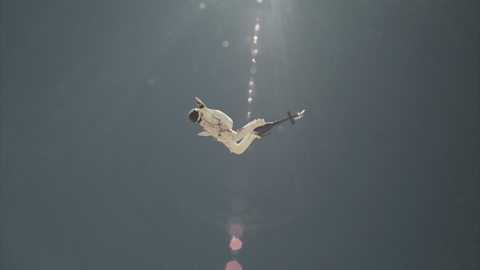
Felix biggest fear was that as he fell he could become locked in a flat spin.
The Science of Space Dive (pt 6/6) - Free-falling through the sound barrier. video
On his record breaking free-fall Felix Baumgartner broke the sound barrier.
The Science of Space Dive (pt 1/6): The world's biggest skydive. video
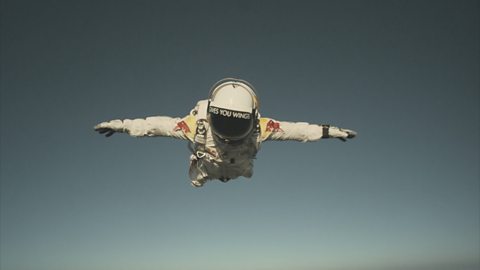
An overview of challenges faced by scientists, engineers and doctors ahead of Felix Baumgartner's record-breaking and historic skydive