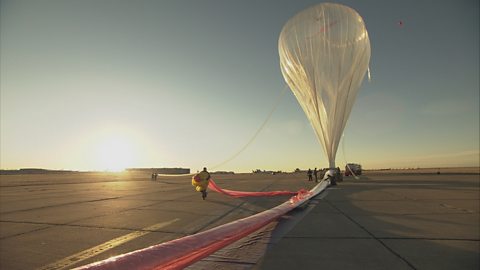
Narrator:Felix Baumgartner is attempting to freefall from 128,000ft. Five times higher than the maximum altitude normally attempted by skydivers jumping from a plane.
Narrator:His team have to anticipate the extra risks of falling from such an extreme height. Their biggest fear is that as Felix falls he could go into what's known as a flat spin.
Luke Aikins:What causes a flat spin is an odd position in freefall, if you have one extremity sticking out more than the other, the faster you go, the more drag affects what you do. So if I have one arm off a little more than the other arm and I don't notice it, it can cause me to spin.
Narrator:Felix is jumping into a near-vacuum at the edge of the Earth's atmosphere. This means any changes in his body position could spell disaster.
Art Thompson:Flat spin is a really serious concern. In a vacuum there's very little to stop motion. The fear is that if Felix starts spinning up at any kind of a rate it could get to the point where he would not be able to control it.
Narrator:This is what happened to Felix's mentor, Joe Kittinger, on one of his jumps, over 50 years ago.
Joe Kittinger:When I was freefalling, all of a sudden I had this violent rotation. And it was so violent I could not pull my arms in. I couldn't do anything. I was just… paralysed.
Narrator:Joe's camera captured just how violent this spin was.
Joe Kittinger:In fact I spun at 120rpm. I was unconscious. I could have died.
Narrator:There are two types of flat spin. Both can be deadly. If Felix spins with his head at the center, then the g force will pull the blood out of his brain causing a blackout.
Narrator:If his feet are at the center, then the blood will rush into his brain, causing what's known as a red-out, which could cause an aneurysm or brain damage.
Narrator:Joe only survived his spin because his parachute fired automatically. But Felix will be freefalling too fast for any normal automatic parachute. So his team throw themselves at the problem. How do you stop a supersonic flat spin?
Luke Aikins:How much of a spin is too much for you to recover from? Nobody really knows.
Lady:Stop, stop, stop!
Luke Aikins:It stopped.Was that fast enough that time?
Luke Aikins:When I'm spinning so fast I can't bring my arms in, that's too much of a spin, that was my first take on it. But I didn't know how much that was, so I went up and skydived and I tried different things and I took a g-meter up to see how much the gs spun and what the effect was.
Narrator:Luke tests lots of systems, but can't find one that will cope with the g-force Felix will achieve. Then he has a brainwave. 'To borrow a technology used by the military to guide supersonic bombs. It's called a drogue parachute.
Luke Aikins:We have a specially designed drogue that can handle supersonic speeds, and we've attached it at his shoulders rather than in the middle of his back like when normal skydiving. So I'm out of control, fire the drogue, boom. It just grabs you and flips you right side up. Pretty amazing how well that works.
Narrator:But there's still a problem. If Felix is spinning so fast that he can't move his arms, how can he pull the drogue?
Luke Aikins:So now I'm gonna spin this thing around. If he's spinning about this fast for six seconds we came up with a device that will automatically fire the drogue. You'll see the light some on and the drogue, boom, the drogue fired.
Narrator:In Felix's record-breaking jump, he did go into a spin.
Joe Kittinger:He's spinning, isn't he?
Narrator:But he didn't spin long enough for his drogue to fire. He managed to regain control.
[CHEERING]
Narrator:And land safely.
Joe Kittinger:Woohoo-hoo-hoo!
[APPLAUSE]
Video summary
This short film, first published in 2012, is for teachers and review is recommended before use in class.
Please note that Felix died in July, 2025, aged 56.
Felix Baumgartner’s team had to anticipate the risks of falling from high altitude. Their biggest fear was that as Felix fell he could become locked in a flat spin and lose consciousness. A flat spin would have been caused by his body becoming aerodynamically unbalanced, sending him into a rotation that he might not be able to escape. If his head was at the centre of the spin, the g-force would pull the blood out of his brain, causing a blackout. If his feet were at the centre, the blood would have pooled in his head, causing a redout or an aneurysm.
Teacher Notes
The clip could be used to stimulate a discussions about gravity, free fall, air resistance and terminal velocity. Can they think of any other times when these dangers need to be overcome?
This is the fifth of six clips from ‘The Science of Space Dive’ and this clip could be used in conjunction with the others.
This clip could be relevant to teaching Science at KS3 and KS4 in England, Wales and Northern Ireland and at National 4/5 or Higher in Scotland.
The Science of Space Dive (pt 6/6) - Free-falling through the sound barrier. video
On his record breaking free-fall Felix Baumgartner broke the sound barrier.
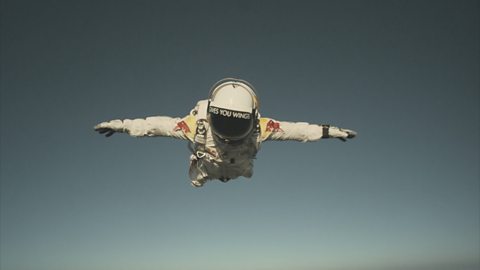
The Science of Space Dive (pt 1/6): The world's biggest skydive. video
An overview of challenges faced by scientists, engineers and doctors ahead of Felix Baumgartner's record-breaking and historic skydive
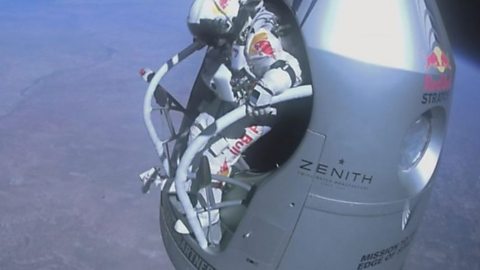
The Science of Space Dive (pt 2/6) - The balloon. video
To raise Felix 24 miles above the earth’s surface he flew the largest manned balloon ever.