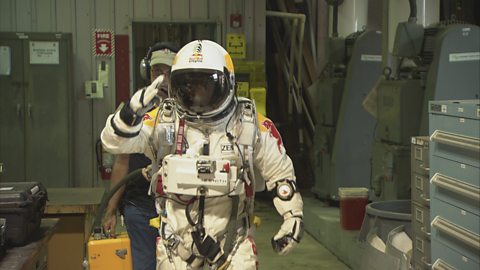
Narrator:For Felix to skydive from higher than anyone has ever dared, he must also do something no human has ever done. Free-fall through the sound barrier. In a computer animation, it looks straightforward enough. But the reality is no-one knows if this is even possible.
Art Thompson:We're putting Felix into a condition that really has never been done, and has never been documented, for sure. So we don't know what happens to the body at the speed of sound.
Narrator:Felix practises freefalling at an angle that gives him the best chance of going supersonic quickly and safely. It's called the delta position. Arms back, tilted forward, head down.
Narrator:But first, he'll have to break through what's known as the transonic wall. This is the moment when some parts of Felix's body begin to go supersonic, while other parts are still subsonic. These tiny differences in speed could cause violent vibrations.
Art Thompson:What occurs is there's a pressure wave. 'Cause if you can imagine an air molecule suspended in the air, and as this object is coming by, trying to reach the speed of sound, these air molecules are crashing into each other, they have to get out of the way. So it creates this pressure wave. As it goes out of the transonic phase, you'll find different areas going into supersonic at different times. These different wave patterns create a convergence, where the waves shock against each other causing a buffeting.
Narrator:In early supersonic jets, this caused extreme vibrations. In Felix, these could damage his organs, and even kill him. But none of these risks were enough to stop him from making his record-breaking jump.
Narrator:On October the 14th, 2012, Felix Baumgartner became the fastest skydiver in history. He went faster than a jumbo jet after 25 seconds. Moments later, faster than a .45 calibre bullet. And after 35 seconds, he broke the sound barrier.
Narrator:The speed of sound is affected by altitude and temperature. Felix fell at temperatures of -45 degrees Celsius. Cold air and low pressure enabled him to go supersonic at around 690mph. Some 10 miles an hour less than at normal air pressure at ground level. As Felix fell back to earth, 'the denser air in the lower atmosphere acted as a drag on his body, slowing him down.
Narrator:Felix's speed fell from supersonic to subsonic, eventually reaching his maximum terminal velocity. This meant that he could no longer continue accelerating.
Felix Baumgartner:I'm pulling my parachute.
Felix Baumgartner:Yes!
Video summary
This short film, first published in 2012, is for teachers and review is recommended before use in class.
Please note that Felix died in July, 2025, aged 56.
For Felix Baumgartner to skydive from higher than anyone has ever dared he must also do something no human has ever done: free-fall though the sound barrier. In a computer animation it looks straightforward enough, but the reality is no one knows if this is possible. To be able to go supersonic Felix will have to break through the transonic wall; at this moment some parts of his body begin to go supersonic while other parts remain sub-sonic. This could cause violent vibrations which could damage his organs or even kill him.
Teacher Notes
This clip could be used to stimulate discussion about gravity, free fall, air resistance and terminal velocity. Ask the students if they can they think of other examples of attempts on world records where science has played a part and the person doing the project put themselves in danger?
This is the last of six clips from ‘The Science of Space Dive’ and this clip could be used in conjunction with the others.
This clip could be relevant to teaching Science at KS3 and KS4 in England, Wales and Northern Ireland and at National 4/5 or Higher in Scotland, and Cambridge IGCSE Physics.
The Science of Space Dive (pt 1/6): The world's biggest skydive. video
An overview of challenges faced by scientists, engineers and doctors ahead of Felix Baumgartner's record-breaking and historic skydive
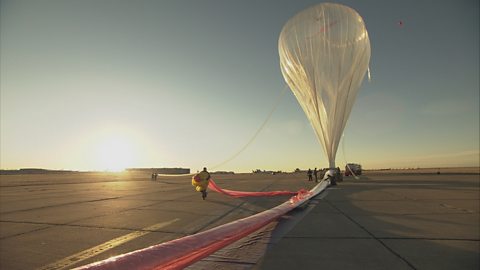
The Science of Space Dive (pt 2/6) - The balloon. video
To raise Felix 24 miles above the earth’s surface he flew the largest manned balloon ever.
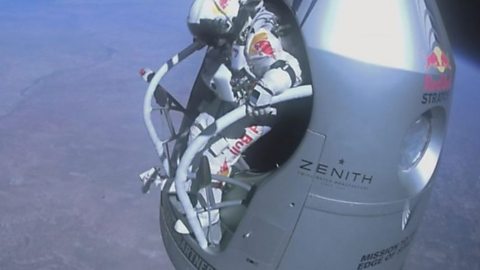
The Science of Space Dive (pt 3/6) - The pressure suit and space capsule. video
The important role of Felix Baumgartner's pressure suit and space capsule in his dive.