Narrator:On Sunday the 14th of October 2012…
Sage Mission Control:Sage Mission Control, we're in perfect conditions for launch.
Narrator:The world watched as Felix Baumgartner climbed aboard a space capsule and flew a balloon 39km above the Earth.
Mission Control:We are away, Felix is away.
Narrator:At 128,000ft, he left the capsule, stood on a tiny step…
Narrator:and jumped.
Narrator:He became the first person to freefall faster than the speed of sound.
Narrator:This incredible achievement took skill, bravery and cutting-edge science.
Narrator:It took a team of engineers and doctors four years to prepare Felix for the task.
Felix:It sometimes feels like… I can't do it. It's just too much.
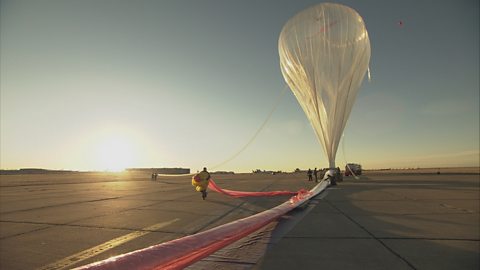
Narrator:They had to build the biggest balloon ever made for manned flight, and battle the weather just to get it off the ground.
Narrator:They had to engineer a pressurised capsule to protect Felix from the deadly environment at 128,000ft.
Space Plumber:I call this a plumbing diagram. We're space plumbers.
Narrator:Felix had to survive in a place where low pressure and lack of oxygen could kill him in an instant.
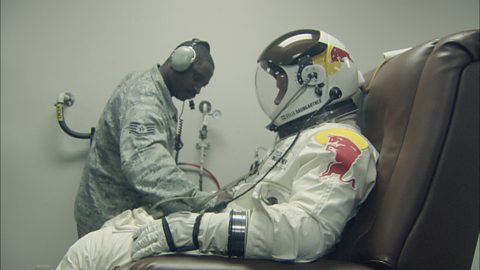
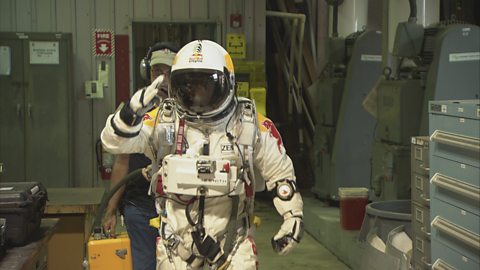
Narrator:They had to design a next-generation pressure suit that Felix could skydive in.
Joe:It's a piece of art.
Narrator:They had to study flight aerodynamics and overcome the dangers of a super-sonic spin.
Joe:He's spinning, isn't he?
Narrator:Felix had to break a record that was set over 50 years ago by this man, Col. Joe Kittinger.
Narrator:In 1960, nine years before man first stepped on the moon, Joe took one of the first journeys to the very edge of the Earth's atmosphere.
Narrator:His mission was to lay the foundations for space travel. And to see if a pilot could survive a bail out at extreme altitude. At just over 100,000ft, Joe leapt from his balloon.
Joe:Took a deep breath. I said, "Lord, take care of me now".
Narrator:The data from his jump helped develop a parachute escape system still used by high-altitude pilots today.
Narrator:Joe came out of retirement to help Felix break his own record. Together, they pushed the boundaries of science to get Felix safely through the sound barrier and into the record books.
Joe:Felix you're up. We're so proud of you. You did absolutely fabulous, absolutely fabulous. I couldn't have done any better myself.
Video summary:
This short film, first published in 2012, is for teachers and review is recommended before use in class.
Please note that Felix died in July, 2025, aged 56.
On Sunday 14 October 2012, Felix Baumgartner set the record for the fastest and highest skydive in history.
To do this Felix and his team of scientists, engineers and doctors had to push the boundaries of science to the very limit; in order to get him safely through the sound barrier and into the record books.
Along the way, Felix flew the largest manned balloon ever and helped to develop a new generation space suit.
This clip gives an overview of the main challenges the team faced from the outset.
It also introduces the history behind the record set by Colonel Joe Kittinger in 1960, which they were trying to break.
This is from the series: The Science of Space Dive - Learning Zone
Teacher Notes
This clip could be used to show students how an elite team, from various disciplines across science and engineering, worked together to achieve a common goal.
This clip is relevant to teaching Science and Physics at KS3 and KS4 in England, Wales and Northern Ireland and at 3rd and 4th Level in Scotland.
The Science of Space Dive (pt 2/6) - The balloon. video
To raise Felix 24 miles above the earth’s surface he flew the largest manned balloon ever.
The Science of Space Dive (pt 3/6) - The pressure suit and space capsule. video
The important role of Felix Baumgartner's pressure suit and space capsule in his dive.
The Science of Space Dive (pt 4/6) - The dangers of altitude. video
In his ascent to 125,000ft Felix Baumgartner risked several life-threatening conditions.