Overview of Planet Planners on Roblox
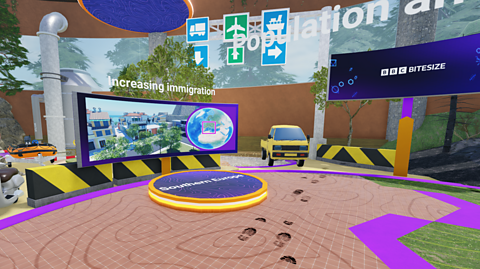
Planet Planners on Roblox is an engaging way for students to learn about some of the world's most pressing challenges – from preparing for natural disasters to managing large cities.
A decision-making exercise game with geographical thinking at its core, it also builds key skills such as teamwork, time management, resilience, problem-solving and decision-making.
It is accessed via Roblox – an immersive platform for 3D experiences. To learn more about Roblox and how it can be used in education, visit Get started with Roblox Education.
For more detailed information about the game, visit How to teach using Planet Planners on Roblox.
Scenario description
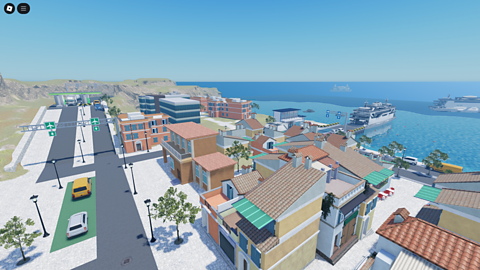
In this scenario, players take on the role of decision-makers, aiming to attract and support new immigrants.
They must analyse data, make decisions and allocate resources to attract workers, support local training programmes and manage resources for a growing population.
Players must think critically about how immigration can contribute to a vibrant, diverse society, while balancing long-term planning with immediate needs.
Approximate location: Southern Europe
Teacher notes
Download/print the teacher notes for this scenario (PDF).
Teacher notes prepared in partnership with the Geographical Association.
Learning objectives
- To identify the reasons why people migrate.
- To make decisions about immigration.
- To examine the impacts of immigration on people, the economy and the environment.
Key decisions
- Should we recruit skilled migrant healthcare workers or invest in training the local workforce?
- How can we attract and retain international students?
- Should we train local drivers or attract experienced migrant HGV (heavy goods vehicle) drivers?
- How can we improve border security while maintaining a welcoming environment?
- Should we build temporary accommodation or invest in permanent housing for new arrivals?
Key geographical terminology
Migration: The movement of people from one area to another. A migrant is someone who moves from one place to another.
Immigration: The movement of people into a country.
Overseas students: An individual who is not a permanent resident of the country where they are studying.
Border security: Measures to stop people entering a country illegally.
Biometric scanners: Devices used to capture information like fingerprints and faces to verify the identity of an individual.
Think, work and apply like a geographer
Encourage students to explore the links between gameplay and real-world job roles, such as:
- migration policy advisor
- health policy advisor
- logistics manager
- border security officer
- housing officer
Questions to explore
- What are the benefits and challenges of immigration for a country’s economy and society?
- What infrastructure and services are needed to support new arrivals?
- How can technology improve border control while ensuring fair treatment of travellers?
- What are the short-term and long-term effects of temporary/permanent housing solutions?
- What role do international students play in the economy and society?
- Who decides who is allowed to move to a country and under what conditions?
Emotional and ethical considerations
Ethical decision-making: How can we ensure that migrants feel welcomed and supported in their new communities? Should priority be given to those already living in the region or to newcomers with specialist skills? How do we balance the need for secure borders with the rights of individuals? Are short-term fixes (like temporary housing) enough, or do we have a responsibility to build sustainable communities?
Fear and uncertainty: Starting a new life in a different place can make people worry about whether they will be accepted andfeel happy in their new home. Consider whether players may have direct experience of these feelings.
Resources
Teacher notes
Download/print a copy of the teacher notes for this scenario (PDF).

Student worksheet
Download/print a copy of the student worksheet (PDF).
Explore more
Support classroom learning with BBC Bitesize resources.
Note: Some video content may only be available in the UK.
Migration
Find out the differences between migration, immigration, and emigration.
Immigration and emigration
An animation for KS3 students on the impact of migration to, from and within Britain over time.
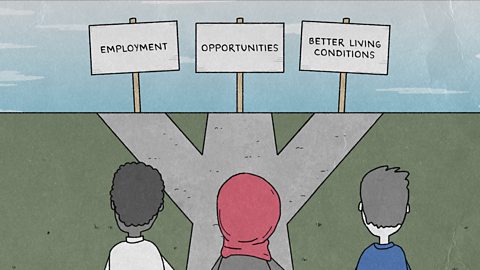
What is migration?
Discover why people move from place to place, the difference between voluntary and forced migration, and what pushes or pulls them to make the move.
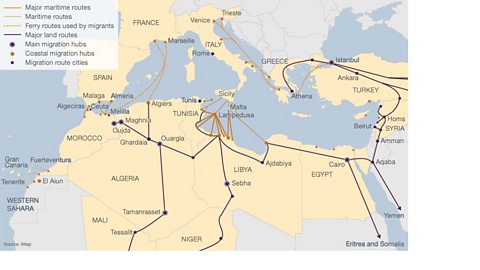
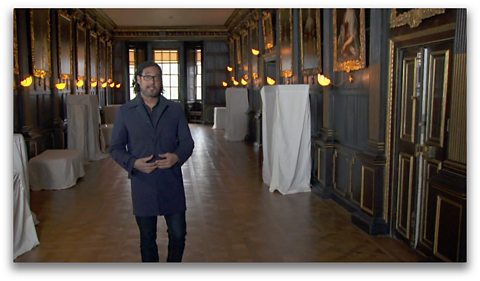
Migration video collection
David Olusoga investigates the lives and experiences of migrants to and from Britain throughout history.
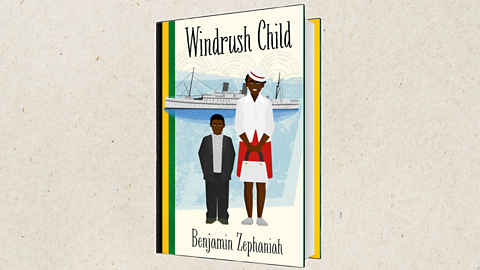
Windrush Child by Benjamin Zephaniah
Explore Windrush Child by Benjamin Zephaniah with BBC Bitesize KS3 English Literature. For students between the ages of 11 and 14.
Migration (Wales)
Looking at the causes, types and impacts of migration, including push and pull factors and different forms of population movement.