What is migration?
- Migration is the permanent movement of people from one place to another.
- It is something that can happen both over long and short distances.
- The place that people leave is called the origin and the place they move to is the destination.
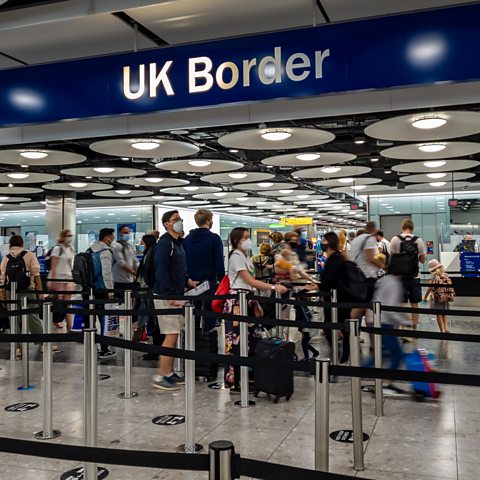
- When people move from one country to another it is known as international migration.
- Some people will move by choice - voluntary.
- Others will have to move - forced migration.
- Forced migration includes refugees and asylum seekers.
The decision to migrate is influenced by two groups of factors:
- Conditions at the origin that encourage people to leave are called push factors (negative)
- Conditions at the destination that encourage people to move there are pull factors (positive).
Barriers to migration
Most international migrants face a series of difficult decisions when they decide to migrate. Moving from one country to another is never easy and any migrant needs to weigh up the push and pull factors that will cause them to move. Often there will be a number of barriers that could get in the way to their migration:
Human barriers to migration
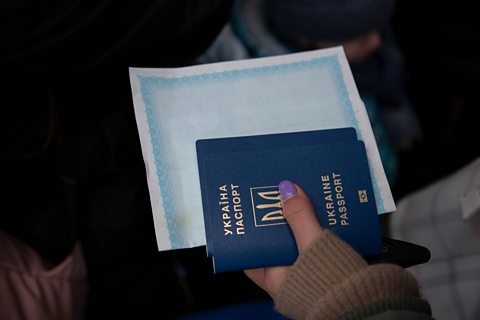
- Today international migrants usually need several documents to move to another country, such as passports, visas and work permits.
- There are normally strict legal restrictions on migrants moving to another country.
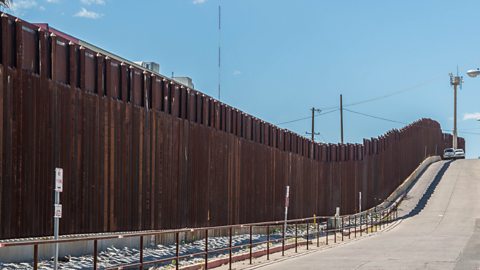
- Many countries have constructed barriers such as fences and patrol their borders to stop people entering illegally.
Physical barriers to migration
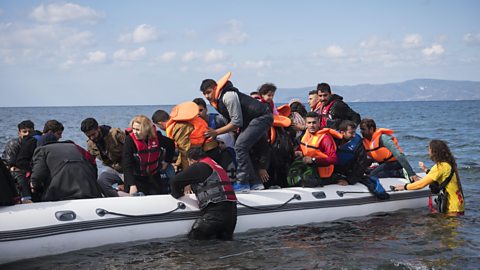
- International migrants may also have to endure physical challenges to get to the country where they want to live.
- Many refugees and asylum seekers have to climb over mountain ranges, walk through deserts or take risky sea journeys.
Economic migrants, refugees and asylum seekers
Economic migrants
- Economic migrants are people who have taken a decision to move to a new country so that they will improve their standard of living.
- They might be aiming to get a new job or better pay for providing the same service.
- This is an example of voluntary migration.
Refugees
- A refugee is someone who is trying to escape from a major event like a war, a natural disaster, disease or famine.
- The United Nations define a refugee as a ‘person who cannot return to his or her own country because of a well-founded fear of persecution for reasons of race, religion, nationality, political association or social grouping.’
- This is an example of a forced migration.
- Refugees are sometimes forced to live in very cramped and unsanitary conditions.
- Water can be scarce and people will need to rely on aid agencies for food, water, shelter and medicine.
Asylum Seekers
- Asylum seekers are people who have travelled to and arrived in a different country who claim that if they are forced to return home they will face persecution, punishment, torture or death.
- They are seeking to be given the status of refugee and permission to stay.
Video: Asylum seekers
Watch the video to find out how we can welcome asylum seekers and help them integrate into our society.
DIRECTOR: Standby on the floor.
DIRECTOR: Coming to you camera two.
DIRECTOR: Cue on two.
DIRECTOR: Mix-through.
MAX: No time for that! Hello! I’m Max Heartrate and this is Knowledge Express.
MAX: Information faster than a cheetah on roller skates. And today’s topic is…
MAX: Migration!
MAX: No! Not birds. Yes, birds migrate but today in fact, we’re talking about people migrating. Of course, they don’t fly –
well actually some of them do fly in planes – and some migrate by boat.
MAX: Anyway the point is that thousands of people arrive here every year to make a new life for themselves. And today we’re answering the question WHY?
MAX: Well, there are four main reasons: Firstly, to work. Secondly, because they have family already here. Thirdly, to be educated and fourthly because they are seeking asylum. That means they are fleeing their home country because it isn’t safe.
MAX: These are all perfectly acceptable reasons to come to Northern Ireland but the last one is extremely important. Many asylum immigrants arrive with no money, nowhere to stay and no English.
MAX: Imagine if you had to leave Northern Ireland because your life was in danger and end up in a different country where no-one understood you and you had no money and no-one to turn to. You’d hope that someone would help you out yeah? Exactly!
MAX: So, here’s a few examples of what we can do to make sure that migrant asylum seekers are made to feel welcome. Firstly, find them somewhere to stay, temporary at first and then a permanent home. Secondly, teach them English. Thirdly, help them get a job and fourthly, help them integrate with the local community. It sounds like a lot, but do you know what? It’s worth it.
MAX: Not only do migrant workers help us grow our economy, they contribute to the overall diversity of our society and help build connections through different languages, different cultures and some very, very nice food. Muh! As we like to say, “it’s dead on so it is!”
Legal and illegal migrants
Most migration is of ‘documented’ migrants, who have permission and the correct paperwork to remain in the destination country. Others, often ‘undocumented’ migrants attempt to get around the migration system by entering a country illegally.
This has led to some countries going to extreme lengths to protect their borders. Border patrol forces are employed to patrol along tall fences and border walls to control the number of illegal migrants who might want to gain access to a new country.
Refugee migrations
The UNHCR (The United Nations High Commissioner for Refugees) is the organisation that takes a lead in taking action to help protect refugees around the world.
In 2023, the UNHCR reported that in Europe there were over 12 million refugees and 1.3 million asylum seekers. However, globally there were 37 million refugees and over 6 million asylum seekers reported.
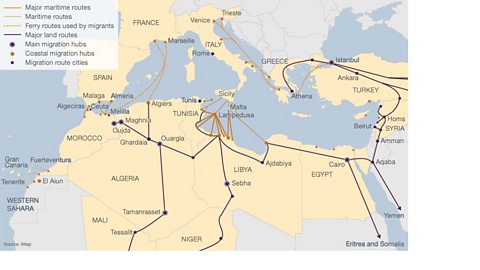
Since 2008 there has been a large increase in the number of people who have been attempting to migrate using a variety of routes across the Mediterranean sea.
During 2011 UNHCR recorded that over 60,000 people fled to Italy from North Africa, in 2022 the number has risen to 104,000.
How did the conflict in Syria cause refugee movements?
The amount of migration in Europe has increased in recent years due to the conflicts in Syria and Ukraine. As a result many millions of people have migrated across Europe.
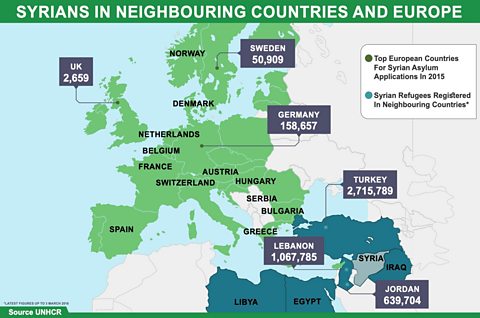
In 2011, the Arab Spring protests in Syria escalated into a complicated armed conflict. By 2020, an estimated 500,000 people had died and around 11 million Syrians had left the country, becoming refugees.
Around 3 million of these refugees have remained in the neighbouring country of Turkey. The Turkish government has given more than $8 billion of aid to these refugees and has set up 22 camps near the border for them to live in.
Quiz: Take the test
More on Human Geography
Find out more by working through a topic
- count3 of 5
- count4 of 5

- count5 of 5

- count1 of 5