| 13 November 2014 |

| |
| BBC Homepage | | |
| |||
| Contact Us | | |
ProfilesYou are in: Suffolk > People > Profiles > The taboo and you 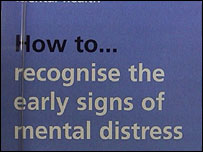 MIND leaflet The taboo and youBy Andrew Woodger The BBC's Headroom project is aiming to dispell some of the myths surrounding mental illness which one Suffolk charity claims is likely to be touch us all. "There was a poll of 100 MPs by the All Party Parliamentary Group on Mental Health a while back and a fifth said they'd suffered from some form of mental ill health," said Jax Devonshire, who's the Development Manager at West Suffolk MIND in Bury St Edmunds. "However, when asked if they'd ever told anyone, many said 'no' because they claimed the tabloids would have a field day with 'Loony MPs running the country' type headlines. "That's the problem. Most of us at some point have had something that would be classed as mental illness if you look at it from the point of asking 'Am I 100% top-notch?' "Most of us most days are going to say we're fine, but a bit worried about this a bit depressed about that. That's mental ill-health. "It's as if people go out of the real world [once they've got a mental illness] and they're never allowed back in." Watch one Suffolk man's film about dealing with mental illness: Help playing audio/video (Click on the BBC link on the right for more about the survey of MPs.) One in four - or one in one?An earlier MIND campaign came up with the statistic that at any one time one in four of us will be suffering from some form of mental ill-health. Jax Devonshire said that could be interpreted further:  MIND, Long Brackland, Bury St Edmunds "When MIND came up with that figure it was powerful and shocked people. It wasn't supposed to panic people, but I think it needs to go further." If, at any one time, one in four of us has problems, then over a lifetime the figure will get even closer to touching four in four. "We actually need to have a one-in-one campaign, because one-in-four still allows people to say 'oh,well. It's not me'. And, of course, the statistics didn't mean that out of any four people only one would have a problem. "It could be a different one at a different moment in time. "Of the one in four, only one out of 50 would have a serious problem, the rest would have a bout and get better, so it's not a big, scary statistic. "I challenge any adult to say they've never had any qualms about anxiety or depression. It's every single one of us." Taboo or not tabooJax Devonshire is the Development Manager for West Suffolk Mind: "I think it's partly historical. It comes from the fear that people didn't understand why other people were acting in the way they were. "The assumption was that people were bad or dangerous or they'd brought it upon themselves. It's tied in with the assumption that people may never get better - they're 'broken for good'. "In reality, in most cases, people who suffer mental illnesses recover fully and they're stronger because they've been through that experience. "If you talk to people about mental illness, the assumption is that it's really serious - it's lifelong schizophrenia, it's clinical psychosis, it's people behaving in a dangerous manner. "What people don't think is, if you're a bit depressed when your cat's died, that's the state of your mental health being affected by an event. "If you go to work on a Monday with backache because you've been gardening, you might expect some sympathy. There should be a similar way of being able to talk about how we feel and think and what's going on in our minds, because the two things are linked. "If you've got a broken leg and can't exercise, you might be a bit depressed and it works the other way round - if you're depressed you might not feel like doing any exercise. "People don't tend to think of the lower end of the scale - a bit of anxiety, a bit of depression, a bit of loss-of-confidence. They all affect your physical health and the two are linked together." MIND expandingMIND offers support to people with 'mild and moderate' problems rather than those of us with 'severe and ongoing' problems. It's a charity funded to the tune of around £4.5m across Suffolk by trusts, foundations, donations, legacies and government contracts for services such as counselling.  MIND's information display East and West Suffolk MIND are separate entities employing 353 full and part time staff, volunteers and external facilitators between them. There are supported flats for 113 clients across the county1. They offer a variety of programmes including counselling, general advice, cognitive behavioural therapy, care for carers, employment advice and self-help groups. Jax Devonshire at West Suffolk MIND said: "If you sat a bunch of staff and a bunch of service-users in a room, you would not be able to tell who was who, because everybody has got jobs and lives and is carrying on. "It's almost like [mental illness] is unforgivable. It's 2008, not 1808, but it's not going to be different until we can find different words and a different way to talk about mental illness." But is the problem that all the range of conditions get grouped together under the 'mental health' label? "Mild anxiety or severe psychosis get lumped under 'mental illness' and people are scared of that. There shouldn't be a dividing line - it should all be part of a spectrum. "At the very mildest/moderate end of the scale it might be people who are in work but recognise their anger is getting out of control. Or maybe their depression is starting to become something more than they can cope with. "They might come to us for an evening course. No-one else knows - they might as well be going to do a college course in French. "I think we need to realise that mental health is a state, just as physical health is. At any given moment, sometimes it's better than at other times. Watch one Suffolk man's film about dealing with mental illness: Help playing audio/video "It shouldn't be an us-and-them thing. This can happen to any of us at anytime and probably will or already has." Visit the BBC Headroom links on the right for more about the campaign. 1 MIND figures 2008. last updated: 17/10/2008 at 17:09 Have Your SayIs it a realistic claim that we all suffer from some form of mental ill health at some time? |
| | About the BBC | Help | Terms of Use | Privacy & Cookies Policy |