Age Regardless of when in the year they are foaled, all horses celebrate their first birthday on the 1 January the following year.
Blinkers
Because horses have eyes on the sides of their head, their range of vision is very wide. Blinkers are sometimes used to ensure the horse looks straight ahead, the theory being that its attention will not wander.
Colours
Colours (or silks) were first used in 1762 to help racegoers distinguish the horses in any given contest. Shades and patterns are limited.
Distances
The official margin of distance - calculated by the judge's computer - between horses at the end of the race.
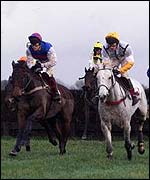 The Hennessy Gold Cup is one of the season's top handicaps
|
In Britain, the terms of distance used are: short head, head, neck, half a length, three-quarters of a length, length, 1 and a quarter lengths, 1 and a half lengths, 1 and three-quarter lengths, two lengths, two and a half lengths, three lengths - and so on until 30 lengths.
Anything over 30 lengths is called a distance.
Length refers to the length of a horse's body.
Entries
For most races, entries must be made five days before the day of the race. For high-profile races, entries are made several months before.
Furlong
A furlong is 220 yards - there are eight furlongs in a mile.
Gelding
A horse which has been castrated. Most National Hunt horses are gelded.
Handicap
Type of race in which the best horse is allocated a weight to carry and other horses given decreasing weights in accordance with their ability (which is decided by an official "handicapper") in order to create a closer race.
In theory, a "perfect" handicap would see all the horses finish in a dead heat.
Because handicaps are theoretically more even races, they are popular betting mediums.
Injured Jockeys' Fund
One of racing's most famous charities. It was set up in 1964 to help jockeys whose career had been curtailed by injury.
Former amateur jockey and TV pundit John Oaksey is one of the driving forces behind the charity, which produces a Christmas card every year, seemingly sent by anybody with any connection to racing.
Judge
Racecourse official who adjudicates in the case of a photo finish and who declares the distances between the horses that finish in placed positions (this is done by computer).
King George VI Chase
A Grade One 3m chase, which takes place on Boxing Day at Kempton Park.
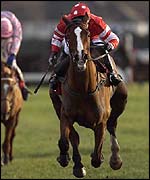 Florida Pearl won last year's King George VI Chase
|
While the Cheltenham Gold Cup is the sport's blue riband chase, many believe the King George winner to be a better test of a true 3m chaser.
Lambourn
The training centre of the National Hunt world. Current trainers with yards there include Nicky Henderson and Noel Chance while previous legends include Fred Winter and Fulke Walwyn.
Mare
Female horse which is five years old or over.
Novice
A horse who has not won a race under that particular code (either chasing or hurdling) in that season
Overweight
Sometimes a jockey is unable to slim down to the weight allocated to a particular horse. Any overweight must be declared.
Place
A placed horse is one that finishes in the first two (if there are five, six or seven runners) or the first three (eight or more runners) - or the first four (in a handicap of 16 or more runners).
Queen Mother
The Queen Mother's death in March 2002 deprived National Hunt of its most famous owner and fan.
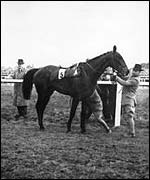 Devon Loch was the Queen Mother's most famous horse
|
Her first winner over fences was in 1949, her last came less than a month before her death. She had over 400 winners in total and was leading owner five times. Among her big-race wins were the King George VI Chase (Manicou in 1950), the Whitbread Gold Cup (Special Cargo in 1984) and the Stayers' Hurdle (Antiar in 1965).
But as far as her horses go, she will be best remembered for a race she did not win.
Devon Loch led the 1965 Grand National until 50 yards from the line when he inexplicably lost his footing and sprawled on the turf.
Retainer
The fee paid by an owner or trainer to secure priority on a jockey. A rider can have more than one retainer but there is always a pecking order in case of a clash.
Seller
The lowest class of race after which the winner is sold at auction.
Trifecta
The flagship bet of the Tote, which involves picking the first three to finish in a race.
Under starter's orders
This is the moment when the starter is ready to allow the horses to start a race. After this point, all bets must stand, even if a horse refuses to actually start.
Visor
Type of blinkers, used to make a horse concentrate.
Weighed in
All jockeys are weighed (with their saddles) before a race to ensure they are carrying the correct weight - this is known as "weighing out". After the race, jockeys who have ridden a horse that is placed must then "weigh in". They must not weigh in at more than a pound less than they weighed out.
X-ray
With jump jockeys falling on average once every 10 rides, having an X-ray becomes a regular occurrence.
Yearling
All horses share a birthday - 1 January. They become yearlings on the first New Year's Day after they have been foaled.
Zodiac
For those who follow the stars, the zodiac signs of some leading personalities are: Jockeys - Tony McCoy (Taurus), Richard Johnson (Leo), Charlie Swan (Capricorn); Trainers - Martin Pipe (Gemini), Aidan O'Brien (Libra), Paul Nicholls (Aries).





 E-mail this story to a friend