Power, width & barnstorming Earl - how England attack sparked into life

England boast an array of attacking options including (from left) scrum-half Alex Mitchell, utility back Tommy Freeman, wing Immanuel Feyi-Waboso and back-row Ben Earl
- Published
England begin their Six Nations campaign against Wales on Saturday having won their past 11 matches and completed their first unbeaten four-Test autumn in nearly a decade.
With recent results driven by greater ambition in attack, BBC Sport examines whether England's firepower can prove decisive in their hunt for a first Six Nations title in six years.
When England had the worst attack
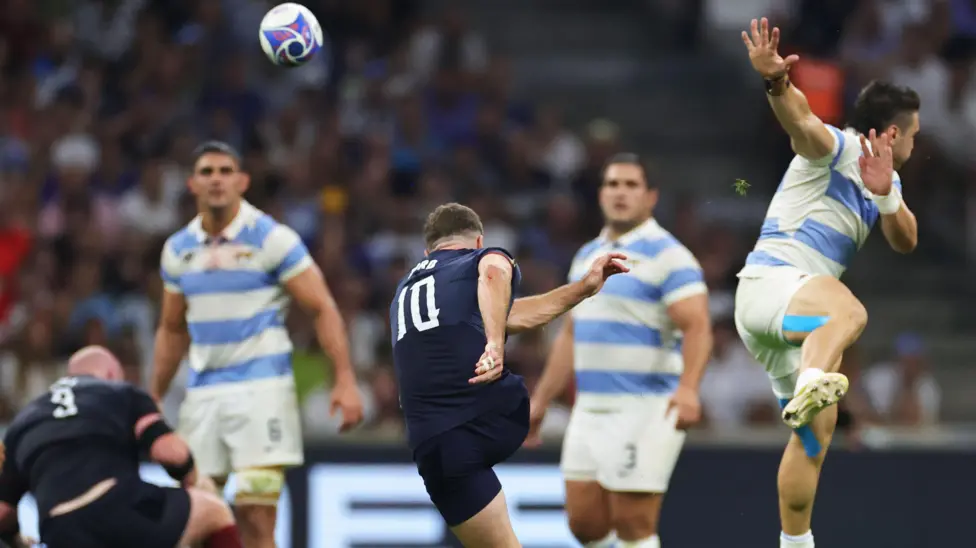
England defeated Argentina in the group stage of the 2023 Rugby World Cup with all 27 points coming from the boot of fly-half George Ford
Rewind to three years ago and England were effectively the worst attacking side in the top tier of Test rugby.
Steve Borthwick had been appointed as head coach with just nine months to prepare for a Rugby World Cup and opted for a failsafe approach: kick high, long and often, and limit mistakes.
The reductive strategy so nearly secured successive World Cup finals - but often proved soporific for supporters.
England's limitations were such that an Italy side which began 2023 ranked 12th in the world - lower than Samoa – still scored more tries across the calendar year, despite playing three fewer matches.
England had not so much left the handbrake on as lost the keys to a car locked in the garage.
The following year, a transitional team lost seven of 12 Tests as they continued to tread water in attack.
Middling metrics. Fleeting momentum.
But not anymore.
In 2025, England's attack evolved into something with verve and variety. Only back-to-back world champions South Africa scored more tries, while Opta data demonstrates a drastic improvement in comparison to every other Tier 1 nation.
And England's new-found ambition underpinned a year of growth – winning a series in Argentina with a depleted squad and defeating New Zealand for just the ninth time in their 120-year rivalry as part of an unbeaten autumn.
England's current run of 11 wins is their longest in nearly a decade.
Those 2025 numbers may have been boosted by a record-breaking triumph against Wales last March but the same could be said for resounding wins by South Africa,New Zealand,France and Argentina against the same opponent – and England's attack still compares favourably over the past year.
Former Red Rose winger Chris Ashton believes the catalyst for change was England's fourth successive loss against Scotland, at Murrayfield in the 2024 Six Nations.
"Steve has a very pragmatic style and it's hard to convince him otherwise," said Ashton, who scored 20 tries in 44 caps for England between 2010 and 2019.
"Sometimes, losses show you where you're going wrong. That loss against Scotland was one-sided and showed we're not spending enough time on attack."
Blackett joins the attacking evolution

Lee Blackett initially joined England as attack coach for last summer's tour to Argentina and helped oversee a series clean sweep
There have been annual gains since the Edinburgh defeat two years ago.
Under the guidance of Richard Wigglesworth, England's attack scored 25 tries in last year's Six Nations, the most the team have managed in a single campaign in almost a quarter of a century.
As well as the 10-try rout of Wales, they ran in four against eventual champions France and seven at home to Italy.
Lee Blackett - the mastermind of a Bath backline that scored an unrivalled 102 tries on their way to winning last year's Premiership - inherited that upward trajectory.
Seconded for the tour of Argentina last summer with a brief to "remould" England's attack, a 2-0 series win followed, despite the absence of 15 senior players to the British and Irish Lions tour of Australia.
Blackett was then appointed attack coach permanently in September.
A clean sweep of the autumn followed, including the exhilarating win against New Zealand.
In the early days of Borthwick's reign, attacking platforms were often wasted by an inaccurate, even hopeful kick. England were statistically the worst of all Tier 1 sides at turning clear opportunities into tries, converting just 28% of their chances.
However, in 2025, only South Africa and France were more effective at scoring from a line-break, with England's completion rate rising to 43%.
"(Blackett) is really good at giving players confidence to take risks," said Ashton. "You need a coach who's encouraging you to score tries."
'Massive change in mindset'
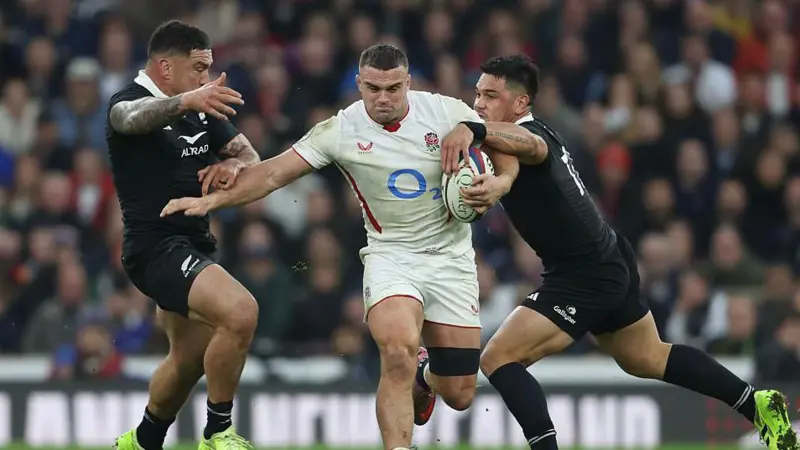
England back-row Ben Earl (centre) has been a standout performer under Borthwick
The statement victory against New Zealand also underlined England's enhanced ability to seize the biggest moments.
In 2024, they lost all three meetings with the All Blacks despite leading each one heading into the final quarter.
But at Twickenham two months ago, England responded to an opening salvo of 12 unanswered points to take control of the game - a hold they did not relinquish in the latter stages despite losing influential back-row Ben Earl to a yellow card on 65 minutes.
It was the ultimate vindication of England's destructive "Pom Squad" bench and followed wins against France, Scotland and Argentina earlier last year when England were either losing, or level, after an hour.
"Accuracy" may be a beloved buzzword of elite coaches, but the data shows a clear improvement in how England handle the closing stages of Test rugby.
"Against New Zealand it was close but in the final quarter they took the game away from them," said Ashton.
"It was a massive moment in terms of development and mindset of the players. They're now trying to go on and win those matches late on, not just survive."
'Signs point' to Six Nations glory

England won the last of their seven Six Nations titles in 2020
There does, however, remain a Springbok in the room. England have defeated France, New Zealand, Australia and Argentina over the past 12 months but will not face the world's most formidable defence until this summer.
Their development will instead be tested when they begin their Six Nations campaign by hosting Wales on Saturday before a round two Calcutta Cup clash in Scotland.
England's preparations have been disrupted by an increasing number of injuries in the front row but Borthwick still named 11 Lions in his matchday squad to take on Wales.
The side is otherwise settled – no debuts were awarded in November, the first time that has happened in an autumn series for England in 26 years.
England, though, have not won at Murrayfield since 2020 – the last time they went on to become Six Nations champions – while they travel to Paris in round five having not triumphed on French soil in a decade.
But Ashton believes strength in depth can help sustain title ambitions for a side who have finished fourth, third and second over the past three years.
"All the signs say England could win it this year," said the former Saracens winger.
"Scotland didn't get the autumn wins they may have wanted, Ireland have injuries and an older squad.
"France are dangerous but England are in a confident place."
How have England improved?
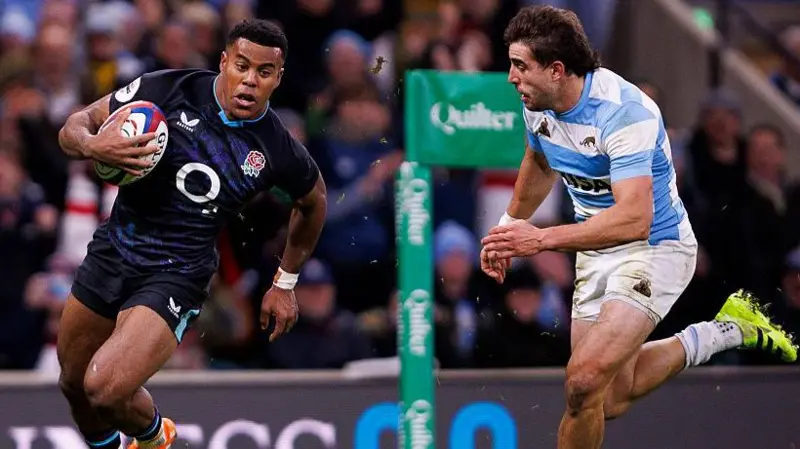
Winger Immanuel Feyi-Waboso (left) has scored seven tries under Steve Borthwick - the joint most of any England player
And such confidence stems from developing different ways to win.
Kicking remains an integral part of the Borthwick battleplan – along with most Test teams – but it is no longer a means to simply mitigate risk.
England are more prepared to play wide and vary their passing game, built on the rediscovery of a physical edge.
Utilising ball carriers like Earl and wing Immanuel Feyi-Waboso in threatening areas, England's gainline success - a metric that indicates how effective the ball-carrying team is at knocking back defenders - has improved significantly.
In 2023, their success rate was just 58%, ranking England sixth in Tier 1. In 2025, it was 65% - second only to hard-hitting South Africa (66%).
They also gained more metres per carry (4.3m) than every other Tier 1 team last year.
As a result, they have scored more tries, beaten more defenders and completed more offloads than at any time under Borthwick.
Feyi-Waboso will not face Wales after sustaining a leg injury in training on Thursday but England's strength in depth is highlighted by the quality of his replacement, Sale winger Tom Roebuck, who was a star of the autumn.
"England are in as good a spot as you could possibly be even with some injuries up front," added Ashton.
"They've won games in different ways which is also key – you can't just have one way of playing against any given team.
"We want to start the Six Nations well, give the lads a lot of confidence and get some tries, too."
