 | 24 September 2014 |

| |
| BBC Homepage | | |
| |||
| Contact Us | | |
Great SalopiansYou are in: Shropshire > History > Great Salopians > Telford - The builder of Britain 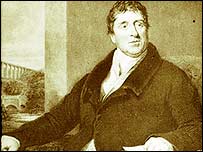 Telford, with his Pontcysyllte Aqueduct Telford - The builder of BritainMany famous Salopians were born in the county, but had to go further afield to make their names. But Thomas Telford was different. It was in Shropshire where he found recognition - and did his best work. And whether or not you think he's the greatest Salopian, you can't deny that his work is still with us everywhere. In Shropshire you don't have to go far to see one of his bridges, churches or even travel along one of his roads or canals. But even putting the highly visible evidence of his life to one side, Telford was responsible for another great achievement - the creation and recognition of an entire profession: Civil engineering. 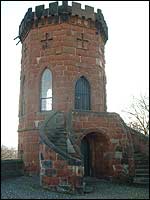 Telford started at Shrewsbury Castle Born in August, 1757, the son of a Scottish shepherd, Thomas Telford was just four months old when his father died. His mother took him to live with relatives and on leaving school he became an apprentice stonemason, working on building new roads and farmhouses on the estate of a local duke. At the age of 24, Telford upped sticks and headed for London, where he was appointed master-mason on the construction of Somerset House. More work on Plymouth Docks followed. However, during this time he made sure he continued his education, spending all his spare time studying. In 1786 he first set foot in Shropshire, where he was tasked with converting Shrewsbury Castle from a derelict ruin into a house for the town's MP. He created more than just a house. On the site where the original Norman motte and bailey had stood, he created a panoramic viewing platform and the folly Laura's Tower, while the main castle building was re-modelled into a home fit for a lord. Well - a knight of the realm, actually...
The work so impressed his customer, Sir William Pulteney, that he convinced the Shropshire County Council into creating a new job for the talented engineer - that of Surveyor of Public Works for the county - and giving the job to Telford. Telford held the post until his death in 1834. Telford set to work on several public buildings, including Shrewsbury prison, and in 1788 he carried out the first excavations in the site of the Roman city of Uriconium. But his reputation became legendary - at least in Shropshire - in a little episode surrounding old St Chad's church in Shrewsbury. He was brought in as a consultant when the church authorities wanted to fix the leaking roof at old St Chad's. But after a brief look the Scotsman announced that a leaking roof was the least of the old building's troubles. Telford reported that the building was subsiding and urgent repair work was needed at once. Three days later there was an almighty crash and down came old St Chad's! 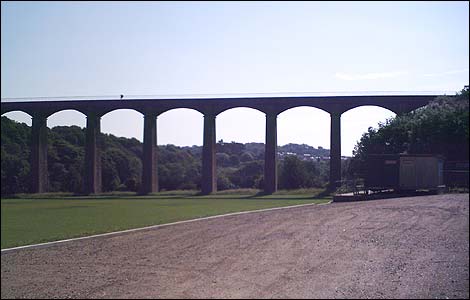 Pontcysyllte Aqueduct, opened in 1805 But if Telford was too late to help St. Chads, his talents as a church builder were on display elsewhere. He built three in Shropshire: St Mary Magdalene in Bridgnorth, St Michael's in Madeley and St Leonard's in Malinslee. You can see features and panoramic images taken from the roofs of two of the three by clicking on the links on the top right. Once again, Telford showed his flair for the unusual in the design for these buildings. St Mary Magdalene, for example, is almost square, with the aim of bringing the congregation closer to the altar. It windows, too, are unusually large for a church of its age and supporting columns are slim, giving an impression of spaciousness and elegance. The county engineer then turned his attention to bridges. His first was the stone structure at Montford Bridge (completed 1792), which still carries the old A5 over the River Severn today. Soon he was to begin experimenting with new materials, such as the iron being cast in the Coalbrookdale area. Appointed asssitant to Josiah Clowes, the chief engineer for the Shrewsbury canal, which was built between Shrewsbury and the coal and iron areas of the Ironbridge Gorge, Telford was set to make his name all over again. Clowes died half way through the project and Telford took over to face a seemingly insurmountable problem: getting the canal across the Tern valley at Longdon upon Tern. A brick aqueduct had already been built across the river, but had been washed away. Telford wanted to rebuild the aqueduct in stone, but was overruled by local ironmaster Williams Reynolds, one of the canal's backers. Seeing a potential new market for his products, Reynolds insisted that iron cast in Ketley was used. So Telford the stonemason added another string to his bow. He designed the 62 foot span aqueduct at Longdon upon Tern with a cast iron trough which held the water, and a dry side for the canal towpath. It wasn't the first structure of its kind - a similar aqueduct opened in Derbyshire a few weeks earlier - but 200 years after it was built it still remains, stranded in a field. More importantly, Telford had learned how to use the new material in his construction projects. 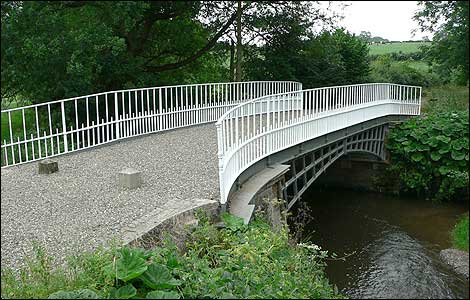 Cantlop Bridge The Shrewsbury canal was a major engineering feat - its length incorporated 11 locks, eight lift bridges, several aqueducts and a 970 yard tunnel at Berwick in its 17 mile length. Canals were to occupy much of the rest of Telford's life. He was general agent on the Ellesmere Canal (now known as the Llangollen canal), and used his experience of the Longdon upon Tern viaduct to construct two of his most impressive structures: The aqueducts at Chirk and, most impressively, Pontcysllte, near Llangollen. Each used an iron trough to carry the water across the valleys, with the trough supported on stone piers. Of course, both still survive today and remain in use. Pontcysyllte was the largest engineering feat of its day, taking ten years to build. Even today the figures for this waterway in the sky are astounding. Its piers are 127 feet high and support an iron trough carrying the canal 1007 feet across the River Dee, with an approach embankment 1,500 yards long. The alternative would have been to build a series of locks down the valley and back up again, with a less ambitious bridge crossing the river. But compromise didn't seem to enter Telford's vocabulary. Chirk aqueduct, which opened four years earlier in 1801, is no less impressive, its stone arches marching across the valley of the River Ceiriog and carrying the canal into Wales. The stunning views from both of these structures can be seen by clicking on the links on the top right. 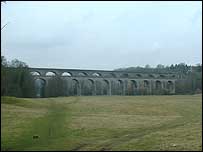 Telford's Chirk aqueduct Telford then departed to Scotland to build the mammoth Caledonian Canal before returning to Shropshire to build his last canal. This last canal was, typically, his greatest and most ambitious. Until the 1830s, many of Britain's canals operated in isolation. Now it was time for them to become part of a linked network. The Birmingham and Liverpool Canal, now known as the Shropshire Union, was a huge project. The aim was to link the Birmingham canal network at Wolverhampton with the sea at Ellesmere Port on the Wirral, linking up all the small canals on the way. Telford thought big, and the Shropshire Union, which was still used by commercial traffic until 1958, was built on a grand scale. Instead of trying to follow the contours of the land, Telford designed his canal to go as straight as possible, digging deep cuttings and using the soil from them to build embankments to take the canal over lower ground. This technique was later used by the railway builders, but more importantly for Telford, the direct route made for shorter journey times along the canal. In among these major projects, Telford was involved in dozens of other smaller ones, including many bridges in Shropshire. The cast iron bridge over the Cound Brook at Cantlop is the only remaining Telford iron bridge, and is preserved as a scheduled ancient monument. Others, such as the iron bridge at Buildwas, which replaced a stone one washed away in floods in 1795, have been replaced. It was the second iron bridge in the county - after the one in Coalbrookdale - and remained in use until 1905, when a new one replaced it, although it still used Telford's abutments. 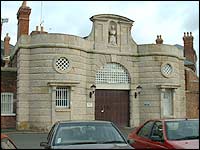 Shrewsbury prison, another Telford job. Telford's name may have been better-known if the canals he built had not been superceded by railways within a generation of his death. But he also did much work on roads - at the time considered an unimportant method of transportation. Indeed, one of his best-known bridges is the road suspension bridge at Conwy Castle. With a fine eye for detail Telford skillfully matched the stonework with the original 13th Century ramparts. In 1811 he presented to Parliament his plan to build the London to Holyhead Road and improve communications between the capital and Ireland. The route between London and Shrewsbury was not too difficult, as the Roman road called Watling Street was the already-established route. But Telford had to pull out all the stops in constructing the final 106 miles between Shrewsbury and Holyhead. His road carved its way through the Welsh hills, first skirting Oswestry and following the Dee valley through Chirk, Llangollen and Corwen, and then on to Betws y Coed and the mountains of Snowdonia. The Holyhead Road scheme also meant that the first permanent bridge linking Anglesey with the mainland - the magnificent Menai Bridge. Telford's hand was everywhere in the building of what is today the A5. He even designed the milestones and the toll houses along the route, and such was his care in the design that today's modern cars and lorries are able to negotiate much the same route and speeds four or five times faster than the mail coaches he designed it for. 13 years before his death he settled in London, although he never married. Sadly, Telford's health faded and he died, aged 77, before the Shropshire Union Canal was opened. He was buried in Westminster Abbey, as a mark of his unrivalled reputation. When Thomas Telford entered the stonemason's trade, there was no such thing as a civil engineering profession. By the time he died it was well-established, and from 1820 he was the first president of the fledgling Institution of Civil Engineers. His work paved the way for the likes of Isambard Kingdom Brunel. His contribution to Shropshire in particular was recognised in the 1970s when the new town of Telford was named in his honour. last updated: 31/10/07 Have Your SayIs Telford the greatest Salopian? What do you think? Peter Turnbull Dawn Andrew molly and sian shaf Joanne Austin Telford Mike Matthews Joshua Telford Frankieee fannel Elspeth Green Matthew Bell mark blakeley Robert McCallum Robert Black Kodie Goodall gail evans Vipul Gupta James Derry Lilly coven Colin Myatt Sylvia Walker Helen Telford Percy Hulmston Julian Smart paul king richard bifield fayble SEE ALSOYou are in: Shropshire > History > Great Salopians > Telford - The builder of Britain |
| | About the BBC | Help | Terms of Use | Privacy & Cookies Policy |

