

Peat cutting and CO2 emissions
Posted: Wednesday, 18 July 2007 |
I returned home a few hours ago after spending the morning tending to my peats. Good progress, though ground very wet. Some (especially the monadh dubh) are ready to come home, others still need some drying time. The moor was empty, save for myself, a few noisy skuas and the occasional piping of a plover. At one time, on a morning like this, the moor would have seen many a person out at their peats. In my home village now though, there is only a handful of households still cutting the peats, yet all around us remains the evidence of a time when peat cutting was a vital part of the year's work. Hard graft but also with a communal and social aspect that many miss, and many will still say that a day at the peats is hard to beat.
The reasons for the decline in peat cutting are many - relative prosperity, the coming of the electric and oil-fired heating systems, population change etc. But I suspect that concern for environmental damage is pretty rare as a reason why many have given up peat cutting, and rightly so. As a subscriber to the view that the crofting life (when widespread and part of the survival of the crofter) was an intrinsically environmentally friendly form of land and animal management, I am bound of course to say that today's concerns about peat cutting and CO2 release is fundamentally misguided.
Environmentally damaging mistakes have been made in the recent history of crofting - including the widespread use of chemical fertilisers, pesticides - and the recourse to machine cutting of peat in some areas. But I believe that hand peat-cutting for solely domestic usage should be encouraged in the interests of the environment.
At present, in a relatively few years - in the post war period - the islands of Lewis and Harris have gone from being quite self-sufficient in terms of fuel, heat, light to being highly dependent on imported fuels - especially oil. That oil is brought into the islands in container ships, and the environmental damage caused by the freighting of fuel via road and sea is surely very substantial. Lewis also has fossil-fuel powered electricity generation, and a liking for bottled gas as a means of fuel for cooking.
This blogger would like to see the development of a sustainable energy and fuel plan and policy for the outer islands based on principles of sustainability and self-sufficiency - and a move towards greater wind and wave power along with sustainable use of our in-situ solid fuels - peat etc.
I could support the developemnt of wind turbines if the power they generated was for island use alone. Why should we ruin our landscape for the sake of meeting the ever increasing and unsustainable demands for (cheap) energy in the rest of the UK? The principle for self-sufficiency and sustainability would remove the need for the costly grid interconnector and pylons and all of its blighting of the Highland landscape.
Therefore, before commenting in isolation on notions of environmental damage and CO2 emission etc, remote, charities and think-tanks should examine the use of peat in the broader context of environmental damage caused by our existing use of all fuels types and sources, and our plans for the future of the islands as a platform for energy generation / export, while we, as communities, remain a heavily dependent energy and fuel importer.
The reasons for the decline in peat cutting are many - relative prosperity, the coming of the electric and oil-fired heating systems, population change etc. But I suspect that concern for environmental damage is pretty rare as a reason why many have given up peat cutting, and rightly so. As a subscriber to the view that the crofting life (when widespread and part of the survival of the crofter) was an intrinsically environmentally friendly form of land and animal management, I am bound of course to say that today's concerns about peat cutting and CO2 release is fundamentally misguided.
Environmentally damaging mistakes have been made in the recent history of crofting - including the widespread use of chemical fertilisers, pesticides - and the recourse to machine cutting of peat in some areas. But I believe that hand peat-cutting for solely domestic usage should be encouraged in the interests of the environment.
At present, in a relatively few years - in the post war period - the islands of Lewis and Harris have gone from being quite self-sufficient in terms of fuel, heat, light to being highly dependent on imported fuels - especially oil. That oil is brought into the islands in container ships, and the environmental damage caused by the freighting of fuel via road and sea is surely very substantial. Lewis also has fossil-fuel powered electricity generation, and a liking for bottled gas as a means of fuel for cooking.
This blogger would like to see the development of a sustainable energy and fuel plan and policy for the outer islands based on principles of sustainability and self-sufficiency - and a move towards greater wind and wave power along with sustainable use of our in-situ solid fuels - peat etc.
I could support the developemnt of wind turbines if the power they generated was for island use alone. Why should we ruin our landscape for the sake of meeting the ever increasing and unsustainable demands for (cheap) energy in the rest of the UK? The principle for self-sufficiency and sustainability would remove the need for the costly grid interconnector and pylons and all of its blighting of the Highland landscape.
Therefore, before commenting in isolation on notions of environmental damage and CO2 emission etc, remote, charities and think-tanks should examine the use of peat in the broader context of environmental damage caused by our existing use of all fuels types and sources, and our plans for the future of the islands as a platform for energy generation / export, while we, as communities, remain a heavily dependent energy and fuel importer.
Posted on Peatstack at 13:06
The Invention of Rubbish, and a note on the Feis
Posted: Wednesday, 25 July 2007 |
All this talk of the islands' ecology and conservation leads me to a note from a friend just yesterday who - quite rightly in my opinion - pointed out that rubbish was not really invented in the Islands (Lewis certainly) until the 1960s.
The average croft house would generate very little material that we would today consider to be routine, disposal rubbish. Butter came in reusable (multi-use!) greased paper not the metal papers or plastic tubs of today, bread came in its own crust, tinned food was rare, milk in a pail from the cow, eggs fresh from a hen; fish in old newspaper or just in its birthday suit.
There was also that common ailment - crofter hoarding syndrome. This required the sufferer to store indefinetly anything that might in future be of use either in its own right or as a handy material for an improvised repair of something otherwise totally unrelated. This syndrome also provided a useful manner in which to recycle / reuse the little non-burnable / non-biodegradable rubbish that the croft house did generate (tins / jars etc).
Having recently empty an old croft shed of its contents (most of which was patently so useable that it went straight back on the shelf), the scale of the illness was for some sufferers, unimaginable. Everything that came into the house could have another life.
It is sad also to report that the growth of rubbish - especially food packaging - has coincided with a decline in the general quality of the nation's diet. We really are being taken for a disasterous ride by the mass-market food producers - and paying for it as it well!
Before the days of the wheelie bin and the fornightly collection, the unusable / unburnable rubbish was general disposed of in a makeshift 'dump' at some redundant place on the croft or nearby - often a disused peatbank or peat bog that would mysteriously devour the little rubbish there was - a kind of smallscale domestic landfill. Not perhaps the most eco-firendly solution but scale is the key to all of this, it was all on such a small scale.
The carbon footprint of our contemporary rubbish mountain is, in contrast nothing short of shameful. Like my previous mailing to this blog, it is difficult to comprehend how in such a short space of time all of this distructive change has happened to a way of life that was just that short time ago an unconsciously (relatively) eco-friendly and relatively sustainable manner of existence.
I don't want to pretend that everything in the crofters garden was eco-rosy - far from it in many ways - but the answers to many of our environemntal problems (think of those suffering in the eye of the climate change storm just now) may be right under our noses.
On a more cheery note - Peatstack took this picture (below) of the start of the Feis (Lewis - Stornoway, Monday last) March. Peatstack Jnr (aka rudhan) is again a participant this year. How good it was to hear children conversing happily, fluently and willingly in Gaidhlig on the streets of Stornoway - and congrats and thanks to all those who work hard to make the Feis happen every year.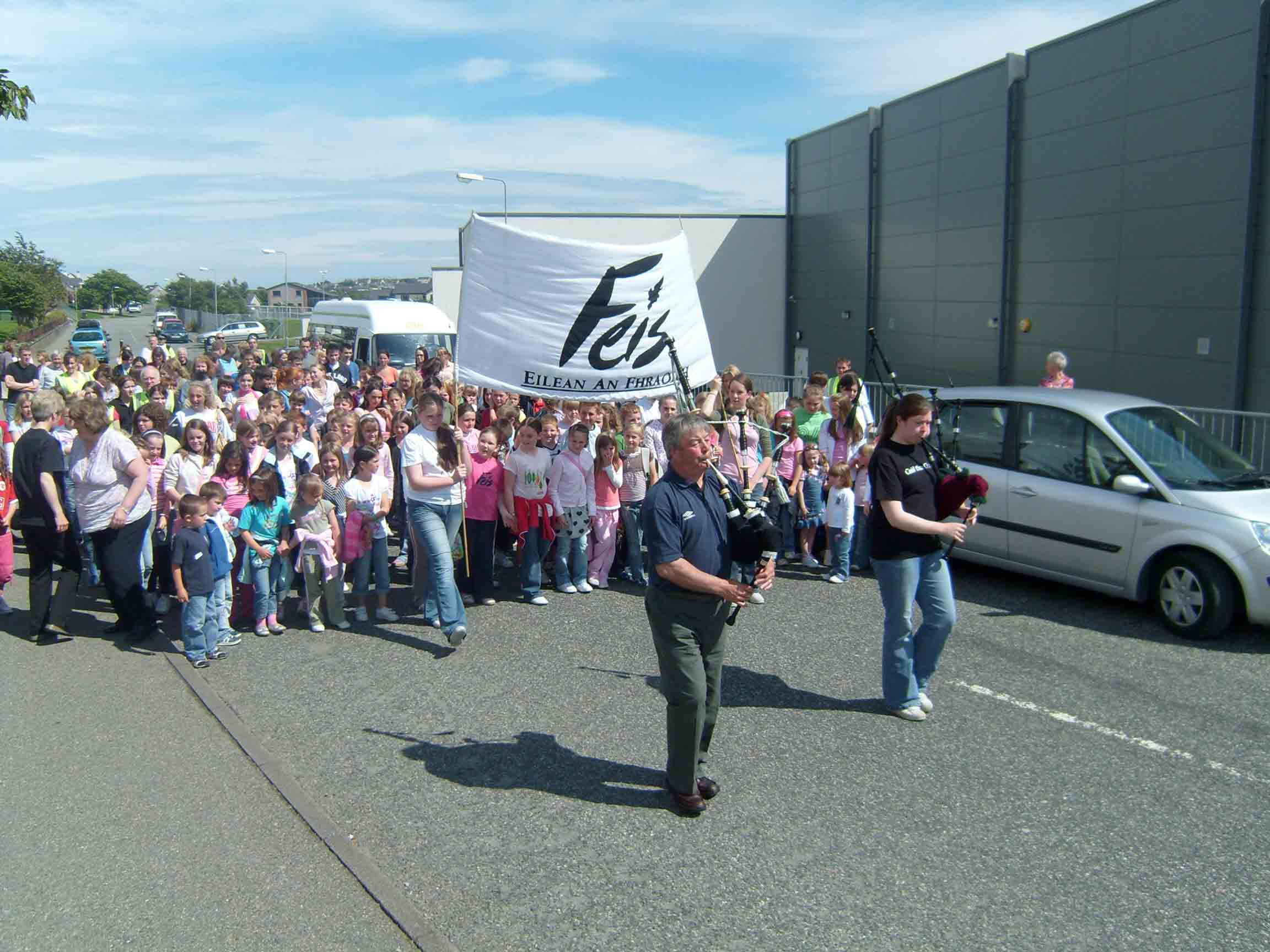
The average croft house would generate very little material that we would today consider to be routine, disposal rubbish. Butter came in reusable (multi-use!) greased paper not the metal papers or plastic tubs of today, bread came in its own crust, tinned food was rare, milk in a pail from the cow, eggs fresh from a hen; fish in old newspaper or just in its birthday suit.
There was also that common ailment - crofter hoarding syndrome. This required the sufferer to store indefinetly anything that might in future be of use either in its own right or as a handy material for an improvised repair of something otherwise totally unrelated. This syndrome also provided a useful manner in which to recycle / reuse the little non-burnable / non-biodegradable rubbish that the croft house did generate (tins / jars etc).
Having recently empty an old croft shed of its contents (most of which was patently so useable that it went straight back on the shelf), the scale of the illness was for some sufferers, unimaginable. Everything that came into the house could have another life.
It is sad also to report that the growth of rubbish - especially food packaging - has coincided with a decline in the general quality of the nation's diet. We really are being taken for a disasterous ride by the mass-market food producers - and paying for it as it well!
Before the days of the wheelie bin and the fornightly collection, the unusable / unburnable rubbish was general disposed of in a makeshift 'dump' at some redundant place on the croft or nearby - often a disused peatbank or peat bog that would mysteriously devour the little rubbish there was - a kind of smallscale domestic landfill. Not perhaps the most eco-firendly solution but scale is the key to all of this, it was all on such a small scale.
The carbon footprint of our contemporary rubbish mountain is, in contrast nothing short of shameful. Like my previous mailing to this blog, it is difficult to comprehend how in such a short space of time all of this distructive change has happened to a way of life that was just that short time ago an unconsciously (relatively) eco-friendly and relatively sustainable manner of existence.
I don't want to pretend that everything in the crofters garden was eco-rosy - far from it in many ways - but the answers to many of our environemntal problems (think of those suffering in the eye of the climate change storm just now) may be right under our noses.
On a more cheery note - Peatstack took this picture (below) of the start of the Feis (Lewis - Stornoway, Monday last) March. Peatstack Jnr (aka rudhan) is again a participant this year. How good it was to hear children conversing happily, fluently and willingly in Gaidhlig on the streets of Stornoway - and congrats and thanks to all those who work hard to make the Feis happen every year.
Posted on Peatstack at 11:53
 RSS Feed