

Thursday 16 October 2014

Review of Audience Council activity
The Council held consultative events across Scotland, gathered audience views and passed them on to the Trust. In June the Council consulted in Annan and Newton Stewart on the progress of digital switchover and the Trust's review of BBC Radio 2 and BBC 6 Music, and in Lochaber on the Digital Britain report. In the autumn, there were events in Stirling on the television service review, and at Liniclate in Benbecula on BBC ALBA. Following the publication of the BBC Executive's strategy review in March, the Council consulted audience groups in Inverness, Perth and Glasgow. The Council submitted responses on the listed events review, the Digital Britain report, the radio and television service reviews, and the review of BBC ALBA.
DCMS listed events review
The Council made a submission to the Trust on the government's review of the list of sports events that should remain free-to-air, and the Council's views were incorporated into the BBC's overall response which was published in July. As noted above, members said the national resonance created by live coverage of national qualifiers was a key opportunity for public service broadcasters to contribute to their social and cultural public purposes through the creation of shared experiences. Such broadcasts would promote social inclusion and motivate young people to become involved in sport. Council believed these benefits for Scottish football and society should be weighed against the benefits which flow to the game from commercial income streams.
Digital Britain report
In September the Council submitted a response to the Trust on the issues raised by the Digital Britain report. The Digital Britain report identified provision of ‘plurality’ in broadcasting as an over-riding priority for UK public policy and as the primary rationale for seeking to sustain public service broadcasting in the UK nations. However members considered that plurality was not an end in itself, but a means of securing a genuine and evolving range of voices, and a principle employed in the belief that competition would lead to higher quality.
Members believed that a wider range of issues in Scotland should be addressed: lack of Scottish content, the development of the local production base, achieving a Scottish perspective in news, increasing network content from Scotland and other issues should be considered alongside the issue of plurality. The Council believed that the BBC could enhance plurality in Scotland, without diverting licence fee funding, by increasing its Scottish content on network and opt-out services; by enriching its news provision, and adding a more distinctively Scottish perspective; by improving coverage of regions within Scotland and by extending the innovative and distinctive output of BBC ALBA to the whole of the viewing audience via Freeview.
The Digital Britain report also addressed the future of broadband and radio transmission. Members emphasised that in the interests of equality of opportunity, any government commitment to universal broadband provision should address differentials in broadband speeds across the UK, to ensure they are not too great.
Members also reported that many audience groups were concerned about analogue radio switch-off.
BBC Radio 2 and BBC 6 Music service review
The Jeremy Vine programme was highly appreciated by audiences, and seen as tackling significant issues in an accessible way.
The Council considered that the network contributed strongly to the BBC's citizenship public purpose through this strand alone. Members noted that the Mike Harding programme featured material from the Scottish folk scene, including new talent, in the context of the folk and traditional scene elsewhere in the UK. This was a model of how different musical traditions around the UK could be presented together, and other genres would benefit from a similar approach. Overall, however, the network was not considered to extend the range of music available to the public to a significant extent, as the content which might have achieved this was perceived to be scheduled away from peak listening times. It was felt that there was scope for the station to develop more original young presenting talent. However, there was acknowledgement that the network contributed to the creativity purpose by providing output such as jazz which was not well served by commercial stations. Members noted that although BBC Radio 2 did not perform strongly on the BBC's public purpose to represent the UK's nations, regions and communities, this did not appear to be an issue for audiences in Scotland. Members noted that only a very small proportion of the network's content was commissioned from Scotland and that the Service Licence does not require the network to commission any output from the nations, requiring only ‘some output from outside the M25 area’.
Audience comments on BBC 6 Music were more prominent later in the year, during engagement on the Strategy Review in which the closure of the station was mooted. Many respondents commented that the network did for contemporary music what BBC Radio 3 did for classical, and that it was a good example of the sort of stimulus to creativity which the BBC, as a licence funded organisation, should support.
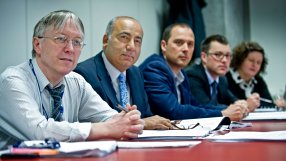
Audience Council meeting at BBC Pacific Quay in Glasgow.
BBC iD
BBC iDBBC navigation
BBC links

BBC © 2014The BBC is not responsible for the content of external sites. Read more.
This page is best viewed in an up-to-date web browser with style sheets (CSS) enabled. While you will be able to view the content of this page in your current browser, you will not be able to get the full visual experience. Please consider upgrading your browser software or enabling style sheets (CSS) if you are able to do so.
