
This article looks at some traditional stories which set out the foundation of Japan and its people, and demonstrate the close relationship between the kami and Japan.
Core stories of Shinto
Last updated 2009-09-21
On this page
- The founding of Japan
- The land of the dead
- The power of purification
- Amaterasu and Susanoo
- The imperial family
- Find out more
Page options
The founding of Japan
Core stories of Shinto
These texts set out the traditional story of the foundation of Japan and its people, and demonstrate the very close relationship between the gods and the people of Japan. The stories also demonstrate many parallels between human beings and the kami.
The foundation of Japan
This part of the story makes the following points:
- Japan was the first land to be created
- Sexual union is a holy creative process
- If certain rituals are not properly followed bad things may happen
- If the natural order of things is disturbed bad things may happen
- The female should be subordinate to the male
- Kami are created by the same process as human beings
- Imperfect children can be abandoned
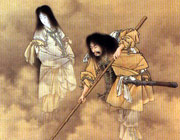 Izanami and Izanagi, by Kobayashi Eitaku c.1885 ©
In the beginning, when the universe was created from the pre-existing chaos a number of kami ('gods' in this context) appeared spontaneously. Their relationships gave rise to a brother and sister; Izanagi and Izanami. Izanagi means 'he who invites' and Izanami means 'she who invites'.
Izanagi and Izanami thrust a jewelled spear into the ocean, and the first land formed where the spear touched the water. This was the central island of Japan.
Izanagi and Izanami married and discovered sexual intercourse.
Their first child, Hiruko, was born deformed and later abandoned by his parents; legend says the deformity was caused because Izanami had spoken first in the sexual ritual.
The couple had sexual intercourse on several other occasions and their other offspring included the other islands of Japan and some of the kami.
The land of the dead
The land of the dead
The next part of the story makes the following points:
- Kami are not immortal - they are vulnerable to injury and can die
- When kami die, they rot just like human beings
- Kami have feelings; they suffer from bereavement like human beings
- Death is a bad thing that disrupts the harmony of the community
- Death and decay are the most potent forms of impurity
- The spirits living in the land of the dead are malicious and lonely, and like to try to drag people from the land of the living
- Human beings should keep away from anything to do with death
- The kami have a duty, based on Izanagi's promise, to support birth and life in the world of the living (which, as far as this legend is concerned, means only Japan)
- The male can subordinate the female
- Life is more powerful than death
Izanami was badly burned during the birth of the kami of fire, and died. This is the first death in the world. Izanagi was furious with sorrow and beheaded the child he blamed for his wife's death. Other kami were born from the blood of the execution.
Izanagi was grief-stricken and went in search of her to the underworld - Yomi, the land of the dead.
When he found her, Izanami had eaten the fruit of the dead and might be doomed to stay in Yomi for ever. Izanami made Izanagi promise not to look at her, but to give her time to consult with the rulers of the underworld to see if they would let her return to the land of the living.
After a while Izanagi broke his promise, and went to look for her. When he found her he saw that her body had rotted and was full of maggots.
Izanagi was horrified and tried to return to the land of the living, but his wife/sister, angry and ashamed at being seen in a state of decay, pursued him so that she could force him to live with her in the underworld for ever.
Izanagi escaped, and blocked the entrance to Yomi with a boulder so that Izanami could not follow him, forming a permanent barrier between the worlds of the living and the dead.
Izanami was furious and said that every day from that moment on she would kill 1000 people every day.
Izanagi replied by saying that he would create 1500 new born babies each day.
The power of purification
The power of purification
In this part of the story we learn:
- Kami are not all-powerful - pollution can affect them too
- Pollution causes bad fortune to the person who has become impure
- Pollution can be removed by purification
- Water and salt are powerful agents of purification
- Purification is also a highly creative process
After escaping from Yomi, Izanagi was contaminated by his contact with death, and as a result was plagued with misfortune.
He bathed himself thoroughly in the ocean to wash away the pollution of death. This was the first example of the harae purification ritual.
During the purification ritual a number of new kami, including Amaterasu (the Sun Goddess) and her brother Susanoo (the kami of the wind and storms) were created.
Amaterasu and Susanoo
Amaterasu and Susanoo
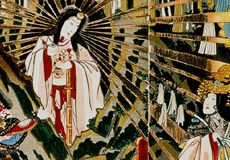 Amaterasu is coaxed out of the cave ©
Some of the things we learn in this part of the story explain ingredients of Shinto rituals and festivals:
- kami are not all-powerful - Amaterasu can't be forced out of the cave by the others, but she can't prevent them seizing her when she eventually emerges
- kami have the human characteristics of behaving badly, sulking, curiosity, and laughing
- kami enjoy bawdy entertainment
- one of way of pleasing kami is to entertain them
- crudity has a place in entertaining kami
- dancing has a place in entertaining kami
Izanagi gave Amaterasu authority to rule the land. Susanoo was disappointed and angry. His tantrums led him to behave so badly that he was banished from heaven.
(Things don't end in disaster for Susanoo, who remains an important and powerful kami. Although he has fearful powers of destruction, he is worshipped at many shrines for having the power to prevent disaster.)
Amaterasu was upset by the behaviour of Susanoo, and in a sulk hid herself in a cave. The absence of the sun brought darkness to the world.
The other kami gathered outside the cave and asked Amaterasu to come out. She, still sulking, refused.
The kami had a party during which a female kami did a sexy dance outside the cave, which make them all laugh.
Amaterasu came out of the cave to see what the jollity was about. The other kami grabbed her and persuaded her to take her proper place in the cosmos.
The imperial family
The imperial family
This part of the story establishes the divine ancestry of the Emperors of Japan.
Interestingly, it also acknowledges the power of the female, something that is at odds with earlier parts of the myth, and which doesn't seem to have played much part in setting gender roles in Japanese life.
Amaterasu had children and grandchildren. In consultation with other senior kami she decided that Japan should be ruled for ever by an Imperial family.
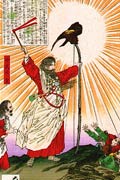 Jimmu, the first Emperor, by Tsukioka Yoshitoshi c. 1876-1882 ©
She sent one grandchild, Ninigi, from heaven to rule Japan. He took with him a mirror (symbol of Amaterasu) and a sword. His grandson, Jimmu Tenno, is regarded as the first Emperor of Japan from whom all the Emperors right up to the present day have been descended.
The politics of myth
These stories have a clear political consequence. They establish the powerful Yamamoto clan as descended from the gods and having been given authority to rule Japan by the gods.
The rival Izumo clan is descended from Susanoo, and so it can be seen as part of the divine plan that they should have a subordinate role.
The legend that the Japanese are loosely descended from the Sun Goddess is shown by the symbol of the sun on the Japanese flag.
BBC iD
BBC iDBBC navigation
BBC links

BBC © 2014The BBC is not responsible for the content of external sites. Read more.
This page is best viewed in an up-to-date web browser with style sheets (CSS) enabled. While you will be able to view the content of this page in your current browser, you will not be able to get the full visual experience. Please consider upgrading your browser software or enabling style sheets (CSS) if you are able to do so.

