
This page provides a brief overview of the holy books of Shinto.
Shinto holy books
Last updated 2009-09-21
Shinto holy books
The holy books of Shinto are the Kojiki or 'Records of Ancient Matters' (712 CE) and the Nihon-gi or 'Chronicles of Japan' (720 CE).
These books are compilations of ancient myths and traditional teachings that had previously been passed down orally.
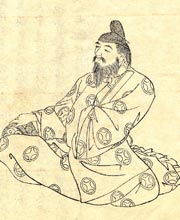 O no Yasumaro, painted by Kikuchi Yosai ©
The Kojiki was dictated by Heida no Are to the scribe O no Yasumaro on the orders of the Emperor Temmu.
The holy books are not exclusively Shinto
The dates are very significant, since by the 8th century, when they were compiled, Japanese religious life had received considerable input from Buddhism and Confucianism, both of which coloured the contents of these books.
Political purpose
Some of the myths have a very clear political purposes. In a wide sense, they are intended to establish the primacy of Japan and the Japanese over all other countries and peoples and in a narrow sense, to give divine authority to the ruling classes of Japan, and to some extent to establish the political supremacy of the Yamato clan over the Izumo clan.
Moral purpose
The myths teach a number of truths:
- Japan and its people are chosen and special to the gods (kami)
- the kami have many qualities in common with human beings
- the kami are very different from God in the Western sense
- the kami have a duty to look after humanity
- humanity should look after the kami
- purity and purification are important if humanity is to thrive
- purification is a creative as well as a cleansing act
- death is the ultimate impurity
BBC iD
BBC iDBBC navigation
BBC links

BBC © 2014The BBC is not responsible for the content of external sites. Read more.
This page is best viewed in an up-to-date web browser with style sheets (CSS) enabled. While you will be able to view the content of this page in your current browser, you will not be able to get the full visual experience. Please consider upgrading your browser software or enabling style sheets (CSS) if you are able to do so.

