
Shinto is based on worship of kami. This article looks at the concepts of kami and lists some important kami and their associations.
Kami
Last updated 2009-09-04
What are kami?
Kami
Shinto is based on belief in, and worship of, kami.
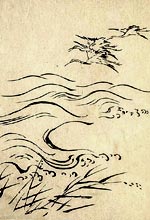 Kami can be elements of the landscape or forces of nature. Painting by Morikuni (1679-1748) ©
The best English translation of kami is 'spirits', but this is an over-simplification of a complex concept - kami can be elements of the landscape or forces of nature.
Kami are close to human beings and respond to human prayers. They can influence the course of natural forces, and human events.
Shinto tradition says that there are eight million million kami in Japan.
Concepts of kami
Shinto belief includes several ideas of kami: while these are closely related, they are not completely interchangeable and reflect not only different ideas but different interpretations of the same idea.
Kami can refer to beings or to a quality which beings possess.
So the word is used to refer to both the essence of existence or beingness which is found in everything, and to particular things which display the essence of existence in an awe-inspiring way.
But while everything contains kami, only those things which show their kami-nature in a particularly striking way are referred to as kami.
Kami as a property is the sacred or mystical element in almost anything. It is in everything and is found everywhere, and is what makes an object itself rather than something else. The word means that which is hidden.
Kami have a specific life-giving, harmonising power, called musubi, and a truthful will, called makoto (also translated as sincerity).
Not all kami are good - some are thoroughly evil.
Kami as 'God'
The idea that kami are the same as God stems in part from the use of the word kami to translate the word 'God' in some 19th century translations of the Bible into Japanese.
This caused a great deal of confusion even among Japanese: the Shinto theologian Ueda Kenji estimated in 1990 that nearly 65% of entering students now associate the Japanese term kami with some version of the Western concept of a supreme being.
The next section shows that kami are actually very different from the Western concept of God.
Kami as beings
The concept of kami is hard to explain.
Shintoists would say that this is because human beings are simply incapable of forming a true understanding of the nature of kami.
To make understanding easier kami are often described as divine beings, as spirits or gods. But kami are not much like the gods of other faiths:
- Kami are not divine like the transcendent and omnipotent deities found in many religions.
- Kami are not omnipotent.
- Kami are not perfect - they sometimes make mistakes and behave badly.
- Kami are not inherently different in kind from human beings or nature - they are just a higher manifestation of the life energy... an extraordinary or awesome version.
- Kami don't exist in a supernatural universe - they live in the same world as human beings and the world of nature
Kami include the gods that created the universe, but can also include:
- The spirits that inhabit many living beings
- Some beings themselves
- Elements of the landscape, like mountains and lakes
- Powerful forces of nature, like storms and earthquakes
- human beings who became kami after their deaths
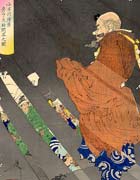 Kobayakawa Takakage, Japanese historical figure, talks to the tengu (minor kami) of Mount Hiko. By Tsukioka Yoshitosi, 1892 ©
The term kami is sometimes applied to spirits that live in things, but it is also applied directly to the things themselves - so the kami of a mountain or a waterfall may be the actual mountain or waterfall, rather than the spirit of the mountain or waterfall.
Not all kami are sufficiently personalised to have names - some are just referred to as the kami of such-and-such a place.
Three types of kami are particularly important:
- Ujigami, the ancestors of the clans: in tribal times, each group believed that a particular kami was both their ancestor and their protector, and dedicated their worship to that spirit
- Kami of natural objects and creatures, and of the forces of nature
- The souls of dead human beings of outstanding achievement
A Japanese description of kami
Motoori Norinaga (1730-1801) was one of the most distinguished Japanese scholars of religion and enthusiasts for Shinto revival. He described kami like this:
I do not yet understand the meaning of the word 'kami'. In the most general sense, it refers to all divine beings of heaven and earth that appear in the classics. More particularly, the kami are the spirits that abide in and are worshipped at the shrines.
Motoori Norinaga
In principle human beings, birds, animals, trees, plants, mountains, oceans - all may be kami. According to ancient usage, whatever seemed strikingly impressive, possessed the quality of excellence, or inspired a feeling of awe was called kami.
Who's who of kami
Who's who of kami
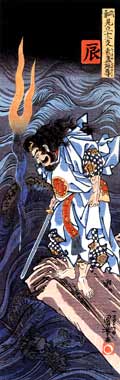 Susanoo and water dragon, by Utagawa Kuniyoshi (1798-1861) ©
The most important kami have many stories associated with them.
Amaterasu (Amaterasu-Omikami)
Usually translated as 'Sun Goddess', and the greatest of the kami. The kami of the Ise shrine, and the ancestor of the Imperial family.
Benten/Benzaiten
A female kami with Hindu origins, associated with music and the arts.
Ebisu
A kami who brings prosperity. Originally the abandoned leech-child of Izanami and Izanagi.
Hachiman
Traditionally the god of archery and war.
Izanami - Izanagi
The two kami who gave birth to Japan.
Konpira/Kompira
Now the kami of safety at sea, but originally a Buddhist deity. Protects sailors, fishermen, and merchant shipping.
Susanoo
The kami of the wind, or the storm-god, who both causes and protects from disasters. The brother of Amaterasu.
Tenjin
The kami of education, originally the Japanese scholar Sugawara no Michizane (845-903 CE). Parents and children often ask Tenjin to grant them success in exams.
Elsewhere on the web
BBC iD
BBC iDBBC navigation
BBC links

BBC © 2014The BBC is not responsible for the content of external sites. Read more.
This page is best viewed in an up-to-date web browser with style sheets (CSS) enabled. While you will be able to view the content of this page in your current browser, you will not be able to get the full visual experience. Please consider upgrading your browser software or enabling style sheets (CSS) if you are able to do so.

