
This article looks at the Japanese concept of the divinity of the Emperor.
Divinity of the Emperor
Last updated 2009-09-07
Divinity of the Emperor
The divinity of the Emperor
Many cultures have attributed divinity or significant spiritual gifts to their rulers. The rulers of ancient Egypt and Rome were treated as gods, and medieval kings (including England's Henry VI) were regarded as having the ability to cure diseases with the royal touch.
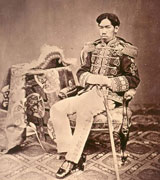 Emperor Meiji in a photograph taken by Uchida Kuichi in 1873 ©
The Japanese concept of the divinity of the Emperor is often misunderstood by Westerners. Neither the Emperor nor most of his people ever thought that the Emperor was a God in the sense of being a supernatural supreme being.
From the 6th century onwards it was accepted that the Emperor was descended from the kami (in this context gods), was in contact with them, and often inspired by them.
This didn't make him a god himself, but rather imposed on him the obligation of carrying out certain rituals and devotions in order to ensure that the kami looked after Japan properly and ensured its prosperity.
Status of the Emperor in Japanese history
For most of Japanese history, the Emperor's status as the direct descendant of the founding kami was not reflected in his political power.
Until the Meiji restoration the Emperor had little power, and was a largely unknown and ceremonial figure. Japan was actually run by feudal noblemen, and the Emperor lived in seclusion, and sometimes in actual imprisonment.
The Emperor after the Meiji restoration
It's been suggested that the divinity of the Emperor was one of the central tenets of the Meiji restoration but this isn't true; none of the official Meiji documents actually declare that the Emperor was kami or god.
The divine status of the Emperor did become a general assumption during World War II, but as a vital element of the Japanese patriotic understanding of themselves as a nation rather than a theological reality.
Other teachers referred to the Emperor as being worshipped as a god, without ever saying that he was god.
The Emperor as akitsu mikami
During the 1930s there were some who taught that the Emperor was akitsu mikami ('manifest god') a human being in which the property of kami nature was perfectly revealed, but they qualified this by saying that the Emperor was neither omniscient or omnipotent.
However the Emperor's qualities of kami nature together with his direct descent from Ameratsu, the highest of the kami, made him so superior that the Japanese thought it entirely logical that people should obey the Emperor and worship him – but it did not make him God in the Western sense.
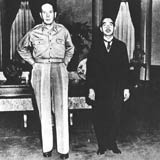 Douglas Macarthur, supreme commander of the Allied forces, with Emperor Hirohito at the US Embassy, Tokyo, in September 1945 ©
The end of divinity
When the Emperor gave up his divinity on the orders of the USA, in the Imperial rescript of January 1 1946, he in fact gave up nothing that he had ever had, but simply restated an earlier traditional set of beliefs about the Imperial family.
The ties between Us and Our people have always stood on mutual trust and affection. They do not depend upon mere legends and myths.
They are not predicated on the false conception that the Emperor is divine, and that the Japanese people are superior to other races and fated to rule the world.
from the Imperial rescript, January 1, 1946
The Emperor continued to claim direct descent from Amaterasu and the priestly status that this inheritance gave him, but his ritual functions ceased being National tasks and became (as they had been through most of Japanese history) private Shinto devotions designed to preserve the good fortune of Japan, and the continuity of the Imperial line.
Divinity of the country
A divine country
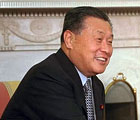 Yoshiro Mori, 2000-2001 Japanese PM ©
In 2000, the Japanese Prime Minister, Yoshiro Mori, sparked a row by describing Japan as a divine country centred on the emperor. He made the remark during a meeting with pro-Shinto politicians.
For a nation keen to shake off the militaristic image of its past, the remark was especially insensitive. "The whole political set-up after 1945 was meant to deny the whole pre-war system so it was a great surprise and dismay to hear Prime Minister Mori say what he said," Professor Takashi Inoguchi of Tokyo University said.
Mr Mori apologised, saying his reference to the divine emperor was about the importance of tradition and education.
BBC iD
BBC iDBBC navigation
BBC links

BBC © 2014The BBC is not responsible for the content of external sites. Read more.
This page is best viewed in an up-to-date web browser with style sheets (CSS) enabled. While you will be able to view the content of this page in your current browser, you will not be able to get the full visual experience. Please consider upgrading your browser software or enabling style sheets (CSS) if you are able to do so.

