
A brief overview of Shinto, a traditional folk religion of Japan.
Shinto at a glance
Last updated 2011-10-07
On this page
Page options
Page options
Introduction
Shinto at a glance
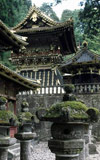
The essence of Shinto is the Japanese devotion to invisible spiritual beings and powers called kami, to shrines, and to various rituals.
Shinto is not a way of explaining the world. What matters are rituals that enable human beings to communicate with kami.
Kami are not God or gods. They are spirits that are concerned with human beings - they appreciate our interest in them and want us to be happy - and if they are treated properly they will intervene in our lives to bring benefits like health, business success, and good exam results.
Shinto is a very local religion, in which devotees are likely to be concerned with their local shrine rather than the religion as a whole. Many Japanese will have a tiny shrine-altar in their homes.
However, it is also an unofficial national religion with shrines that draw visitors from across the country. Because ritual rather than belief is at the heart of Shinto, Japanese people don't usually think of Shinto specifically as a religion - it's simply an aspect of Japanese life. This has enabled Shinto to coexist happily with Buddhism for centuries.
- The name Shinto comes from Chinese characters for Shen ('divine being'), and Tao ('way') and means 'Way of the Spirits'.
- Shrine visiting and taking part in festivals play a great part in binding local communities together.
- Shrine visiting at New Year is the most popular shared national event in Japan.
- Because Shinto is focussed on the land of Japan it is clearly an ethnic religion. Therefore Shinto is little interested in missionary work, and rarely practised outside its country of origin.
- Shinto sees human beings as basically good and has no concept of original sin, or of humanity as 'fallen'.
- Everything, including the spiritual, is experienced as part of this world. Shinto has no place for any transcendental other world.
- Shinto has no canonical scriptures.
- Shinto teaches important ethical principles but has no commandments.
- Shinto has no founder.
- Shinto has no God.
- Shinto does not require adherents to follow it as their only religion.
Shinto fire festival
Peter Owen-Jones observes a Shinto Oto Matsuri Fire Festival in Shingu and discusses with some of the participants ideas around purification, and ritual as a way of reflecting a world created out of chaos.
Elsewhere on the web
BBC iD
BBC iDBBC navigation
BBC links

BBC © 2014The BBC is not responsible for the content of external sites. Read more.
This page is best viewed in an up-to-date web browser with style sheets (CSS) enabled. While you will be able to view the content of this page in your current browser, you will not be able to get the full visual experience. Please consider upgrading your browser software or enabling style sheets (CSS) if you are able to do so.

