
This page looks at the importance of ritual in Shinto.
The importance of ritual
Last updated 2009-09-16
The importance of ritual in Shinto
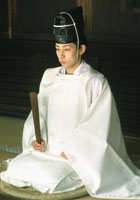 A priest at the Meiji Jingu shrine
 In Shinto, the importance of the ritual is simply the ritual itself. It's wrong to think that Shinto ritual is important because of the beliefs that lie behind the ceremonies.
Taking part in a series of actions or behaviours is a religious act that 'does' religion, provides a holistic religious experience, and strengthens the participants' relationships with the kami and with other members of the community.
Critics of Shinto ritual make some of the following points:
- it lacks any intellectual content
- it seems like a performance rather than a personal act of devotion to God
- some Shinto rituals are relaxed and almost irreverent
- it's childish to make food offerings to spirit beings
- it's childish to think that water or salt or anything physical could make one morally and spiritually pure
- the rituals last a very long time.
These criticisms betray a lack of understanding of how a religion like Shinto works:
- The important element of the ritual is taking part in it correctly - doing it in the right way is what counts, not believing the right thing
- Since one is taking part in a religious act, the longer it lasts, the greater and the better is the religious experience
- Taking part in rituals together binds the community together just as, or more, effectively than do shared beliefs
- Taking part includes participation as a spectator: the aesthetics (sights and sounds) of the ritual can have a powerful emotional and spiritual effect
- Watching or taking part in ancient ceremonies brings a sense of being joined to the past traditions of the religious culture
The lack of intellectual content is in one way is a strength, since it excludes the doubting mind. Intellectual content may be lacking, but important truths are not.
For example: Taking part in certain ceremonies teaches the participants ethics, i.e. the value of behaving in certain ways. Taking part in a ceremony which asks the kami for a favour, or thanks the kami for past favours, teaches the participants that they can have a relationship with the spiritual elements of the world.
Taking part in festival procession through the village teaches that the spiritual is an inseparable part of this world, and that the community itself is a key focus of the participants' lives.
BBC iD
BBC iDBBC navigation
BBC links

BBC © 2014The BBC is not responsible for the content of external sites. Read more.
This page is best viewed in an up-to-date web browser with style sheets (CSS) enabled. While you will be able to view the content of this page in your current browser, you will not be able to get the full visual experience. Please consider upgrading your browser software or enabling style sheets (CSS) if you are able to do so.

