
This article looks at Shinto worship, which can take place in the home or in shrines.
Shinto worship
Last updated 2009-09-16
Shrine and home worship
Shinto worship
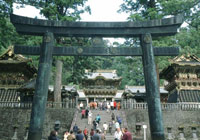 People arriving to worship at Tosho Gu shrine, Nikko
 Shinto worship is highly ritualised, and follows strict conventions of protocol, order and control. It can take place in the home or in shrines.
Although all Shinto worship and ritual takes place within the patterns set when the faith was centralised in the 19th century, there is much local diversity.
The spirit of Shinto worship
In keeping with Shinto values, Shinto ritual should be carried out in a spirit of sincerity, cheerfulness and purity.
Shinto worship and the senses
Shinto ritual is intended to satisfy the senses as well as the minds of those taking part, so the way in which it is carried out is of huge importance. Shinto ceremonies have strong aesthetic elements - the setting and props, the sounds, the dress of the priests, and the language and speech are all intended to please the kami to whom the worship is offered.
Private and public worship
Although Shinto worship features public and shared rituals at local shrines, it can also be a private and individual event, in which a person at a shrine (or in their home) prays to particular kami either to obtain something, or to thank the kami for something good that has happened.
Worship at home
Many Japanese homes contain a place set aside as a shrine, called a kami-dana (kami shelf), where they may make offerings of flowers or food, and say prayers.
The kami-dana is a shelf that contains a tiny replica of the sanctuary of a shrine, and may also include amulets bought to ensure good luck (or absorb bad luck). A mirror in the centre connects the shelf to the kami.
If a family has bought a religious object at a shrine they will lay this on the kami-dana, thus linking home to shrine.
Worship at a shrine
There is no special day of the week for worship in Shinto - people visit shrines for festivals, for personal spiritual reasons, or to put a particular request to the kami (this might be for good luck in an exam, or protection of a family member, and so on).
Worship takes place in shrines built with great understanding of the natural world. The contrast between the human ritual and the natural world underlines the way in which Shinto constructs and reflects human empathy for the universe.
The journey that the worshipper makes through the shrine to the sanctuary where the ritual takes place forms part of the worship, and helps the worshipper to move spiritually from the everyday world to a place of holiness and purity.
The aesthetics (or to put it over simply, the 'look') of the shrine contribute substantially to the worship, in the way that the setting of a theatre play contributes significantly to the overall drama.
Although Shinto rituals appear very ancient, many are actually modern revivals, or even modern inventions.
Rituals
Jichinsai - Ji Matsuri
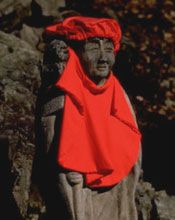 Shrines are often decorated with colourful cloth for special occasions ©
Jichinsai are ceremonies held before the construction of a building (business or private) in Japan. The aim is to purify the ground, worship the local kami and pray for safety during construction.
Norito
Norito are Shinto ritual prayers that are addressed directly to the kami during formal ceremonies. They are recited by a priest on behalf of the worshippers. The norito are spoken in formal Japanese phrases of great beauty.
Shinto believes that certain words have spiritual power if properly spoken, and this style of language is used because of a belief that using these 'beautiful', 'correct' words will bring about good.
During the State Shinto period formal prayers were laid down by the government, but priests can now use any appropriate prayers - or can compose their own.
Norito include the yogoto, which is a blessing specifically for the preservation of the imperial reign. The Nakatomi no yogoto is pronounced on the day of the emperor's accession to the throne.
Typical ritual
The conventional order of events in many Shinto festival rituals is as follows:
- Purification - this takes place before the main ceremony
- Adoration - bowing to the altar
- Opening of the sanctuary
- Presentation of food offerings (meat cannot be used as an offering)
- Prayers (the form of prayers dates from the 10th century CE)
- Music and dance
- Offerings - these are symbolic and consist of twigs of a sacred tree bearing of white paper
- Removal of offerings
- Closing the sanctuary
- Final adoration
- Sermon (optional)
- Ceremonial meal (this is often reduced to ceremonial sake drinking)
BBC iD
BBC iDBBC navigation
BBC links

BBC © 2014The BBC is not responsible for the content of external sites. Read more.
This page is best viewed in an up-to-date web browser with style sheets (CSS) enabled. While you will be able to view the content of this page in your current browser, you will not be able to get the full visual experience. Please consider upgrading your browser software or enabling style sheets (CSS) if you are able to do so.

