
This article looks at Shinto ethics.
Ethics in Shinto
Last updated 2009-09-16
Ethics
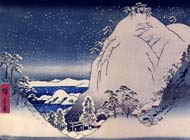 Shrines in the snow, by Hiroshige Ichiyusai (1797-1858) ©
Note: Because Shinto coexists with Buddhism and Confucianism and their ethical values, it's hard, and not very useful, to isolate the distinctly Shinto elements in Japanese ethics. Confucian values in particular have inspired much of the Japanese ethical code.
Summary
Specifically Shinto ethics are not based on a set of commandments or laws that tell the faithful how to behave, but on following the will of the kami. So a follower of Shinto will try to live in accordance with the way of the kami, and in such a way as to keep the relationship with the kami on a proper footing.
But it's important to remember that the kami are not perfect - Shinto texts have many examples of kami making mistakes and doing the wrong thing. This clear difference with faiths whose God is perfect is probably why Shinto ethics avoids absolute moral rules.
The overall aims of Shinto ethics are to promote harmony and purity in all spheres of life. Purity is not just spiritual purity but moral purity: having a pure and sincere heart.
No moral absolutes
Shinto has no moral absolutes and assesses the good or bad of an action or thought in the context in which it occurs: circumstances, intention, purpose, time, location, are all relevant in assessing whether an action is bad.
Good is the default condition
Shinto ethics start from the basic idea that human beings are good, and that the world is good. Evil enters the world from outside, brought by evil spirits. These affect human beings in a similar way to disease, and reduce their ability to resist temptation. When human beings act wrongly, they bring pollution and sin upon themselves, which obstructs the flow of life and blessing from the kami.
Things which are bad
Things which are usually regarded as bad in Shinto are:
- things which disturb kami
- things which disturb the worship of kami
- things which disrupt the harmony of the world
- things which disrupt the natural world
- things which disrupt the social order
- things which disrupt the group of which one is a member
BBC iD
BBC iDBBC navigation
BBC links

BBC © 2014The BBC is not responsible for the content of external sites. Read more.
This page is best viewed in an up-to-date web browser with style sheets (CSS) enabled. While you will be able to view the content of this page in your current browser, you will not be able to get the full visual experience. Please consider upgrading your browser software or enabling style sheets (CSS) if you are able to do so.

