| | | Back to Beeching | | | |
| | With the publication, in 1963, of The Re-Shaping of British Railways Britain's transport system would never be the same. | | | 
| | PROGRAMME 2: BLEAK FUTURE FOR FORGOTTEN TRACKS
 Listen to programme 2 Listen to programme 2
Go to read transcript of Live Chat with BBC Transport Correspondent Alan Whitehouse, and Professor Colin Dival of the Institute of Railway Studies.
A few branch lines did survive the Beeching era. Dr Beeching wanted to see them all closed - he said they never had made money and never would. But anti-closure campaigns made the politicians think again and some lines were kept open for social reasons - today we would call it social exclusion.
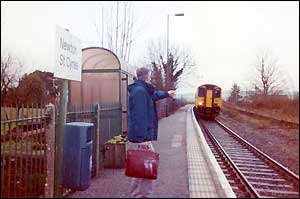 The station at the Devon village of Newton St Cyres narrowly escaped the Beeching cuts, but 40 years on hardly anyone uses it. The station at the Devon village of Newton St Cyres narrowly escaped the Beeching cuts, but 40 years on hardly anyone uses it.
But these lines have led a hand to mouth existence for the last 40 years. They have seen little investment and a re-equipment programme in the 1980s meant there were too few trains to go round, so the timetables on many lines were drastically cut back - sometimes by around 50 per cent.
Trains on the line from Middlesbrough to Whitby for example were cut from seven a day to four.
But some lines have been cut back so badly that they might as well be closed - they are almost useless for any practical purpose.
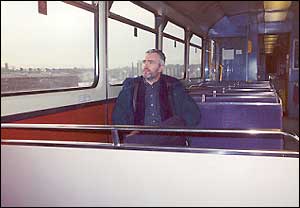 On the outskirts of Manchester, Alan Whitehouse travels on the once weekly train that leaves Denton station. Lines like these amount to the living dead. They’re theoretically open, but useless for any practical purpose. On the outskirts of Manchester, Alan Whitehouse travels on the once weekly train that leaves Denton station. Lines like these amount to the living dead. They’re theoretically open, but useless for any practical purpose.
Take Denton station in South Manchester. You cannot buy a return ticket from Denton because there is only one train a week and it runs in one direction only. You can go, but you cannot come back.
The line from Sheffield to Brigg in North Lincolnshire and Cleethorpes has three trains - but only on Saturdays, while the line from York to Pontefract and Sheffield has three trains one way and two the other. But they all run at off-peak times so you cannot use them to get to work or school.
The worry now is that the soaring cost of running trains will cause more cutbacks and even more closures. One of the side-effects of privatisation has been to push up the cost of maintaining tracks, signals and structures like bridges and tunnels. That pushes up the cost of running the trains themselves, making them look poor value for money.
One estimate - from the former managing director of a train company - is that the worst lines need a subsidy of between £8 and £10 for every £1 taken in fares. It adds up to a huge amount and even the Strategic Rail Authority has been making the point that secondary lines generate only 17 per cent of rail travel while swallowing up 64 per cent of the subsidy.
In recent months both the Transport Secretary, Alistair Darling and the chairman of the Strategic Rail Authority, Richard Bowker, have spoken about using substitute buses as a cheaper way of delivering the same service and taking pressure off the rail network.
One recent prediction is that between 3,000 - 4,000 miles of the network - it currently is about 10,000 miles - are at risk of closure simply because of the high cost of keeping it open. One analyst reckons that about 200 country stations handle less than 50 passengers per year and should be closed immediately.
The issue will be settled next year when the Government announces the results of the 2004 public spending round. The SRA is bidding for extra money. But last month the Government actually cut its budget by over £300m - hardly a vote of confidence. This is why some rail industry experts believe that, 40 years on, history may be about to repeat itself.
Selected Reading
Beeching: Champion of the Railway?
by R H N Hardy,
Ian Allan, 1989
The Great Railway Conspiracy
by David Henshaw
Leading Edge, 1991
British Rail after Beeching
by G. Freeman Allen
Ian Allan, 1966
British Rail - The first 25 years
by Michael R. Bonavia
David & Charles, 1981
British Railways 1948 - 73
by T.R Gourvish
Cambridge Univeristy Press, 1986
|
| | |