| | | Back to Beeching | | | |
| | With the publication, in 1963, of The Re-Shaping of British Railways Britain's transport system would never be the same. | | | 
| |
PROGRAMME 1: BEECHING'S LEGACY
 Listen to programme 1 Listen to programme 1
Go to read transcript of Live Chat with BBC Transport Correspondent Alan Whitehouse, and Professor Colin Dival of the Institute of Railway Studies.
It's March 1963 and the future of Britain's railway system has just been settled with the publication of a dry and dusty looking booklet called The Re-Shaping of British Railways. But inside the plain blue covers, it was dynamite.
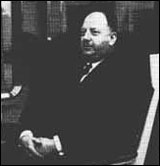
Written almost entirely by the recently appointed chairman of the British Railways Board - a hitherto unknown industrialist called Dr Richard Beeching - it proposed closing almost a third of the network , around 5,000 miles. Over 2,000 stations would shut, thousands of passenger carriages would be scrapped, along with a staggering third of a million freight wagons.
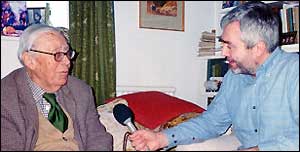 A senior civil servant in the 1960's, Sir David Serpell explains to Alan Whitehouse how he persuaded Dr Beeching to take the on job to run British Railways. A senior civil servant in the 1960's, Sir David Serpell explains to Alan Whitehouse how he persuaded Dr Beeching to take the on job to run British Railways.
It was nothing short of seismic. But Dr Beeching saw his reforms as the only way to save the railway network from financial meltdown. Ever since the mid-1950s the rail system had been losing money. By the early 60's, cash - many millions of pounds a year - was just pouring into a black hole. The Government decided enough was enough.
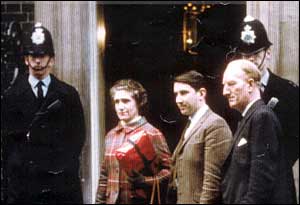 Madge Elliot from Hawick in the Borders area of Scotland, pictured standing with David Steel on the steps of Number 10 Downing Street in 1968. She is holding a petition calling for the closure of the Edinburgh - Carlisle route, "The Waverley Line", to be stopped. It was earmarked for closure under the Beeching proposals and was eventually closed in 1969. She has been campaigning for its restoration ever since. Madge Elliot from Hawick in the Borders area of Scotland, pictured standing with David Steel on the steps of Number 10 Downing Street in 1968. She is holding a petition calling for the closure of the Edinburgh - Carlisle route, "The Waverley Line", to be stopped. It was earmarked for closure under the Beeching proposals and was eventually closed in 1969. She has been campaigning for its restoration ever since.
Beeching's plan was a simple one: He began by looking at where the railways actually lost money - which services and lines were responsible for the deficit. That would tell him what railways did well and what they did badly. His plan would then concentrate on what they did best.
He made two basic findings: firstly that around 95 per cent of all rail traffic was being carried on about 50 per cent of the network - the remaining 50 per cent was hardly used. Secondly, he found that what railways did best was high speed, long distance bulk haulage - whether passenger or freight the conclusions were the same.
That is why his report proposed closing hundreds of branch lines. They were hopeless loss-makers and always would be. He also proposed taking local stopping trains off lines that were to remain open. They also lost money. Similarly, local goods trains would be chopped and wayside goods depots closed along with the passenger stations.
 Alan Whitehouse stands on what remains of a railway bridge that served the route from Edinburgh to Carlisle but which was closed under the Beeching cuts in 1969. Campaigners still hope to have the line reopened. Alan Whitehouse stands on what remains of a railway bridge that served the route from Edinburgh to Carlisle but which was closed under the Beeching cuts in 1969. Campaigners still hope to have the line reopened.
Instead, railways would focus on what they did best. Passenger trains would be re-invented. Beeching came up with the Intercity concept of high speed expresses connecting the major towns and cities. It is still how Britain's railways are run.
It was the same story for freight. Traditional goods trains would be replaced by two new types: block trains running between major centres carrying a limited range of goods - coal, aggregates for building work, oil and petrol and so on - and container trains carrying smaller loads which could be quickly switched from trains to lorries for collection and delivery to places off the rail network. Beeching reckoned a loss of over £30m a year would become a profit of £12m a year within eight years.
The first wave of closures was quickly pushed through. But protest groups began forming to combat his closure plans. In most cases they had little effect. But the campaigners did score a few notable victories. The lines from Manchester to Buxton and Leeds to Ilkley were earmarked for closure but saved after hard-fought campaigns. So were lines to places like Kyle of Lochalsh, Mallaig, Thurso and Wick in the Highlands of Scotland. Half a dozen branch lines in the West Country to seaside towns such as St Ives, Newquay and Looe were also reprieved.
Was it worth it? Opinion is still divided. Beeching's fans - and there are lots of them, including many professional railwaymen - say yes. They reckon Beeching saved the railway from financial meltdown and a far bigger closure programme.
But others disagree. They say mistakes were made and some lines were closed that under any rational scheme would have stayed open, including the Great Central main line from London to Nottingham. It had been built to Continental standards, and was capable of carrying European sized carriages and wagons which are too big for most British lines. It could today be carrying Channel Tunnel trains all the way to Sheffield.
And the savings that Beeching expected to make never materialised. He reckoned that closing the branch lines would save £30m. In fact, the closure programme saved less than a quarter of that - just £7m.
And there is still talk of re-opening some of the lines that Beeching closed. But doing it would be hugely expensive and so far there's only one example of it happening - the Robin Hood Line between Nottingham and Mansfield.
Selected Reading
Beeching: Champion of the Railway?
by R H N Hardy,
Ian Allan, 1989
The Great Railway Conspiracy
by David Henshaw
Leading Edge, 1991
British Rail after Beeching
by G. Freeman Allen
Ian Allan, 1966
British Rail - The first 25 years
by Michael R. Bonavia
David & Charles, 1981
British Railways 1948 - 73
by T.R Gourvish
Cambridge Univeristy Press, 1986
|
| | |