The Magic Number
A selection of programmes looking at the quirky side of maths
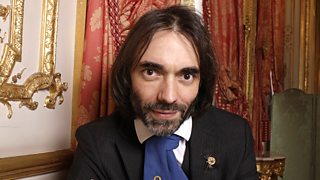
The Mathematical Mind with Cedric Villani—Start the Week
Tom Sutcliffe with Cedric Villani, Vicky Neale, Zia Haider Rahman and Morgan Matthews.
Release date:
The Statistical State—A History of Britain in Numbers, Series 2
Andrew Dilnot charts the history of the British state through its numbers.
Release date:
Maths and Magic
Magician Jolyon Jenkins investigates the links between numbers and illusion.
Release date:
The Most Beautiful Equation in The World—Book of the Week, Cédric Villani - Birth of a Theorem
Rock-star mathematician Cédric Villani's magical mystery tour through the world of maths
Release date:
![]()
Jo Boaler—The Educators
Professor Jo Boaler believes there is a crisis in maths education.
Release date:
Land Of The Rising Sums
Alex Bellos visits Japan to discover why Asian cultures seem so much better at maths.
Release date:
Six degrees of separation—Simon Singh's Numbers, A Further Five Numbers
Six is often treated as 2x3, but has many characteristics of its own.
Release date:
Random and Pseudorandom—In Our Time
Melvyn Bragg and his guests discuss mathematical randomness and pseudorandomness.
Release date:
The Sphere—Marcus du Sautoy's Five Shapes
The sphere's perfect form is the most economical shape for containing matter.
Release date:
The maths of spies and terrorists—More or Less
Tim Harford examines the maths of terror surveillance, and kidney donations.
Release date:
How to Teach Maths
Alex Bellos looks at the science behind learning maths and if school lessons reflect this.
Release date:
Godel's Incompleteness Theorems—In Our Time
Melvyn Bragg and guests discuss the mathematician Kurt Godel and his work.
Release date:
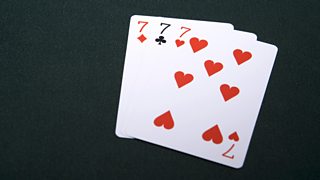
The Number Seven—Simon Singh's Numbers, Another Five Numbers
Are 7 shuffles sufficient to achieve a good degree of randomness in a deck of 52 cards?
Release date:
Zero—In Our Time
Melvyn Bragg examines the number between 1 and -1, once denounced as the devil's work.
Release date:
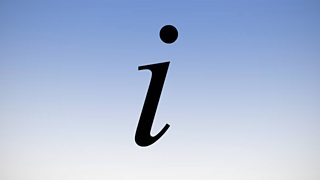
Imaginary Numbers—In Our Time
Melvyn Bragg and his guests discuss imaginary numbers.
Release date:
Infinity—Simon Singh's Numbers, Five Numbers
Georg Cantor defined infinity as the size of the never-ending list of counting numbers.
Release date:
The Bagel—Marcus du Sautoy's Five Shapes
The bagel is not just a good shape for baking. It's also good for office complexes.
Release date:
Infant mortality rates presented in sound
Andrew Dilnot presents an innovative use of sound to bring numbers home to the senses.
The Cube—Marcus du Sautoy's Five Shapes
Why isn't the cube form used more often? And what does it look like in four dimensions?
Release date:
Zero—Simon Singh's Numbers, Five Numbers
Strangely, 'nothing' had to be invented, and then it took thousands of years to catch on.
Release date:
The Pyramid—Marcus du Sautoy's Five Shapes
The Pyramid: a classic shape to bury Pharoahs and an influence on modern designers.
Release date:
The Blob—Marcus du Sautoy's Five Shapes
From globular cartoon characters to curvy cars, the blob has always been around.
Release date:
Joseph Fourier—A Brief History of Mathematics
Marcus du Sautoy argues that mathematics is the driving force behind modern science.
Release date:
Leonhard Euler—A Brief History of Mathematics
Marcus du Sautoy argues that mathematics is the driving force behind modern science.
Release date: